Mel Acheson: Ballistic Cosmic Rays.
The European Space Agency announces that cosmic rays are caused by supernova shock waves.
A recent press release from the European Southern Observatory announces that “a unique ‘ballistic study’” proves that cosmic rays are caused by supernova shock waves bumping particles to near light speed.
One author of the study noted that astronomers have thought that for a long time, raising the question among skeptics whether the study proves instead the bias of belief: one tends to see (and to prove) what one believes. The author concludes: “that proves it.” Upon critical examination, “proves it” is found to mean that it’s allowed by my theory, so if I exclude all other possible theories mine has to be true.
One has to wonder: if these particle accelerators in the Milky Way are so “very efficient,” the particle physicists at the Large Hadron Collider should replace their inefficient electromagnetic device with one based on the new ballistic laws of electromagnetism. The particles can be accelerated by directing shock waves from explosions to bump them to high velocities. Farther down the ballistics totem pole, dentists can replace their inefficient x-ray machines that generate x-rays by accelerating electrons with electric fields, substituting the new machines that work with tiny but powerful shock waves. Your next x-ray won’t just buzz, it’ll bang.
The efficiency of transfer of energy from shock waves to particles and the number of particles so affected can only be determined by counting the number of cosmic rays and guessing the number of supernovae that could produce them. The theory must take as its initial assumption the conclusion it is said to prove, hence proving that tautologies are…tautologous.
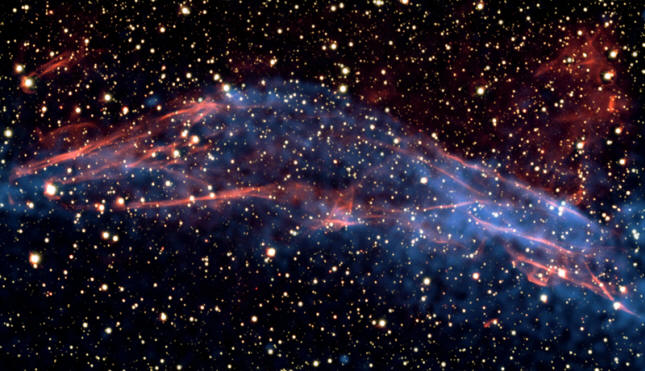
Filaments. Pairs of filaments. Pairs of filaments spiraling around each other. Pairs of pairs of twisting filaments. Anyone familiar with plasma will immediately recognize them (in the image above, as in almost any image of a so-called supernova remnant) as Birkeland currents. Only an astronomer in intellectual free-fall with his eyes squeezed shut could fail to see plasma. And so astronomers see “gas” and “ballistics” where plasma researchers see electric currents, double layers, and electric fields. It’s probably significant that the press release uses the term “particles” exclusively, never “charged particles,” despite mentioning that they are protons.
When these twisted structures were first discovered, some astronomers tried to explain them with a physics of twisted shock waves. They never mentioned Birkeland currents. The physics was more twisted than the shock waves, and the astronomers moved on to more tractable problems. Now a few astronomers are beginning to refer to Birkeland currents but only with the assumption that they “don’t do anything.”
But Birkeland currents do “do things.” The study’s author is correct to note that “the energy that is used for particle acceleration is at the expense of heating” but is mistaken to append “the gas, which is therefore much colder than theory predicts.” It’s not gas, it’s plasma, and the study is using the wrong theory.
Birkeland currents are also known as field-aligned currents because the electric field of the current is aligned with the magnetic field. Charged particles are therefore accelerated in the direction of the field. Their random motion—which is what temperature measures—is reduced; therefore the plasma which they make up appears “colder” than would be expected from their being bumped by a shock wave in gas.
Perhaps it’s not the cosmic rays that have gone ballistic but the astronomers.









-759725.jpg)