Showing posts with label Sirius. Show all posts

Thursday, January 21, 2010

Aquatic Aliens of the Ancient World


Oannes or Dagon is the aquatic extraterrestrial from Sirius and from whom the Dogon tribe derive their name.

[Lucius C.] Alexander "Polyhistor": Berossus: Of the Cosmogony and Deluge

At Babylon there was (in these times) a great resort of people of various nations, who inhabited Chaldæa, and lived in a lawless manner like the beasts of the field.
The same is confirmed in the Western Hemisphere by Von Humboldt.

"In the remotest times, before the Moon accompanied the Earth, according to the mythology of the Muysca or Mozca Indians, the inhabitants of the plain of Bogota lived like barbarians, naked, without any form of laws or religious worship." --Alexander Von Humboldt, naturalist, Researches, 1814

Alexander Polyhistor continues:

In the first year there appeared, from that part of the Erythræan sea which borders upon Babylonia, an animal destitute of reason, by name Oannes, whose whole body (according to the account of Apollodorus) was that of a fish; that under the fish's head he had another head, with feet also below, similar to those of a man, subjoined to the fish's tail. His voice too, and language, was articulate and human; and a representation of him is preserved even to this day.
This Being was accustomed to pass the day among men; but took no food at that season; and he gave them an insight into letters and sciences, and arts of every kind. He taught them to construct cities, to found temples, to compile laws, and explained to them the principles of geometrical knowledge. He made them distinguish the seeds of the earth, and shewed them how to collect the fruits; in short, he instructed them in every thing which could tend to soften manners and humanize their lives. From that time, nothing material has been added by way of improvement to his instructions. And when the sun had set, this Being Oannes, retired again into the sea, and passed the night in the deep; for he was amphibious. After this there appeared other animals like Oannes, of which Berossus proposes to give an account when he comes to the history of the kings. Moreover Oannes wrote concerning the generation of mankind; and of their civil polity; and the following is the purport of what he said:

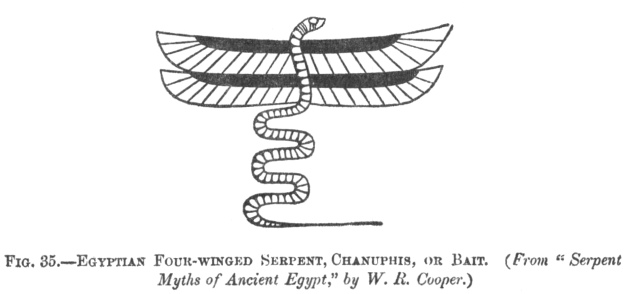
"There was a time in which there existed nothing but darkness and an abyss of waters, wherein resided most hideous beings, which were produced of a two-fold principle. There appeared men, some of whom were furnished with two wings, others with four, and with two faces. They had one body but two heads: the one that of a man, the other of a woman: and likewise in their several organs both male and female. Other human figures were to be seen with the legs and horns of goats: some had horses' feet: while others united the hind quarters of a horse with the body of a man, resembling in shape the hippocentaurs. Bulls likewise were bred there with the heads of men; and dogs with fourfold bodies, terminated in their extremities with the tails of fishes: horses also with the heads of dogs: men too and other animals, with the heads and bodies of horses and the tails of fishes. In short, there were creatures in which were combined the limbs of every species of animals. In addition to these, fishes, reptiles, serpents, with other monstrous animals, which assumed each other's shape and countenance. Of all which were preserved delineations in the temple of Belus at Babylon.

Tuesday, November 10, 2009

The Nabta Playa Star Map


"... people living over seven thousand years ago may have possessed technical knowledge in astronomy and physics more advanced than our current understanding of the same subjects." -- Robert M. Schoch, geologist, 2002

"Even cursory initial consideration of the locations of the six Orion stars in question (Alnitak, Alnilam, Mintaka, Betelguese, Bellatrix, and Meissa) suggests that the megaliths probably represented them." -- Thomas G. Brophy, archaeoastronomer, 2002

"By even the more conservative estimate, these are by far the most certain ancient megalithic astronomical alignments known in the world." -- Thomas G. Brophy, archaeoastronomer, 2002

"Pursuing further what one would expect to be the logical meaning of the alignment distances in a chart, namely the actual distances to the stars, just for fun I looked up our current measures for the astrophysical distances to these stars. The best star distances astronomers have been able to measure are from the Hipparcos Space Astronomy satellite parallax measurements. Astonishingly, these Hipparcos astrophysical distance measurements match the megalith distance pattern quite well." -- Thomas G. Brophy, archaeoastronomer, 2002

The ancients knew the exact distances (in light years) of all the stars in Orion.

Hunter-gatherers?

Abderite LOL!

Malville, J.M., et al., Megaliths and Neolithic Astronomy In Southern Egypt, Nature, 392, pages 488-491, Apr 1998

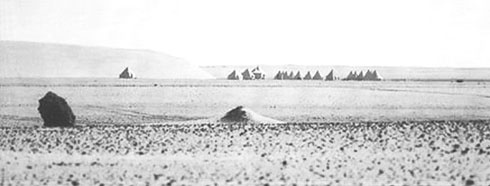
We report the discovery of megalithic alignments and stone circles next to locations of Middle and Late Neolithic communities at Nabta, which suggest the early development of a complex society. The southward shift of the monsoons in the Late Neolithic age rendered the area once again hyperarid and uninhabitable some 4,800 radiocarbon years before the present (years bp). This well-determined date establishes that the ceremonial complex of Nabta, which has alignments to cardinal and solstitial directions, was a very early megalithic expression of ideology and astronomy.
Wendorf, F., and Schild, R., Late Neolithic Megalithic Structures at Nabta Playa, Comparative Archaeology, Mar 1998

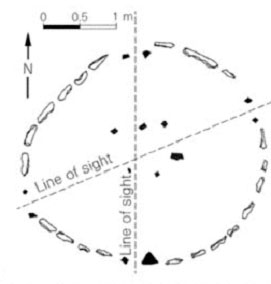
... the gates on the other two pairs form a line at 700 east of north, which aligns with the calculated position of sunrise at the summer solstice 6000 years ago. ... Charcoal from one of the numerous hearths around the "calendar" dated around 6800 years ago (6000 bp +- 60 years, CAMS - 17287).


Wendorf, F., et al., Holocene Settlement of the Egyptian Sahara: The Archaeology of Nabta Playa, 2001

Brophy, T.G.., The Origin Map: Discovery of a Prehistoric Megalithic Astrophysical Map and Sculpture of the Universe, 2002

Brophy, T.G., and Rosen, P.A., Satellite Imagery Measures of the Astronomically Aligned Megaliths at Nabta Playa, Bulletin of the American Astronomical Society, Volume 35, Page 1259, 2003

The satellite images allow refinement, often significant, of the reported locations of the megaliths. The report that the primary megalithic alignment was constructed to point to the bright star Sirius, circa 4,820 BC, is reconsidered in light of the satellite data, new field data, radiocarbon, lithostratigraphic and geochronologic data, and the playa sedimentation history. Other possible archaeoastronomical interpretations are considered for that alignment, including the three stars of Orion's Belt circa 6,270 BC that are also implicated in the small Nabta Playa `calendar circle'.
Brophy, T.G., and Rosen, P.A., Satellite Imagery Measures of the Astonomically Aligned Megaliths at Nabta Playa, Mediterranean Archaeology and Archaeometry, Volume 5, Number 1, Pages 15-24, 2005

Malville, J.M., et al., Astronomy of Nabta Playa, Astrophysics and Space Science Proceedings: African Cultural Astronomy, Pages 131-143, Jan 2008

Saturday, September 5, 2009

Naga (Siriusly)


"... the imaginative power of the old storytellers was so incredible that the books of contemporary writers of science fiction seem banal by comparison. So it must be that the ancient storytellers had a store of things already seen, known, and experienced ready at hand to spark off their imagination!" -- Erich Von Däniken, author, 1968

"To me the most exciting speculation is the idea that extraterrestrials have indeed visited this planet in the past, which is what deductive logic would dictate." -- Tom Van Flandern, astronomer, 1995

"They came from outerspace -- and posed for portraits." -- Erich Von Däniken, author, December 3rd 2002

Two possibilities. Either (1) the Indians and the Greeks and the Jews and the Dogon were conspiring with one another in one mass hallucination spanning several millenia (using time machines obviously since the history and art is from different time periods), or (2) Nagas (aka Mermen aka Nommo aka Pelasgians) were (are?) real and came from the star Sirius. Since I don't believe in mass hallucinations, time travel, or global conspiracy theories, the latter is the most logical belief.

Sunday, August 16, 2009

Is Sirius a Triple Star?


Benest, D., and Duvent, J.L., Is Sirius a Triple Star?, Astronomy and Astrophysics, Volume 299, Page 621, July 1995

Sirius has been discovered as double more than 130 years ago. From the beginning of our century up to now, observational as well as physical and dynamical indications lead to the hypothesis of the existence of a third body in the system. In this paper, we present recent orbital analysis of the binary Sirius A-B which, helped by numerical simulation of triple systems, strengthens the idea for the triplicity of Sirius: a tiny star could revolve in about 6 years around Sirius A. Finally, we discuss the possibility of direct detection for this suspected Sirius C.
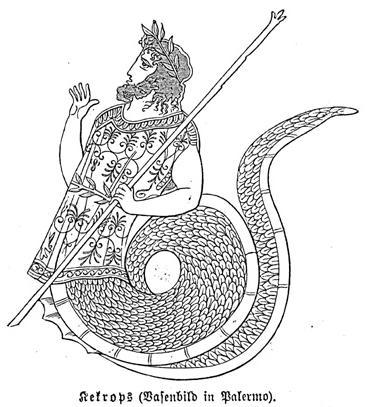
If there is indeed a Sirius C it would support Dogon and Egyptian cosmology. Mermen, called the Nommo, such as the Athenian King Cecrops I are said to have come from the Sirius system. The Acropolis in Athens is named after Cecrops I.


The white main sequence star Sirius A and it's white dwarf companion Sirius B are 8.58 light years from the Earth.

Saturday, August 15, 2009

Was Sirius B a Red Giant?


Rens Van Der Sluijs: Siriusly Red.

As has often been pointed out, by definition the uniformitarian creed precludes the very real possibility of rare and radical changes in nature.

Since the late 19th century, most geologists have fondly embraced the adage of the British lawyer and geologist, Sir Charles Lyell (1797-1875): ‘The present is the key to the past.’ Its naïve implication is that all phenomena that ever happened in nature still occur today and can be observed. Historical evidence is valuable precisely because it offers an even better key to the past than present-day analogues: eye-witness accounts.

A prime application of the historical method concerns the colour of Sirius A or α Canis Majoris, the brightest star in the night sky. Sirius appears bright white today, but – as the English amateur astronomer, Thomas Barker (1722-1809), first pointed out in 1760 – was emphatically qualified as red in many classical texts. Poetical passages aside, Seneca commented that Sirius was of a deeper red than Mars, while Ptolemy labeled the star “reddish” and grouped it with five other stars, all of which are indeed of red or orange aspect.

Even as late as the 6th century CE, the Gallo-Roman chronicler, Gregory of Tours, could label the Dog Star rubeola or ‘reddish’. It is claimed that the earliest unambiguous reference to Sirius as a white star is found in the pages of the Persian astronomer, ‘Abd al-Raḥman al-Sufī (903-986 CE).

What to make of all this? The paradox has sparked a prolonged and fairly intense debate, which has led to a fair number of publications, including Noah Brosch’s recent book Sirius Matters (2008). The evasive explanation that Sirius’s red traced to a simple textual error is easily refuted by the eminent authority of Ptolemy and Seneca as well as the observation that the same attribution is attested in a number of other cultures. For example, the Pawnee, of the North American Plains, associated each of the four intercardinal points with a colour, a type of weather, an animal, a tree, and a star.

The southeastern corner was the domain of red, the “Red Star” – which might be the planet Mars – and the wolf, explicitly linked to Sirius. Another suggestion, that an optical illusion accounts for the confusion, seems merely a red herring. It may be so that the star, to the unaided eye, often appears to be flashing with red, white and blue hues when near the horizon, but such scintillations would not have deluded such a skilled observer as Ptolemy. The belief in a red Sirius was clearly genuine. But how can it be reconciled with the white hue seen today?

Two Canadian archaeoastronomers, David Kelley and Eugene Milone, followed a rather more promising direction: “We conclude that the bulk of the evidence supports a literal red Sirius interpretation … Thus, the discovery that the bright star, Sirius, was once described as red, when it is now clearly white, may light up formerly obscure paths of stellar evolution.” The trouble is that, on the current astronomical model of stellar evolution, no shift from red to white is possible over such a short time.