Showing posts with label Ancient Technology. Show all posts

Friday, August 26, 2011

Ancient Protractor Denied By Darwinists


New Scientist: Egyptian tomb mystery may be world's first protractor.

The bizarre object to the right was found in the tomb of an ancient Egyptian architect. For over 100 years, it has languished while archaeologists debated its function.

Now, a physicist has thrown her hat into the ring, arguing that it is the world's first known protractor. The intriguing suggestion – which has drawn scepticism from archaeologists – is based on the numbers encoded within the carvings on its surface.

The architect Kha helped to build pharaohs' tombs during the 18th dynasty, around 1400 BC. His own tomb was discovered intact in 1906 by archaeologist Ernesto Schiaparelli in Deir-al-Medina, near the Valley of the Kings. Among Kha's belongings were measuring instruments including cubit rods, a levelling device that resembles a modern set square, and what appeared to be an oddly shaped empty wooden case with a hinged lid.

Schiaparelli thought this last object had held another levelling instrument. The museum in Turin, Italy, where the items are now exhibited identifies it as the case of a balancing scale.

But Amelia Sparavigna, a physicist at Turin Polytechnic, suggests that it was a different architectural tool – a protractor. The key, she says, lies in the numbers encoded in the object's ornate decoration, which resembles a compass rose with 16 evenly spaced petals surrounded by a circular zigzag with 36 corners.

Sparavigna says that if the straight bar part of the object were laid on a slope, a plumb line would revealed its inclination on the circular dial (as illustrated in this graphic).

The fraction of one-sixteenth features in a calculus system the Egyptians used, says Sparavigna, and they also identified 36 star groups called the decans, which later formed the basis of a star clock. She suggests the object was "a protractor instrument with two scales, one based on Egyptian fractions, the other based on decans".

But Kate Spence, an archaeologist at the University of Cambridge who specialises in ancient Egyptian architecture, is not convinced and maintains the object is simply a decorative case. She says that unlike those on known measuring instruments, the markings in question are not particularly accurate: "When the Egyptians want to be precise, they are." She says the Egyptians tended to define angles by measuring the two sides of a rectangle, and that no similar instrument is known.

Monday, April 18, 2011

Nimrud Lens: World's Oldest Telescope!


"It is a short and simple step to place one lens in front of another to make a basic telescope, and the chances are it could have happened and many times. Galileo himself noted that the 'ancients' were aware of telescopes. The question is just how good these telescopes were and how much knowledge the astronomer/priests of these early civilizations were able to obtain from them. Yet Brecher and Sagan give no consideration to this at all! Their narrow vision cannot alter the facts, but their writings do cast light on the root of their problem...." -- Hunter H. Adams III, archaeoastronomer, African Observers of the Universe: The Sirius Question, 1983

Contrary to Darwinist faith-based belief, neither Hubble, nor Galileo, nor any Dutchman invented the telescope.

World's Oldest Telescope?, BBC, Jul 1999
If one Italian scientist is correct then the telescope was not invented sometime in the 16th century by Dutch spectacle makers, but by ancient Assyrian astronomers nearly three thousand years earlier.

According to Professor Giovanni Pettinato of the University of Rome, a rock crystal lens, currently on show in the British museum, could rewrite the history of science. He believes that it could explain why the ancient Assyrians knew so much about astronomy.

But experts on Assyrian archaeology are unconvinced. They say that the lens is of such low quality that it would have been a poor aid to vision.

Magnifying glass


It is called the Nimrud lens and it was found in 1850 by the legendary archaeologist Sir John Layard, during an epic series of excavations at the palace of Nimrud in what is now Iraq.

Upon his return to England, he showed the lens to physicist Sir David Brewer who thought it could have been used as a magnifying glass or to concentrate the Sun's rays.

Used as a magnifying glass, it could have been useful to Assyrian craftsman who often made intricate seals and produced minuscule texts on clay tablets using a wedge-shaped script.

It is a theory many scientists might be prepared to accept, but the idea that the rock crystal was part of a telescope is something else. To get from a lens to a telescope, they say, is an enormous leap.

Saturn's serpents

Professor Pettinato counters by asking for an explanation of how the ancient Assyrians regarded the planet Saturn as a god surrounded by a ring of serpents?

Could they not have seen Saturn's rings through their telescope and interpreted them as serpents? An unconvincing argument, say experts. The Assyrians saw serpents everywhere. And why is it in their many astronomical reports on clay tablets there is no mention of such a device?

The conventional understanding of the invention of the telescope is that it was developed in the 16th century by Dutch spectacle-makers who held one lens in front of another.

One thing is sure: Galileo did not invent it - a common misconception - although he was one of the first to turn it towards the sky. By then, lenses used as spectacles had been known for hundreds of years at least, and it has been a puzzle to historians why it took so long for the telescope to be invented.

Commercial and military use

It may have been developed and then forgotten, or even kept secret. However, experts regard this as unlikely given the commercial and military uses that a telescope could serve.

Whatever its origin, as ornament, as magnifying lens or part of a telescope, the Nimrud lens is the oldest lens in the world. Looking at it evokes mystery and wonder. It can be seen in room 55 of the British Museum, in case 9 of the Lower Mesopotamian Gallery

It may not be unique. Another, possibly 5th century BC, lens was found in a sacred cave on Mount Ida on Crete. It was more powerful and of far better quality than the Nimrud lens.

Also, Roman writers Pliny and Seneca refer to a lens used by an engraver in Pompeii. So perhaps the ancients knew more about lenses than we give them credit for.
Also see my earlier post on ancient Egyptian telescopes.

Wednesday, February 23, 2011

Ancient Flamethrowers


"The Boeotians presently sent for darters and slingers from [the towns on] the Melian gulf; and with these, and with two thousand men of arms of Corinth, and with the Peloponnesian garrison that was put out of Nisaea, and with the Megareans, all which arrived after the battle, they marched forthwith to Delium and assaulted the wall. And when they had attempted the same many other ways, at length they brought to it an engine, wherewith they also took it, made in this manner: Having slit in two a great mast, they made hollow both the sides, and curiously set them together again in the form of a pipe. At the end of it in chains they hung a cauldron; and into the cauldron from the end of the mast they conveyed a snout of iron, having with iron also armed a great part of the rest of the wood. They carried it to the wall, being far off, in carts, to that part where it was most made up with the matter of the vineyard and with wood. And when it was to, they applied a pair of great bellows to the end next themselves, and blew. The blast, passing narrowly through into the cauldron, in which were coals of fire, brimstone, and pitch, raised an exceeding great flame, and set the wall on fire, so that no man being able to stand any longer on it, but abandoning the same and betaking themselves to flight, the wall was by that means taken." -- Thucydides, historian, History of the Peloponnesian War, Book IV, Chapter 100, 431 B.C.

Tuesday, July 6, 2010

Scientists Rediscover Flying Submarines


"O Pusan, with thy golden ships that travel across the ocean, in the air's mid-region, Thou goest on an embassy to Surya ...." -- Rig Veda, 8, 58, 3

"It is there, O thou tiger among men, that I heard that Salwa was coursing on his car of precious metals near the ocean, and I followed in his pursuit. And, O thou slayer of thy foes, having reached the main, Salwa on his car of costly metals was in the midst of the deep heaving with billows!" -- Vasudeva, Mahabharata, Book III: Vana Parva, Section XX, 8th century B.C.

"But as that car of costly metals was in the sky [U.F.O.], full two miles off, it could not, O Bharata, be seen by my troops [cloaking device]. They could therefore only remaining on the field of battle look on like spectators in a place of amusement, cheering me on by shouts loud as the roar of the lion, and also by the sound of their clapping. And the tinted arrows [missiles] shot by the fore-part of hand penetrated into the bodies of the Danavas [extraterrestrial demons] like biting insects. And then arose cries in the car of precious metals from those that were dying of wounds by those sharp arrows and falling into the waters of the mighty ocean. And the Danavas deprived of their arms, necks, and wearing the form of Kavandhas,--fell, sending up tremendous roars. And as they fell they were devoured by animals living in the waters of the ocean." -- Vasudeva, Mahabharata, Book III: Vana Parva, Section XX, 8th century B.C.

"O king, when I had said these words, Indra with a smile said unto me 'Nothing is there in the three worlds that is not in thy power (to achieve). My enemies, those Danavas [extraterrestrial demons], named, Nivata-Kavachas [aquatic extraterrestrials] dwell in the womb of the ocean. And they number thirty million and are notorious, and all of equal forms and strength and splendour. Do thou slay them there, O Kunti's son; and that will be thy preceptor's fee.'" -- Arjuna, Mahabharata, Book III: Vana Parva, Section CLXVII, 8th century B.C.

New Scientist: From sea to sky: Submarines that fly.

GUILLEMOTS and gannets do it. Cormorants and kingfishers do it. Even the tiny insect-eating dipper does it. And if a plan by the Pentagon's Defense Advanced Research Projects Agency (DARPA) succeeds, a remarkable airplane may one day do it too: plunge beneath the waves to stalk its prey, before re-emerging to fly home.

The DARPA plan, announced in October 2008, calls for a stealthy aircraft that can fly low over the sea until it nears its target, which could be an enemy ship, or a coastal site such as a port. It will then alight on the water and transform itself into a submarine that will cruise under water to within striking distance, all without alerting defences.

Wednesday, June 3, 2009

Ancient Electricity and Computing


"Each generation imagines itself to be more intelligent than the one that went before it, and wiser than the one that comes after it." -- George Orwell, writer, 1945


Ancient Electricity

Keyser, P.T., The Purpose of the Parthian Galvanic Cells: A First Century AD Electric Battery Used For Analgesia, Journal of Near Eastern Studies, Volume 52, Number 2, Pages 81-98, Apr 1993

Von Handorf, D.E., The Baghdad Battery: Myth or Reality?, Plating and Surface Finishing, Volume 89, Number 5, Pages 84-87, 2002

Riddle of 'Baghdad Batteries', BBC, Feb 2003

Pilkington, M., Ancient Electricity, The Guardian, Apr 2004

Kanani, N., The Parthian Battery: Electric Current 2000 Years Ago?, VINI, Number 7, Pages 167-204, 2004

Corder, G.W., Using an Unconventional History of the Battery to Engage Students and Explore the Importance of Evidence, Virginia Journal of Science Education, Volume 1, Number 1, Pages 33-36, 2006

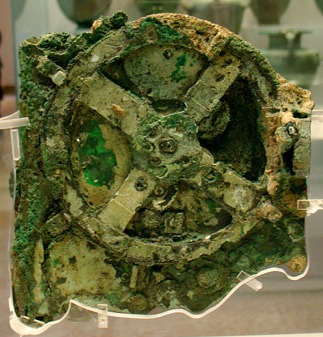
Ancient Computers

Charette, F., Archaeology: High Tech From Ancient Greece, Nature, Volume 444, Pages 551-552, Nov 2006

Freeth, T., Decoding the Ancient Greek Astronomical Calculator Known as the Antikythera Mechanism, Nature, Volume 444, Pages 587-591, Nov 2006

Ball, P., Complex Clock Combines Calendars: Antikythera Mechanism May Have Timetabled Ancient Olympic Games, Nature, Volume 454, Page 561, Jul 2008

Wilford, J.N., Discovering How Greeks Computed In 100 B.C., The New York Times, Jul 2008

Marchant, J., Was Ancient Greek 'Computer' an Astronomical Tool?, New Scientist, Issue 2667, Jul 2008

Marchant, J., Archimedes and the 2000-Year Old Computer, New Scientist, Issue 2696, Dec 2008

Sorrel, C., World's First Computer Rebuilt: Rebooted After 2000 Years, Wired, Dec 2008