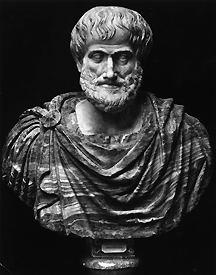
"... a thing will either be at rest or must be moved ad infinitum, unless something more powerful get in its way." -- Aristotle, philosopher, Physics, Book IV, 350 B.C.
Despite the actual historical record, the Neo-Darwinist Carl E. Sagan believed that Sir Isaac Newton "discovered" the law of inertia in 1663.
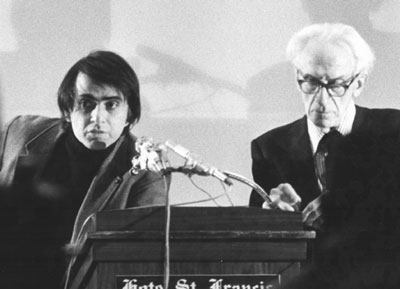
"Newton discovered the law of inertia, the tendency of a moving object to continue moving in a straight line unless something influences it and moves it out of it's path." -- Carl E. Sagan, professor, Cosmos, 1980
However Isaac Newton himself knew this was false.
"All those ancients knew the first law [of motion] who attributed to atoms in an infinite vacuum a motion which was rectilinear, extremely swift and perpetual because of the lack of resistance... Aristotle was of the same mind, since he expresses his opinion thus...[in Physics 4.8.215a19-22], speaking of motion in the void [in which bodies have no gravity and] where there is no impediment he writes: 'Why a body once moved should come to rest anywhere no one can say. For why should it rest here rather than there ? Hence either it will not be moved, or it must be moved indefinitely, unless something stronger impedes it.'" -- Isaac Newton, alchemist/mathematician, Unpublished Scientific Papers of Isaac Newton, 1962
"Democritus' atomism in principle is built only on quantities, namely the number and size of the atoms and their velocities. Here Democritus was far ahead of his time in that he took, preceding Galileo in assuming something like a law of inertia, each atom's velocity to be constant, unless a collision with another atom prevents it's free motion. For Democritus, the cosmos is a world of quantities uniquely given which continue their motion according to their own inertia until they are perturbed by other particles of the same nature." -- Hans-Jürgen Treder, physicist, October 1987












-759725.jpg)