Archaeology News Network: Homo Erectus travelled the high seas.
Early manlike creatures may have been smarter than we think. Recent archaeological finds from the Mediterranean show that human ancestors traveled the high seas.
A team of researchers that included an N.C. State University geologist found evidence that our ancestors were crossing open water at least 130,000 years ago. That's more than 100,000 years earlier than scientists had previously thought.
Their evidence is based on stone tools from the island of Crete. Because Crete has been an island for eons, any prehistoric people who left tools behind would have had to cross open water to get there.
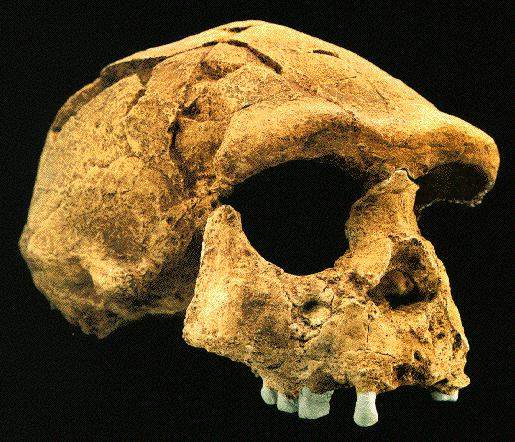
The tools the team found are so old that they predate the human species, said Thomas Strasser, an archaeologist from Providence College who led the team. Instead of being made by our species, Homo sapiens, the tools were made by our ancestors, Homo erectus.
The tools are very different from any others found on Crete, Strasser said. They're most similar to early Stone Age tools from Africa that are about 700,000 years old, he said.
Initially the team didn't have any way to date the tools.
That's where NCSU geologist Karl Wegmann came in.
At the time, Wegmann didn't know much about archaeology, but he did know quite a bit about Crete's geology. He had been figuring out the ages of Crete's rock formations to study earthquakes.
A few of the stone tools the team had discovered were embedded in those same rock formations. Those rocks were formed from ancient beach sands, Wegmann said.
Today, the rocks and the tools embedded in them are hundreds of feet above the shore.
The same process that drives the region's strong earthquakes - colliding continents - is pushing Crete upward out of the sea at a rate of less than 1/20 of an inch every year.
The island's slow rise has preserved beaches from many eras as terraces along the coast.
The lower terraces are the easiest to date. Scientists can measure the age of seashells embedded in the rock using radioactive carbon dating.
This method estimates the age of those terraces at about 45,000 and 50,000 years old.
"We know that (the tools) are tens of meters above the terrace we dated at 50,000 years old, so we know right off the bat that they have to be at least that old," Wegmann said.
But 50,000 years ago is carbon dating's limit. Anything older has to be dated using another method.
Dating by terraces
Crete's rise from the sea gives a fairly simple way of doing that. Once they know the age of lower terraces, geologists can calculate the age of higher terraces just by measuring the difference in the beaches' elevation.
If geologists know how much farther the older terrace traveled upward from the newer, and they know how fast it was going, they can figure out how long it took to get there.
Or, in other words, its age, in this case a record-smashing 130,000 years old.
"The thing to me that really makes this unique and exciting is ... these other sister species maybe weren't entirely stupid like we portray them," Wegmann said. "They were capable of really complex things."