skip to main |
skip to sidebar
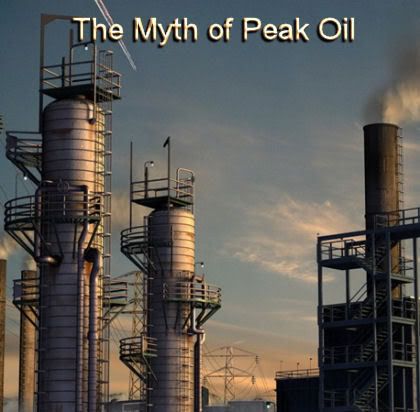 Peak oil "wrong," says Schwartz
.
"The peak oil people simply don't know what they're talking about," said environmental futurist Peter Schwartz today at the Cleantech Forum in Washington, D.C.
Forget everything you've heard about peak oil as a driver of clean technology, said futurist Peter Schwartz today in a provocative closing session at the Cleantech Forum XVIII in Washington D.C.
"The peak oil people simply don't know what they're talking about, they don't know the facts," claimed Schwartz, co-founder and chairman of the Global Business Network and author of five books.
"Peak oil is wrong. We really don't know how much oil there is in most of the oil reservoirs of the world. Oil reservoirs are complex geological structures, and most of the data is in private hands, or in state governments, and they are not particularly forthcoming about how much is there." ...
"We don't know how much is out there," he said today. "And they tend to be very conservative, these estimates. And technology changes, and that opens up new reserves deep offshore. When I was at Shell, we could only drill into a thousand feet of water. Today, they're drilling into 10,000 feet of water, and 20,000 feet below that."
 Oil prices continue to drop
.
Oil prices extended their retreat, shedding $10 a barrel in a violent, two-day slide as Wall Street dims hope for a swift economic recovery and signals another drop in US energy demand.
Light, sweet crude for October delivery fell $4.56 to settle at $91.15 a barrel on the New York Mercantile Exchange, after earlier dipping to $90.51, its lowest level since February 8.
On Tuesday prices closed below $100 for the first time in six months, shedding more than $5 and wiping out all of oil's gains for the year.
Crude has fallen about $55, or 37 per cent, since shooting above $147 on July 11.
Crude Oil Rises in New York on Speculation of AIG Rescue Plan.
Sept. 17 (Bloomberg) -- Crude oil rose from a seven-month low amid speculation the Federal Reserve may rescue American International Group Inc. from collapse.
Oil climbed as U.S. stocks advanced after floor trading closed on the New York Mercantile Exchange yesterday. U.S. crude-oil and fuel inventories probably fell last week as production platforms and refineries on the Gulf of Mexico shut because of hurricanes Gustav and Ike, a Bloomberg survey showed.
``The rebound in the stock market probably encouraged some buying, and then I think we're also setting up for the DOE report, which should show lower U.S. inventories in the major categories,'' said Tim Evans, an analyst with Citi Futures Perspective in New York.
Crude oil for October delivery rose $1.60, or 1.8 percent, to $92.75 a barrel at 9:15 a.m. Sydney time on the Nymex after touching $92.98. Crude futures declined more than $10 a barrel in the past two days on concern that financial market disruptions may weaken the global economy and cut fuel demand.
Irwin Stelzer:
It’s a myth that the world’s oil is running out (Hat tip: stretched)
Another myth: we are running out of oil. According to WorldPublic Opinion.org, “majorities in 15 of the 16 nations surveyed around the world think that oil is running out . . . only 22% on average believe that ‘enough oil will be found so that it can remain a primary source of energy for the foreseeable future’ ”. Those majorities who think we are running out of oil include 85% of the British and 76% of the American citizens polled. Luckily, they are wrong.
Production of oil is being constrained by several forces, none of them due to God’s failure to put enough of the black gold under our feet. Several countries that are important sources of supply are in political turmoil, and unable to bring to market the oil they are capable of producing. Think Nigeria, where security problems have shut down about 20% of the nation’s capacity of 2.5m barrels a day and discouraged new investment, and Iraq, where political paralysis and terrorists have kept production at less than half its potential.
Other countries will not develop the reserves of oil known to lie under their territories.
Russia has made it clear that foreigners who invest in its oil industry might be playing a game with Vladimir Putin known as heads I win, tails you lose. Find nothing and you lose your money; find substantial reserves and the state squeezes you until your shareholders’ pips squeak. Only companies at least 51% owned by Russians – read FOPs, Friends of Putin – are allowed to look for oil in the new, difficult areas in which it is to be found. Little surprise that oil output dropped in the first quarter of this year.
Mexico’s president, Felipe Calderon, wants to revive Petroleos de Mexico (Pemex), the world’s third-largest oil producer, by contracting with foreign companies to introduce modern methods of extracting more from existing fields and finding new ones. But legislation is stalled by left-wingers who have seized and are sleeping at podiums in both houses of congress.
Saudi Arabia’s royal family has announced that it will not expand capacity. Abdallah Jum’ah, chief executive of the kingdom’s oil company, said high prices didn’t mean the world needs more oil because such market signals were “imperfect”, and energy minister Ali al-Naimi has announced that there are no plans to embark on a new round of expansion. The oil is there, but with current production yielding about $120 a barrel, there is no incentive to find more, especially since new production might drive down prices as demand from the slowing American economy falls.
Venezuela’s oil industry can only be described as a mess. President Hugo Chavez’s cronies are inadequate substitutes for the technicians they have replaced, so production is falling, while foreign investors are reluctant to trust hundreds of millions in exploration dollars to a regime that treats contracts as the first step in a negotiation.
In America, Congress alternates between calls for “energy independence” and refusals to allow drilling in what it considers environmentally sensitive areas in Alaska and offshore California and Florida.
There’s more, but you get the idea. There is a lot of oil out there to be found and produced, not even including the vast reserves in Canada’s tar sands. We might have reached the age of peak panic about oil supplies, but not of peak oil. ...
These $100+ prices have led to a massive flow of wealth, and hence power, from consuming to producing countries. If oil were still $20 or even $40 a barrel Russia would not have the wherewithal to revert to its bullying foreign policy, and America’s banks would not be going hats-in-hand to Arab capitals in search of new capital.










-759725.jpg)