Friday, December 5, 2008

Imagination Vs. Measurement


Math Vs. Physical Science or Imagimetry Vs. Geometry.

There was a time (back in the days of philosophy) when geometry actually meant "Earth Measure." Measurement is an empirical physical science. It's truths are determined empirically through measurement of physical material. Today, geometry doesn't measure anything. Geometry has become Imagimetry. Instead of measuring the Earth with a ruler as geometry once did, Imagimetry on the other hand measures imaginary mathematical space with a magic ruler that has no defined units of measurement.

Where did science go wrong? One word: Newton. "Mathematical Principles of Natural Philosophy" are not "Empirical Conclusions of Physical Science." Science went wrong when it started worshipping Newtonian "absolute, true, and mathematical time" while ignoring the fact that Kantian mathematical time is a priori and not a physical object in itself. Physical "relative, apparent, and common time" must be measured with actual units. "Absolute, true, and mathematical" time on the other hand has no units because it is imaginary.

"Nothing exists until it is measured." -- Niels Bohr, physicist, 1930

"Today's scientists have substituted mathematics for experiments, and they wander off through equation after equation, and eventually build a structure which has no relation to reality." -- Nikola Tesla, physicist, 1934

"The elements of the physical reality cannot be determined by a priori philosophical considerations [aka mathematics], but must be found by an appeal to results of experiments and measurements." -- Albert Einstein, Boris Podolsky, and Nathan Rosen, physicists, 1935

Stephen Smith: What is truth?

Astronomical research in the virtual realm [aka imagination] instigates foregone conclusions [aka a priori mathematical principles].

The Thunderbolts Picture of the Day has never considered questions that involve the search for subjective meaning in the universe to be necessary when analyzing the observations that NASA and other research groups provide. It is enough in most instances to draw correspondence between the theories proposed in peer-reviewed journals and the concepts embodied in Electric Universe [EU] hypotheses. The so-called anomalies in consensus opinions tend to disappear in most cases when EU theory is brought to bear on the questions.

A recent article in the scientific press highlights the disparity between the conclusions that should be drawn from observations and those that are drawn from within the imagination.

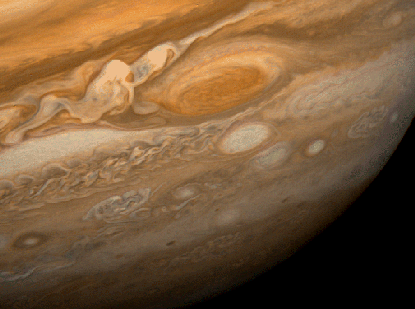
"Jupiter has a rocky core that is more than twice as large as previously thought, researchers announced today."

On its face the headline is not unusual and seems to indicate that evidence has been uncovered supporting a previously held theory. Not only that, the previous theory is tacitly assumed to have been correct because new information is enabling them to amplify its conclusions. However, when the announcement is fleshed-out the headline has no basis in evidence at all:

"Burkhard Militzer, a geophysicist at the University of California, Berkeley, and his colleagues ran computer simulations to look at conditions inside Jupiter... With information gleaned from these simulations, the researchers developed another computer model..."

Shell Breaks Subsea Drilling Record


Shell oil well in Gulf sets undersea record. (Hat tip: Anaconda)

HOUSTON - Shell Oil Co. said Tuesday it has set a world water-depth record by drilling and completing an oil well in 9,356 feet of water in the Gulf of Mexico.

The well is part of Shell's Perdido Development project about 200 miles south of Houston. It easily topped the previous record of 6,950 feet - also set by Shell in the Gulf of Mexico. Anadarko Petroleum Corp. has completed natural-gas wells in about 9,000 feet of water in the Gulf.

Production at Perdido is scheduled to begin around 2010. Shell says the project, which dates to a lease sale in 1996, will be capable of producing 130,000 barrels of oil equivalent a day.

Deepwater drilling in the Gulf dates to 1979 when Shell began production, but development really didn't take off until the 1990s as technological advancements made it more feasible.

Shell didn't disclose Perdido's costs, but such ventures can cost billions of dollars.

Thursday, December 4, 2008

Nassim Taleb On Charlie Rose

NASA Observes Comets Then Ignores The Observations


"Men occasionally stumble over the truth, but most of them pick themselves up and hurry off as if nothing had happened." -- Sir Winston Churchill

NASA's Swift Looks To Comets For A Cool View.

ScienceDaily (Dec. 3, 2008) — NASA's Swift Gamma-ray Explorer satellite rocketed into space in 2004 on a mission to study some of the highest-energy events in the universe. The spacecraft has detected more than 380 gamma-ray bursts, fleeting flares that likely signal the birth of a black hole in the distant universe. In that time, Swift also has observed 80 exploding stars and studied six comets.

Comets? ... Comets are "dirty snowballs" made of frozen gases mixed with dust.
Comets are dirty snowballs? I wonder why they haven't melted in the sun during the past million years. It looks more like a unicorn than a snowball.

X-rays come from superhot plasmas.
Eureka!!!

What do cold comets have in common with exploding stars or the birth of black holes?
Good question. I suspect either plasma or else absolutely nothing.

"It was a big surprise in 1996 when the NASA-European ROSAT mission showed that comet Hyakutake was emitting X-rays," says Dennis Bodewits, a NASA Postdoctural Fellow at the Goddard Space Flight Center in Greenbelt, Md. "After that discovery, astronomers searched through ROSAT archives. It turns out that most comets emit X-rays when they come within about three times Earth's distance from the sun."
Hmmm, they emit x-rays but they don't melt. Sounds like the snowballs I know. A database full of comets observed and every time they emit x-rays it's a surprise? When will it stop being a surprise?

Bodewits is working with the Swift team at NASA's Goddard Space Flight Center in Greenbelt, Md., to study comets using data from the spacecraft's Ultraviolet/Optical Telescope (UVOT) and X-Ray Telescope (XRT). "Swift is an excellent platform for studying dynamic processes in comets," he says.

Ultraviolet wavelengths let astronomers identify the chemical composition of the comet's atmosphere, observe the structure of dust emission, and identify the rotation of the comet's icy nucleus. X-rays reveal the structure of the comet's gas and the state of the solar wind, a stream of charged particles that flows from the sun at speeds upwards of 900,000 mph.
Plasma? What's that all about? Ah nevermind, just forget it. Let's talk about gravity some more.

Swift's UVOT captured a striking sequence that shows unresolved blobs of dust trailing from a crumbling comet.
Dust or plasma? Must be dust.

Wednesday, December 3, 2008

Another Geological Myth Refuted


Geological science fiction refuted: A ‘cool’ new picture of early Earth.

The first 700 million years of Earth’s 4.5-billion-year existence are known as the Hadean period, after Hades, or, to shed the ancient Greek name,
Hell.

That name seemed to fit with the common perception that the young Earth was a hot, dry, desolate landscape interspersed with seas of magma and inhospitable for life. Even if some organism had somehow popped into existence, the old story went, surely it would soon have been extinguished in the firestorm of one of the giant meteorites that slammed into the Earth when the young solar system was still crowded with debris.

Over the last decade, the mineralogical analysis of small hardy crystals known as zircons embedded in old Australian rocks has painted a picture of the Hadean period “completely inconsistent with this myth we made up,” said T Mark Harrison, a professor of geochemistry at the University of California, Los Angeles.
Those same zircon crystals also show that the modern oceans didn't exist in the Triassic and the Earth was half it's present diameter. Maybe now people can start to realize the mantle is also cold and therefore mantle convection is a myth.

Tuesday, December 2, 2008

What Time Is It?


Louis, as in Louis Hissink, made a very keen Kantian observation the other day in the comments section.

"What we have thrown out is purely mathematical science with no connection to physical reality, and why we throw out Einstein's relativity theory - his initial error was to make time a physical entity - it isn't. Knock that assumption off its perch and the rest falls down." -- Louis Hissink, Nov 2008

Which got me thinking (yet again) about the unparalleled genius of my favorite scientist and philosopher of all time, Immanuel Kant, a.k.a. "The Great Chinaman of Königsberg" (Nietzsche, 1886).

"Ah-so, Grasshopper, your shaolin metaphysical training with respect to transcendental idealism in accordance with empirical realism is now complete," Kant must've been saying with folded legs and squinting eyes in Nietszche's imagination.


As you may or may not know, it was Immanuel Kant who discovered in 1754 that the Aristotelian/Newtonian concept of "absolute, true, and mathematical time" (Newton, 1687) does not exist in material reality but can only be thought of as ideal.

In order for time to be known in any absolute sense, it must be in the form of units, and in order for it to be in the form of units, it must be measured. So what units is time measured in? Days of course.

What Kant discovered in 1754 that changed the world forever is that the rotation of the Earth is being retarded due to tidal forces not to mention the radial increase of the Earth, thus the lengthening of the day.

"Kant pointed out in the middle of last [18th] century, what had not previously been discovered by mathematicians or physical astronomers, that the frictional resistance against tidal currents on the earth's surface must cause a diminution of the earth's rotational speed. This really great discovery in Natural Philosophy seems to have attracted little attention,--indeed to have passed quite unnoticed,--among mathematicians, and astronomers, and naturalists, until about 1840, when the doctrine of energy began to be taken to heart." -- Lord Kelvin, physicist, 1897

Time, according to Kant (1781), is the a priori form of our intuition and therefore not a thing in itself or a so-called "fabric" as claimed by 20th century dogmatism.

"If we...consequently take objects as they are in themselves, then time is nothing." -- Immanuel Kant, philosopher, 1781

"...As our intuition is always sensuous, no object can ever be presented to us in experience, which does not come under the condition of time. On the other hand, we deny to time all claim to absolute reality; that is, we deny that it, without having regard to the form of our sensuous intuition, absolutely inheres in things as a condition or property. Such properties as belong to objects as things in themselves never can be presented to us through the medium of the senses. Herein consists, therefore the transcendental ideality of time, according to which, if we abstract the subjective conditions of sensuous intuition, it is nothing, and cannot be reckoned as subsisting or inhereing in objects as things in themselves, independently of our intuition." -- Immanuel Kant, philosopher, 1781

If I had known about the essay contest "On The Nature of Time" and the $10,000 cash prize being offered by the Foundational Sciences Institute earlier [in time?], I would've addressed this issue in detail.

Physicist Brian Cox and others, interviewed on the BBC, agree as well.


And thus the house of cards that Einsteinian relativity is built upon comes tumbling down.

The speed of light is not a constant "c" as there is no such material thing as empty space, a vacuum, or void (the universe is filled with plasma) and the speed of light has been experimentally slowed to less than 38 miles per hour (Hau et al., 1999, 2001) in a frozen sodium ion chamber. The records continue to be broken. Therefore special relativity has been empirically falsified.

Newton, I., Principles of Math Treating Time As Absolute, 1687

Kant, I., Kant's Cosmogony: As In His Essay On The Retardation Of The Rotation Of The Earth And His Natural History And Theory Of The Heavens, 1754

Kant, I., Critique of Pure Reason, 1781

Kant, I., Metaphysical Foundations of Natural Science, 1786

Nietzsche, F.W., Beyond Good and Evil, 1886

Bostick's Plasmoids: Plasma Vortices and Spiral Galaxies


Ian Tresman of Plasma Universe: Bostick’s Plasmoids.

On December 12, 1956, the front page of the New York Times announced: "Physicist 'Creates' Universe in a Test Tube; Atom Gun Produces Galaxies and Gives Clues to Creation".

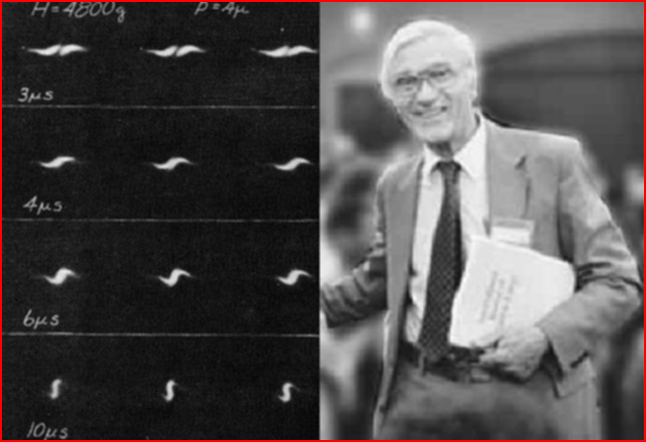
Just over 50 years ago, plasma physicist Winston H. Bostick made the kind of news headlines that many a scientist dreams. In his laboratory experiment Bostick created a simple "plasma gun" consisting of a 4-inch diameter glass jar around which he wound a wire carrying an electric current that created a small magnetic field. Most of the air was removed from the jar and two titanium wires were connected to a high-voltage, high-current electric power source.

On flicking the power switch, a 10,000 ampere electric current passed through the titanium wires, instantly vaporizing them and creating a puff of ionized gas (a plasma) travelling at 450,000 miles per hour. Bostick noted that the puffs of plasma formed distinctive shapes that resembled galaxies at various stages of aging and formation. Bostick called his laboratory produced plasma entities, "plasmoids".

Over the next thirty years, Bostick, a Professor of Physics at Stevens Institute of Technology in Hoboken, New Jersey, investigated plasmoids further and found that "not only the morphology [shape] but the controlling dynamic elements, electric and magnetic fields, are the same in the laboratory as in the galactic phenomena".

Bostick's theory describes galaxies as analogous to series-wound homopolar generators (a kind of motor) that convert gravitational energy of rotation into increasing magnetic energy that causes galaxies to expand away from each other. Furthermore, Bostick suggested that such a model could produce a concentration of current perpendicular to the galactic disk that would be a cosmic-sized "plasma focus" – a device that produces high energy, relativistic (near the speed of light) particle beams, or jets.

Winston H. Bostick was born in 1916, and died January 19, 1991, at age 74.


Left: Two plasmoids in a magnetic field producing similarities to the shape of barred spiral galaxies.
Right: Winston H. Bostick makes the news headlines in 1956.

Further reading: Winston H. Bostick and Plasmoids.