Showing posts with label Plasma. Show all posts

Friday, September 11, 2009

UCLA Scientists Discover Birkeland Currents


Science Daily: Surprise In Earth's Upper Atmosphere: Mode Of Energy Transfer From The Solar Wind.

ScienceDaily (Sep. 11, 2009) — UCLA atmospheric scientists have discovered a previously unknown [to the mainstream] basic mode of energy transfer from the solar wind to the Earth's magnetosphere. The research, federally funded by the National Science Foundation, could improve the safety and reliability of spacecraft that operate in the upper atmosphere.

"It's like something else is heating the atmosphere besides the sun. This discovery is like finding it got hotter when the sun went down," said Larry Lyons, UCLA professor of atmospheric and oceanic sciences and a co-author of the research, which is in press in two companion papers in the Journal of Geophysical Research.

The sun, in addition to emitting radiation, emits a stream of ionized particles called the solar wind that affects the Earth and other planets in the solar system. The solar wind, which carries the particles from the sun's magnetic field, known as the interplanetary magnetic field, takes about three or four days to reach the Earth. When the charged electrical particles approach the Earth, they carve out a highly magnetized region — the magnetosphere — which surrounds and protects the Earth.

Charged particles carry currents, which cause significant modifications in the Earth's magnetosphere. This region is where communications spacecraft operate and where the energy releases in space known as substorms wreak havoc on satellites, power grids and communications systems.

...

"Any space physicist, including me, would have said a year ago there could not be substorms when the interplanetary magnetic field was staying northward, but that's wrong," Lyons said.

Tuesday, May 19, 2009

Cold Dust or Glowing Plasma?


Stephen's daily gem: Cold Dust Or Glowing Plasma.

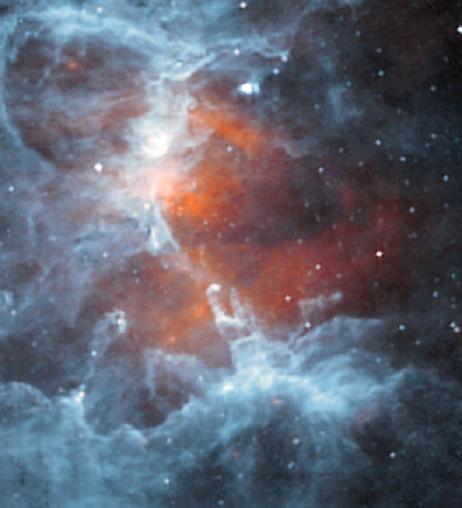
Rather than frigid clouds of dust and gas, spiraling filaments suggest electric currents in space.

Dust at a temperature near absolute zero shows up in the infrared image above as a blue fog deep in the heart of the Eagle nebula. The Eagle nebula is an active "star nursery" located in the constellation Serpens, approximately 7000 light-years away. It is a multi-spectral cloud of gas mixed with microscopic particles of dust.

The consensus view is that cold dust is a necessary ingredient when stars condense out of nebulae. When gas and dust start to collapse into a new star it naturally warms up and radiates energy. As the theory states, outward pressure is created that opposes the inward force of gravity. If the outward force wins and overcomes the force of gravity, the atoms in the gas will never be compressed enough to undergo nuclear fusion. However, if the dust in the nebula is cold enough, it allows the heat created in the gravitational collapse to be radiated away, therefore a new star can ignite.

On the other hand, when the Electric Universe theory is considered, cold nebulae are evidence of electrical activity even at temperatures near absolute zero. Bipolar symmetry is typical of most nebulae, and most of them are dense enough to emit light because they are extremely hot in some regions. But the middle of the Eagle nebula is cold: radio measurements indicate the dust clouds around the inner part are only one degree above absolute zero. We are able to see the center of the nebula because dust particles reflect light from the star.

The filamentary structure of the "fingers" and the way the filaments spiral away from the central stars indicates Birkeland currents, named after Kristian Birkeland, who first proposed their existence in the late 1800s. These currents form scalable tubes of plasma that can transmit electric power all around the galaxy. Electromagnetic forces sometimes cause them to pinch down to smaller and smaller sizes. Plasma confined within the center of the pinch is crushed and increases in current density until the so-called "z-pinch" produces a star. Plasma surrounding the star will often glow as an "emission nebula," but in some conditions of opacity and density the surrounding plasma can be cold, as in the Eagle Nebula, revealing its presence only in infrared light.

Conventional astronomers do not know how stars throw off clouds of gas and dust that eventually become other stars because stars are not made of gas and dust. A star is the focus of Birkeland currents that make up circuits flowing around the galaxy. The electromagnetic pinch that squeezes plasma into the star also forms a toroidal current around the star’s equator. The density of the current causes the plasma in the ring to glow. The Electric Universe explanation is that we are looking at plasma structures when we look at nebulae, and they behave according to the laws of electrical discharges and circuits.

Instead of mechanical action and cold gas, the Orion Nebula’s radiant new stars were created in a boost of electric current. It is not necessary to prevent young stars from heating up by shielding them in cold dust. The electrical sheath around a new star receives input from the galactic Birkeland currents in which it is immersed and gets pushed into the "glow" discharge state. Gravity has little if anything to do with the processes of star formation.

Monday, April 27, 2009

Solar Plasma Causes Asteroids to Age Faster Than Thought


Science Daily: Solar Wind Tans Young Asteroids.

ScienceDaily (Apr. 27, 2009) — A new study published in Nature this week reveals that asteroid surfaces age and redden much faster than previously thought — in less than a million years, the blink of an eye for an asteroid. This study has finally confirmed that the solar wind is the most likely cause of very rapid space weathering in asteroids.

Wednesday, April 22, 2009

More Electrically Charged Particles In Space


Enceladus, yet another moon with blatant expansion tectonics, has a visible plasma corona just like the Sun.

Royal Astronomical Society: Charged dust from inside Enceladus. (Via Universe Today)

A team of planetary scientists working on the NASA/ESA/ASI Cassini-Huygens mission has discovered tiny, charged icy particles in the plume from Saturn’s moon Enceladus that offer a tantalising glimpse of the interior of this enigmatic world. Dr Geraint Jones and Dr Chris Arridge, both from University College London’s Mullard Space Science Laboratory, will present the results on behalf of the Cassini Plasma Spectrometer (CAPS) instrument team on Wednesday 22nd April at the European Week of Astronomy and Space Science conference at the University of Hertfordshire.

Cassini has been exploring Saturn and its moons since 2004. Five hundred kilometre (300 mile)-wide Enceladus, discovered from Slough in 1789 by William Herschel, has been found by Cassini’s suite of instruments to possess active jets near its southern pole that spew gas and water out into space over thousands of kilometres. During two particularly close flybys of the moon in 2008, skimming only 52 and 25 km from the surface at around 15 km per second (54000 km per hour), the CAPS instrument on the spacecraft was pointed to scoop up gas as it zoomed through the plume.

The CAPS instrument is designed to detect charged gas (plasma) ....

Friday, April 10, 2009

Charged Particles In Space...Gasp


A good title and first two paragraphs from Science Daily (note the use of quotation marks, a question mark (gasp), the reference to charged particles, and the use of the "so-called" qualifier: Scientists Pinpoint The 'Edge Of Space'.

ScienceDaily (Apr. 10, 2009) — Where does space begin? Scientists at the University of Calgary have created a new instrument that is able to track the transition between the relatively gentle winds of Earth's atmosphere and the more violent flows of charged particles in space – flows that can reach speeds well over 1000 km/hr. And they have accomplished this in unprecedented detail.

Data received from the U of C-designed instrument sent to space on a NASA launch from Alaska about two years ago was able to help pinpoint the so-called edge of space: the boundary between the Earth's atmosphere and outer space.
But then the article sort of falls on it's face because, as BF reminds us, the exact altitude fluctuates and changes.

Thursday, March 26, 2009

Electrically Charged Particles Correlated To Antarctic Ozone Hole


Protons, alpha particles, and electrons. Oh my! (Via Watts Up With That)

Lu, Q.B., Correlation Between Cosmic Rays and Ozone Depletion, Physical Review Letters, Volume 102, Number 11, 118501, Mar 2009

This Letter reports reliable satellite data in the period of 1980–2007 covering two full 11-yr cosmic ray (CR) cycles, clearly showing the correlation between CRs and ozone depletion, especially the polar ozone loss (hole) over Antarctica. The results provide strong evidence of the physical mechanism that the CR driven electron-induced reaction of halogenated molecules plays the dominant role in causing the ozone hole. Moreover, this mechanism predicts one of the severest ozone losses in 2008–2009 and probably another large hole around 2019–2020, according to the 11-yr CR cycle.

Monday, January 12, 2009

NASA: "The Sun Is Earth's Life Blood"


Science Daily: Hazards Of Severe Space Weather Revealed.

ScienceDaily (Jan. 12, 2009) — A NASA-funded study describes how extreme solar eruptions could have severe consequences for communications, power grids and other technology on Earth.

The National Academy of Sciences in Washington conducted the study. The resulting report provides some of the first clear economic data that effectively quantifies today's risk of extreme conditions in space driven by magnetic activity on the sun and disturbances in the near-Earth environment. Instances of extreme space weather are rare and are categorized with other natural hazards that have a low frequency but high consequences.

"Obviously, the sun is Earth's life blood," said Richard Fisher, director of the Heliophysics division at NASA Headquarters in Washington. "To mitigate possible public safety issues, it is vital that we better understand extreme space weather events caused by the sun's activity."

Besides emitting a continuous stream of plasma called the solar wind, the sun periodically releases billions of tons of matter called coronal mass ejections. These immense clouds of material, when directed toward Earth, can cause large magnetic storms in the magnetosphere and upper atmosphere. Such space weather can affect the performance and reliability of space-borne and ground-based technological systems.

Space weather can produce solar storm electromagnetic fields that induce extreme currents in wires, disrupting power lines, causing wide-spread blackouts and affecting communication cables that support the Internet. Severe space weather also produces solar energetic particles and the dislocation of the Earth's radiation belts, which can damage satellites used for commercial communications, global positioning and weather forecasting. Space weather has been recognized as causing problems with new technology since the invention of the telegraph in the 19th century.

A catastrophic failure of commercial and government infrastructure in space and on the ground can be mitigated through raising public awareness, improving vulnerable infrastructure and developing advanced forecasting capabilities. Without preventive actions or plans, the trend of increased dependency on modern space-weather sensitive assets could make society more vulnerable in the future.

Monday, December 15, 2008

Stream of Atomic Hydrogen Coming From The Sun


James Anthony Phillips: Solar Flare Surprise.

Dec. 15, 2008: Solar flares are the most powerful explosions in the solar system. Packing a punch equal to a hundred million hydrogen bombs, they obliterate everything in their immediate vicinity. Not a single atom should remain intact.

At least that's how it's supposed to work.

"We've detected a stream of perfectly intact hydrogen atoms shooting out of an X-class solar flare," says Richard Mewaldt of Caltech. "What a surprise! These atoms could be telling us something new about what happens inside flares."

The event occurred on Dec. 5, 2006. A large sunspot rounded the sun's eastern limb and with little warning it exploded. On the "Richter scale" of flares, which ranks X1 as a big event, the blast registered X9, making it one of the strongest flares of the past 30 years.

NASA managers braced themselves. Such a ferocious blast usually produces a blizzard of high-energy particles dangerous to both satellites and astronauts. Indeed, moments after the explosion, radio emissions from a shock wave in the sun's atmosphere signaled that a swarm of particles was on its way.

An hour later they arrived. But they were not the particles researchers expected.

NASA's twin STEREO spacecraft made the discovery: "It was a burst of hydrogen atoms," says Mewaldt. "No other elements were present, not even helium (the sun's second most abundant atomic species). Pure hydrogen streamed past the spacecraft for a full 90 minutes."
Read the whole thing.

Sunday, December 14, 2008

Warm Plasma Cloak Discovered


Science Daily: Discovery Of Warm Plasma Cloak Surrounding Earth, New Region Of Magnetosphere

ScienceDaily (Dec. 14, 2008) — A detailed analysis of the measurements of five different satellites has revealed the existence of the warm plasma cloak, a new region of the magnetosphere, which is the invisible shield of magnetic fields and electrically charged particles that surround and protect Earth from the onslaught of the solar wind.

The study was conducted by a team of scientists headed by Charles "Rick" Chappell, research professor of physics and director of the Dyer Observatory at Vanderbilt University and published this fall in the space physics section of the Journal of Geophysical Research. The northern and southern polar lights – aurora borealis and aurora australis – are the only parts of the magnetosphere that are visible, but it is a critical part of Earth's space environment.

"Although it is invisible, the magnetosphere has an impact on our everyday lives," Chappell said. "For example, solar storms agitate the magnetosphere in ways that can induce power surges in the electrical grid that trigger black outs, interfere with radio transmissions and mess up GPS signals. Charged particles in the magnetosphere can also damage the electronics in satellites and affect the temperature and motion of the upper atmosphere."

The other regions of the magnetosphere have been known for some time. Chappell and his colleagues pieced together a "natural cycle of energization" that accelerates the low-energy ions that originate from Earth's atmosphere up to the higher energy levels characteristic of the different regions in the magnetosphere. This brought the existence of the new region into focus.

The warm plasma cloak is a tenuous region that starts on the night side of the planet and wraps around the dayside but then gradually fades away on the afternoon side. As a result, it only reaches about three-quarters of the way around the planet. It is fed by low-energy charged particles that are lifted into space over Earth's poles, carried behind the Earth in its magnetic tail but then jerked around 180 degrees by a kink in the magnetic fields that boosts the particles back toward Earth in a region called the plasma sheet.

Chappell and his colleagues – Mathew M. Huddleston from Trevecca University, Tom Moore and Barbara Giles from the National Aeronautics and Space Administration, and Dominique Delcourt from the Centre d'etude des Environments Terrestre et Planetaires, Observatoire de Saint-Maur in France – used satellite observations to measure the properties of the ions in different locations in the magnetosphere.

Thursday, December 4, 2008

NASA Observes Comets Then Ignores The Observations


"Men occasionally stumble over the truth, but most of them pick themselves up and hurry off as if nothing had happened." -- Sir Winston Churchill

NASA's Swift Looks To Comets For A Cool View.

ScienceDaily (Dec. 3, 2008) — NASA's Swift Gamma-ray Explorer satellite rocketed into space in 2004 on a mission to study some of the highest-energy events in the universe. The spacecraft has detected more than 380 gamma-ray bursts, fleeting flares that likely signal the birth of a black hole in the distant universe. In that time, Swift also has observed 80 exploding stars and studied six comets.

Comets? ... Comets are "dirty snowballs" made of frozen gases mixed with dust.
Comets are dirty snowballs? I wonder why they haven't melted in the sun during the past million years. It looks more like a unicorn than a snowball.

X-rays come from superhot plasmas.
Eureka!!!

What do cold comets have in common with exploding stars or the birth of black holes?
Good question. I suspect either plasma or else absolutely nothing.

"It was a big surprise in 1996 when the NASA-European ROSAT mission showed that comet Hyakutake was emitting X-rays," says Dennis Bodewits, a NASA Postdoctural Fellow at the Goddard Space Flight Center in Greenbelt, Md. "After that discovery, astronomers searched through ROSAT archives. It turns out that most comets emit X-rays when they come within about three times Earth's distance from the sun."
Hmmm, they emit x-rays but they don't melt. Sounds like the snowballs I know. A database full of comets observed and every time they emit x-rays it's a surprise? When will it stop being a surprise?

Bodewits is working with the Swift team at NASA's Goddard Space Flight Center in Greenbelt, Md., to study comets using data from the spacecraft's Ultraviolet/Optical Telescope (UVOT) and X-Ray Telescope (XRT). "Swift is an excellent platform for studying dynamic processes in comets," he says.

Ultraviolet wavelengths let astronomers identify the chemical composition of the comet's atmosphere, observe the structure of dust emission, and identify the rotation of the comet's icy nucleus. X-rays reveal the structure of the comet's gas and the state of the solar wind, a stream of charged particles that flows from the sun at speeds upwards of 900,000 mph.
Plasma? What's that all about? Ah nevermind, just forget it. Let's talk about gravity some more.

Swift's UVOT captured a striking sequence that shows unresolved blobs of dust trailing from a crumbling comet.
Dust or plasma? Must be dust.

Monday, December 1, 2008

Magnetic Reconnection On Mars


Solar Wind Rips Up Martian Atmosphere.

ScienceDaily (Nov. 29, 2008) — Researchers have found new evidence that the atmosphere of Mars is being stripped away by solar wind. It's not a gently continuous erosion, but rather a ripping process in which chunks of Martian air detach themselves from the planet and tumble into deep space. This surprising mechanism could help solve a longstanding mystery about the Red Planet.

"It helps explain why Mars has so little air," says David Brain of UC Berkeley, who presented the findings at the 2008 Huntsville Plasma Workshop on October 27th.

Billions of years ago, Mars had a lot more air than it does today. (Note: Martian "air" is primarily carbon dioxide, not the nitrogen-oxygen mix we breathe on Earth.) Ancient martian lake-beds and river channels tell the tale of a planet covered by abundant water and wrapped in an atmosphere thick enough to prevent that water from evaporating into space.

Some researchers believe the atmosphere of Mars was once as thick as Earth's. Today, however, all those lakes and rivers are dry and the atmospheric pressure on Mars is only 1% that of Earth at sea-level. A cup of water placed almost anywhere on the Martian surface would quickly and violently boil away—a result of the super-low air pressure.

So where did the air go? Researchers entertain several possibilities: An asteroid hitting Mars long ago might have blown away a portion of the planet's atmosphere in a single violent upheaval. Or the loss might have been slow and gradual, the result of billions of years of relentless "sand-blasting" by solar wind particles. Or both mechanisms could be at work.

Brain has uncovered a new possibility--a daily ripping process intermediate between the great cataclysm and slow erosion models. The evidence comes from NASA's now-retired Mars Global Surveyor (MGS) spacecraft.

In 1998, MGS discovered that Mars has a very strange magnetic field. Instead of a global bubble, like Earth's, the Martian field is in the form of magnetic umbrellas that sprout out of the ground and reach beyond the top of Mars' atmosphere. These umbrellas number in the dozens and they cover about 40% of the planet’s surface, mainly in the southern hemisphere.

For years, researchers thought the umbrellas protected the Martian atmosphere, shielding pockets of air beneath them from erosion by the solar wind. Surprisingly, Brain finds that the opposite can be true as well: "The umbrellas are where coherent chunks of air are torn away."

Addressing his colleagues at the Workshop, he described how he made the discovery just a few months ago:

Brain was scrolling through archival data from Global Surveyor's particles and fields sensors. "We have measurements from 25,000 orbits," he says. During one of those orbits, MGS passed through the top of a magnetic umbrella. Brain noticed that the umbrella's magnetic field had linked up with the magnetic field in the solar wind. Physicists call this "magnetic reconnection."


What happened next is not 100% certain, but Global Surveyor's readings are consistent with the following scenario: "The joined fields wrapped themselves around a packet of gas at the top of the Martian atmosphere, forming a magnetic capsule a thousand kilometers wide with ionized air trapped inside," says Brain. "Solar wind pressure caused the capsule to 'pinch off' and it blew away, taking its cargo of air with it." Brain has since found a dozen more examples. The magnetic capsules or "plasmoids" tend to blow over the south pole of Mars, mainly because most of the umbrellas are located in Mars' southern hemisphere.

Brain isn't ready to declare the mystery solved. "We're still not sure how often the plasmoids form or how much gas each one contains." The problem is, Mars Global Surveyor wasn't designed to study the phenomenon. The spacecraft was only equipped to sense electrons, not the heavier ions which would make up the bulk of any trapped gas. "Ions and electrons don't always behave the same way," he cautions. Also, MGS sampled the umbrellas at fixed altitudes and at the same local time each day. "We need to sample many altitudes and times of day to truly understand these dynamic events."

In short, he told the audience, "we need more data."

Brain is pinning his hopes on a new NASA mission named MAVEN. Short for "Mars Atmosphere and Volatile Evolution," MAVEN is an upper atmosphere orbiter currently approved for launch to Mars in 2013. The probe is specifically designed to study atmospheric erosion. MAVEN will be able to detect electrons, ions and neutral atoms; it will be able to measure both magnetic and electric fields; it will travel around Mars in an elliptical orbit, piercing magnetic umbrellas at different altitudes, angles, and times of day; and it will explore regions both near and far from the umbrellas, giving researchers the complete picture they need.

Sunday, November 30, 2008

How Should We Presume?


Mel Acheson: How Should We Presume?

The burden of proof is on gravity theorists to explain some mechanism that suppresses the large initial electromagnetic energies and then enables the weak force of gravity to build them back up again.

Several astrophysicists have told me that, although plasma cosmology appears interesting, they won’t consider it until proponents can prove that some mechanism can produce charge separation in space from neutral matter on an astronomically significant scale.

At first thought, the presumption that neutral matter is the starting condition appears reasonable. It’s consistent with our everyday experience, and it fits with our other physical theories. It’s compatible with “secure knowledge.” Until the space age, human experience was almost exclusively that of neutral earth, air, fire, and water. Except for a few intermittent events such as lightning, plasma phenomena occur only in the high-energy domains of outer space. The concept of plasma didn’t exist until the twentieth century.

Investigations of plasma phenomena in the past century now confront us with another possibility. We’ve become aware that most of the observable universe is composed of plasma. The starting condition could just as well be separated charges, and what we observe is the consequential charge combination (not recombination).

Consilience with the “already known” is a circular argument because our other physical theories are also based on this presumption. After removing tautologies, “reasonableness” reduces to “familiarity” and parochialism.

Geology provides an illustration of this bias. The formations on Earth have been exclusively described in terms of mechanical action, and the resulting facts are turned back to justify the presumption. A river flows down a valley, and the valley’s existence and form are attributed to the water’s erosion acting over a long time. Then the existence of the valley and the river as the only apparent instrumental agency is thought to justify the attribution.

Stephen Smith, in many Thunderbolts Pictures of the Day, has examined these formations in the light of a presumption that plasma forces may have caused them. The valley could have been formed in a short time by planetary-scale electric arcs, and the river would have been opportunistically “captured.” After all, we see similar formations on planets and moons that don’t have, and probably never had, water.

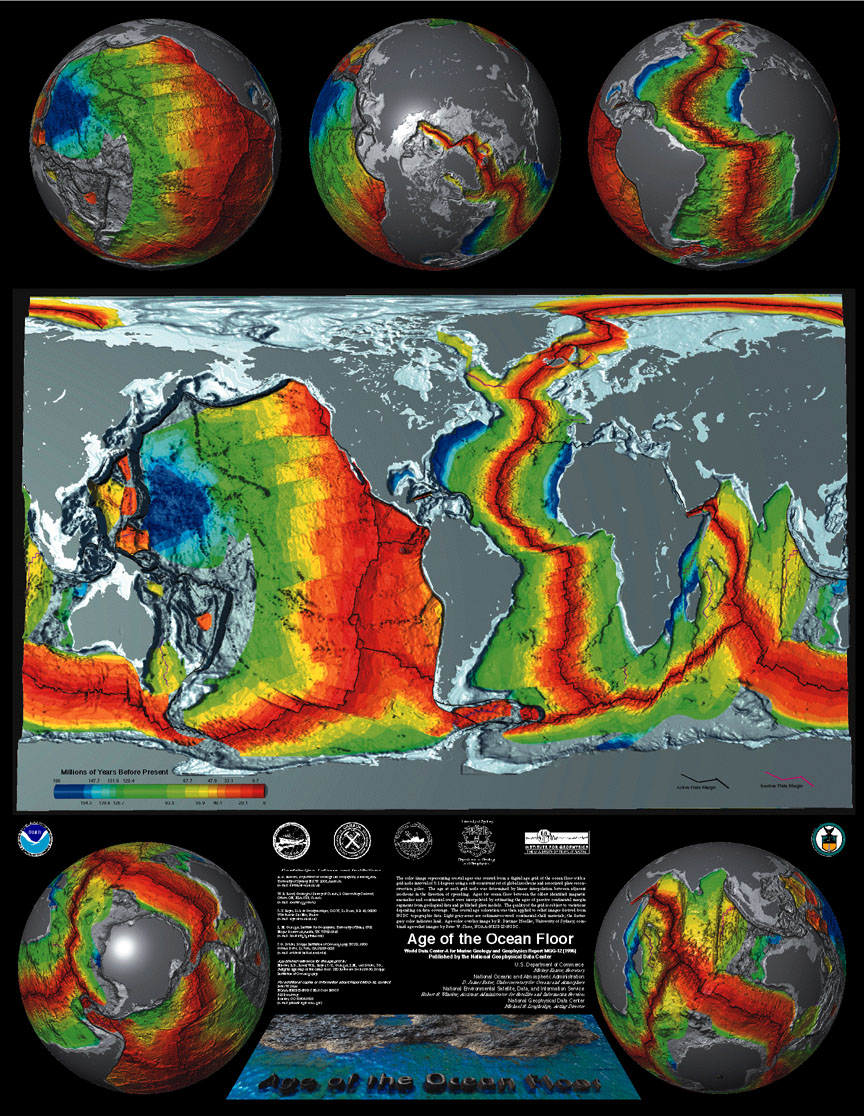
The electrical presumption is as general as the mechanistic one: the ocean floor may be understood as the scar of an Earth-engulfing plasma discharge, a small-scale version of what we see in planetary nebulae, and the water subsequently collected at the bottom. Changing the familiar presumption changes the familiar landscape into an unfamiliar one.

Awareness of the “bias of familiarity” then provokes a second thought. The bias arises not from where we live but from the peculiar limits of our senses. Plasma activity proclaims itself largely in frequencies such as radio and x-ray that lie outside the sensitivities of our senses. We are unfamiliar with plasma because we are blind to it. Modern astrophysicists are in this sense correct to claim that 90% of the universe is undetectable “dark” substances. Their error is to fill in the blank with mathematical extrapolations from familiar theories and to leave their thinking blind to plasma.

The space age has provided us with instruments and techniques that extend our senses to detect plasma. We are now able to experiment with it in laboratories. Our thinking tends to remain stuck in familiar habits and ideas, however. We must make an effort, sometimes a great and frightening effort, to root out our familiar presumption and to adapt our thinking to an unfamiliar new empirical foundation.

Saturday, November 22, 2008

Consensus and the Crab


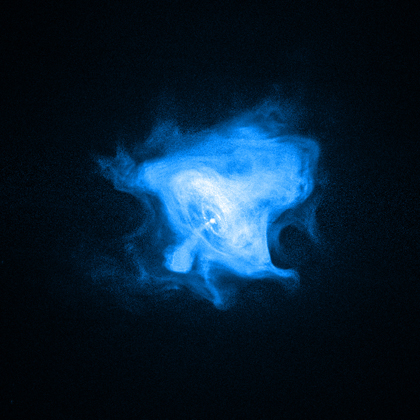
X-Ray (electromagnetic radiation emitted by electrons) image of the Crab Nebula, NASA Chandra X-Ray Telescope
Credit: NASA/CXC/SAO/F.Seward et al

Mel Acheson: The Consensus and the Crab.

Gravity is a weak force, and it can generate only a dribble of energy. Yet throughout the universe we see floods of energy.

The consensus of opinion among astronomers is that the energies of the universe can only come from gravitational mechanisms. Because the force of gravity, and therefore its energy, is directly related to mass, the floods of energy require enormities of mass.

Because the consensus opinion holds that magnitude of mass is equivalent to amount of matter, many of the floods of energy require more matter than can fit into the observed sizes of their sources. Consensus opinion takes recourse in boosting densities: by ignoring all that is known empirically and much that is known theoretically about the compression of matter, the consensus opinion can believe that however much matter is needed can be crammed into the available volume.

The coincidence of such super-densities with the requirements for gravitational production of observed energies is accepted as prima facie proof that the consensus opinion is, in fact, a fact, despite the circular reasoning.

This is the fact that makes the central star in the Crab Nebula’s inner x-ray structure (above image) a pulsar. The press release for this new image states matter-of-factly: “The nebula is powered by a rapidly rotating, highly magnetized neutron star, or pulsar (white dot near the center). The combination of rapid rotating [sic] and strong magnetic field generates an intense electromagnetic field that creates jets of matter and antimatter moving away from the north and south poles of the pulsar, and an intense wind flowing out in the equatorial direction.”

A neutron star has so much matter squeezed into it that the electrons have been squeezed into the nucleus to combine with the protons there and form neutrons. The uncharged neutrons are then packed together, as congested as commuters at rush hour. The pulsations of the pulsar are attributed to a hot spot on its surface that sends a flash of radiation with each rotation of the star. Its operation is analogous to a lighthouse light, back when such lights were mechanically rotating devices, before they were converted to electrically pulsed lamps.

The Crab Nebula’s pulsar pulses 30 times a second. This would mean that the star rotates 30 times a second. This would mean that the centrifugal force is stronger than the star’s gravity … which would mean that the star tore itself apart a long time ago, except that consensus opinion crammed in additional matter to bump up the mass sufficiently to increase the gravitational force enough to hold it together.

Of course, another possibility, one not considered by consensus opinion, is that, as with modern lighthouses, electrical oscillations make the pulsar blink. Super-dense matter and super-fast rotation aren’t needed. The x-ray structure—the jets and rings and sharp boundaries of the diocotron instability around the periphery—are common characteristics of plasma discharges … as is the strong magnetic field, the origin of which consensus opinion neglects to explain. Externally driven electrical circuits provide a unified and coherent explanation that is consistent with electromagnetic theory and laboratory investigations. It’s an explanation that doesn’t require exceptions, circular reasoning, or a consensus of opinion.

Thursday, November 13, 2008

Fluid Dynamic (Ether) Sink Gravity


So this might be my most bizarre post yet but my ego is not really involved in this since I can just blame it all on people much smarter than me.

"The most reasonable mechanism for planetary expansion, in my opinion, involves fluid-sink views of gravity which involves the collection (not the spontaneous generation) of ultra-mundane matter at the cores of astronomical bodies." -- Dennis D. McCarthy, geoscientist, October 2003

"There is no known physical principle, no known physics law, no known physics theory, and no known physics equation which remotely suggests that planets and stars cannot gain mass via collection of sub-sub-sub atomic particles. None. There is no violating regarding known laws of physics. Indeed, the Earth does gain some mass (a small amount) due to being pelted with solar wind, neutrinos, etc. Does this change all of physics? It does not change or alter basic physics -- or even modern physics. It merely reinterprets the equations of general relativity. It is consistent with mass conservation and energy conservation. I really can't state this any more simply." -- Dennis D. McCarthy, geoscientist, October 2003

This model specifically predicts the spiral shape of galaxies which is a failing of mainstream views of gravity.


Ether is actually quite mainstream: "With regards to the general theory of relativity, space cannot be imagined without ether." -- Albert Einstein, physicist, 1920

And, as Anaconda notes, every 8 minutes we have an electromagnetic "flux" transfer event.

Magnetic Portals Connect Sun and Earth

Oct. 30, 2008: During the time it takes you to read this article, something will happen high overhead that until recently many scientists didn't believe in. A magnetic portal will open, linking Earth to the sun 93 million miles away. Tons of high-energy particles may flow through the opening before it closes again, around the time you reach the end of the page.
Nope no mass there.


Le, et al., The Magnetic and Plasma Structure of Flux Transfer Events, Journal of Geophysical Research, Volume 104, Number A1, Pages 233–245, 1999
Visser, M., Acoustic Black Holes: Horizons, Ergospheres, and Hawking Radiation, Classical and Quantum Gravity, Volume 15, Pages 1767-1791, Jun 1998

Volovik, G.E., Induced Gravity in Superfluid 3He, Journal of Low Temperature Physics, Volume 113, Numbers 5-6, Dec 1998

Barcelo, C., et al., Analogue Gravity from Bose-Einstein Condensates, Classical and Quantum Gravity, Volume 18, Pages 1137-1156, Mar 2001

Visser, M., et al., Analogue Models of and for Gravity, General Relativity and Gravity, Volume 34, Pages 1719-1734, 2002

Jacobson, T.A., and Parentani, R., An ECHO of Black Holes, Scientific American, Pages 69-75, 2005

Thornhill, W., Electric Earthquakes, Dec 2005

"Many strange phenomena precede large earthquakes. Some of them have been reported for centuries, even millennia. The list is long and diverse: bulging of the Earth's surface, changing well water levels, ground-hugging fog, low frequency electromagnetic emission, earthquake lights from ridges and mountain tops, magnetic field anomalies up to 0.5% of the Earth's dipole field, temperature anomalies by several degrees over wide areas as seen in satellite images, changes in the plasma density of the ionosphere, and strange animal behavior. Because it seems nearly impossible to imagine that such diverse phenomena could have a common physical cause, there is great confusion and even greater controversy." (Freund 2003)

"Based on the reported laboratory results of electrical measurements, no mechanism seemed to exist that could account for the generation of those large currents in the Earth's crust, which are needed to explain the strong EM signals and magnetic anomalies that have been documented before some earthquakes. Unfortunately, when a set of observations cannot be explained within the framework of existing knowledge, the tendency is not to believe the observation. Therefore, a general malaise has taken root in the geophysical community when it comes to the many reported non-seismic and non-geodesic pre-earthquake phenomena. There seems to be no bona fide physical process by which electric currents of sufficient magnitude could be generated in crustal rocks." (Freund 2003)
Barcelo, C., et al., Analogue Gravity, Living Reviews In Relativity, Dec 2005

Thornhill, W., Electric Gravity In An Electric Universe, Aug 2008

Einstein in his special theory of relativity postulated there was no medium, called the ‘aether.’ But Maxwell’s theory of electromagnetism requires it. And Sir Oliver Lodge saw the aether as crucial to our understanding. So Einstein, at a stroke, removed any possibility that he, or his followers, would find a link between electromagnetism and gravity. It served the egos of his followers to consecrate Einstein’s ideas and treat dissent as blasphemy. “Sometimes a concept is baffling not because it is profound but because it's wrong.”[9,10]

Decades later, Paul R. Heyl wrote in Scientific Monthly, May 1954:
“The more we study gravitation, the more there grows upon us the feeling that there is something peculiarly fundamental about this phenomenon to a degree that is unequalled among other natural phenomena. Its independence of the factors that affect other phenomena and its dependence only upon mass and distance suggest that its roots avoid things superficial and go down deep into the unseen, to the very essence of matter and space.” —Gravitation: Still A Mystery.

This sentiment has been echoed down to the present but few are listening. The problem has been worsened by the particle physicists who indulge in their own virtual reality — inventing “virtual particles” to transmit forces. If they “could understand the structure of the particle, in terms of the medium of which it is composed” and put flesh on the metaphysical bones of quantum theory we should be much further advanced. Sir Oliver Lodge deserves to be heard once more:
“..it may be that when the structure of an electron is understood, we shall see that an ‘even-powered’ stress in the surrounding aether is necessarily involved. What I do feel instinctively is that this is the direction for discovery, and what is needed is something internal and intrinsic, and that all attempts to explain gravitation as due to the action of some external agency, whether flying particles or impinging waves, are doomed to failure; for all these speculations regard the atom as a foreign substance -- a sort of ‘grit’ in the aether -- driven hither and thither by forces alien to itself. When, some day, we understand the real relation between matter and aether, I venture predict that we shall perceive something more satisfying than that.”[11]
Bryner, J., Strange Portal Connects Earth to Sun, Live Science, Nov 2008

Also see: Sansbury, R., PlasmaCosmology.Net