Showing posts with label Electromagnetism. Show all posts

Sunday, February 21, 2010

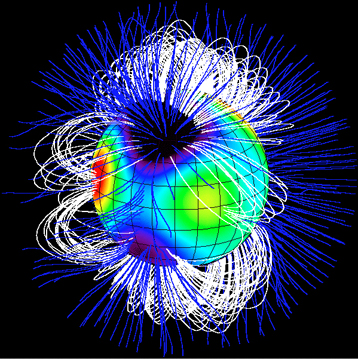
Magnetic Star Formation


"He [Anaxagoras] asserted that the sun was a mass of burning iron...." -- Diogenes Laertius, historian, 3rd century

"The form of the corona and the motion of the prominences suggest that it [the sun] is a magnet." -- George E. Hale, astronomer, 1913

"Gravity has little if anything to do with the processes of star formation." -- Stephen Smith, writer, May 2009

Science Daily: Massive Stars’ Magnetically Controlled Diets.

ScienceDaily (Feb. 21, 2010) — A team of astronomers, led by Dr. Wouter Vlemmings at Bonn University, has used the MERLIN radio telescope network centred on the Jodrell Bank Observatory to show that magnetic fields play an important role during the birth of massive stars. Magnetic fields are already known to strongly influence the formation of lower-mass stars like our Sun. This new study reveals that the way in which high-mass and low-mass stars form may be more similar than previously suspected.

The scientists report their work in the journal Monthly Notices of the Royal Astronomical Society.

Thursday, April 23, 2009

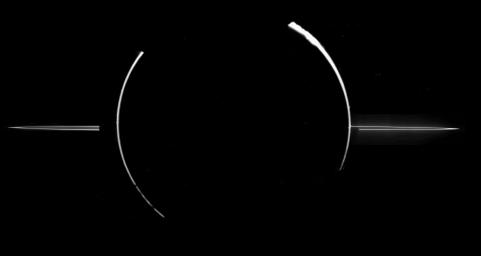
Shedding Some Electricity On Jupiter


Planetary rings are electromagnetic and not gravitational.

Planetary rings orbit in a flat plane perpindicular to the lines of force of the local magnetic field.

Stephen Smith: Shedding Some Light On Jupiter.

Jupiter’s rings were unknown until about thirty years ago [Voyager 1]. Recent data analysis from the Galileo spacecraft reveals electric currents flowing around the planet, just as EU theorists predicted.

A recent announcement by scientists from the Jet Propulsion Laboratory, NASA and the University of Maryland states that Jupiter’s rings are actually electrically charged. Douglas Hamilton, a planetary scientist from the University of Maryland wrote:

"On Jupiter's day side, the sunlight charges the dust particles positively, while on the night side the particles carry a negative charge. Different charges react differently to Jupiter's magnetic field, leading to changes in particle orbits, and when conditions are right, even the tilt or inclinations of the ring particles change.”
Said plainly, orbits are controlled by electromagnetism and not gravitation.

Jupiter's rings are formed out of a thin sheet of material encircling the planet. The ring structure is quite diffuse, making observations difficult unless they are in correct alignment with the Sun. The outer radius begins at 129,000 kilometers, almost the same distance as the moon Adrastea. The four small moons, Metis, Adrastea, Amalthea and Thebe, are said to influence the structure of Jupiter’s rings in the same way that the “shepherd moons” of Saturn govern the shape of its huge ring formation.

More than four years ago Picture of the Day articles addressed the "volcanic" plumes on Jupiter's moon Io and demonstrated that they are plasma discharges from the moon to the gas giant. Some planetary scientists later began to acknowledge the electrical connection between them when Io's "footprint" was seen in the polar aurora on Jupiter. In fact, all four of Jupiter’s largest moons were discovered to leave their marks in the aurora in the shape of “tails” flowing within the plasma column. Later, when NASA launched New Horizons on a mission to study Pluto and Charon, the “plumes” of Tvashtar, a gigantic volcano on Io, were found to be filamentary in structure with indications that they are actually corona arc discharges from the electric “hot spots” linking the moon with Jupiter.

Astronomers suggested that “tides” on Io from the “kneading” effect of Jupiter’s gravity cause the charged particles to be released in the "volcanic" plumes. The particles then flow as an electric current to Jupiter. Since electricity does not flow in one direction the one-way connection cannot be correct, so how is the electricity moving between Io and Jupiter?

Conventional theories assume that the universe is electrically neutral, so when observational evidence confirms electrically active plasma for instance, localized phenomena no matter how improbable are invoked. Tidal forces and volcanoes are presented as the cause for the activity seen on Io and the evidence for electric circuits is ignored. In the case of Jupiter’s rings, the same thing is happening. The ring charge is said to be caused by sunlight and shadow rather than by an electrically active circuit between Jupiter and the Sun.

Jupiter is connected with the Sun and the Sun is connected with the Milky Way – and the Milky Way is probably connected with the Local Group and then with the Cluster and so on and so on. That idea is what forms the basis of Electric Universe Theory that all things throughout the cosmos are composed of electrically quasi-neutral conducting plasma - extremely diffuse on the large-scale but capable of transmitting currents powerful enough to energize stars and the galaxies.

An electrical interaction between Jupiter and its moons means that they are charged bodies and are not electrically neutral. Jupiter exists in a dynamic electrical relationship to the Sun and it is now known that charged particles from the Sun and not “electric dynamos" power the planetary aurorae. Just like the aurorae, the ring system on Jupiter is probably behaving in similar fashion to what is seen on Saturn, so a similar explanation is most likely correct.

The gas giant planets all have rings in some form or another. The plasma torus that surrounds each of them and the electric currents flowing along the polar axes and then out the equatorial plane are the likely cause for their persistence. No one knows for sure how planetary ring systems are formed and maintained, but rather than seeking the answer in strictly mechanical action electricity and current flow through dusty plasma will provide more reasonable explanations.

Tuesday, November 25, 2008

Cosmic Ray Hot Spots Identified


Cosmic Ray 'Hot Spots' Bombarding Earth With Cosmic Rays.

ScienceDaily (Nov. 24, 2008) — A Los Alamos National Laboratory cosmic-ray observatory has seen for the first time two distinct hot spots that appear to be bombarding Earth with an excess of cosmic rays. The research calls into question nearly a century of understanding about galactic magnetic fields near our solar system.

Joining an international team of collaborators, Los Alamos researchers Brenda Dingus, Gus Sinnis, Gary Walker, Petra Hüntemeyer and John Pretz published the findings November 25 in Physical Review Letters.

“The source of cosmic rays has been a 100-year-old problem for astrophysicists,” Pretz said. “With the Milagro observatory, we identified two distinct regions with an excess of cosmic rays. These regions are relatively tiny bumps on the background of cosmic rays, which is why they were missed for so long. This discovery calls into question our understanding of cosmic rays and raises the possibility that an unknown source or magnetic effect near our solar system is responsible for these observations.” ...

Researchers used Los Alamos’ Milagro cosmic-ray observatory to peer into the sky above the northern hemisphere for nearly seven years starting in July 2000. The observatory is unique in that it monitors the entire sky above the northern hemisphere. Because of its design and field of view, Milagro was able to record over 200 billion cosmic-ray collisions with the Earth’s atmosphere. ...

But because Milagro was able to record so many cosmic-ray events, researchers for the first time were able to see statistical peaks in the number of cosmic-ray events originating from specific regions of the sky near the constellation Orion. The region with the highest hot spot of cosmic rays is a concentrated bulls eye above and to the right visually of Orion, near the constellation Taurus. The other hot spot is a comma-shaped region visually occurring near the constellation Gemini. ...

Milagro scientists are currently working with researchers in Mexico to build a second-generation observatory known as the High-Altitude Water Cherenkov (HAWC) experiment. If built, the HAWC observatory could help researchers solve the mystery of cosmic-ray origin.

Saturday, November 22, 2008

Consensus and the Crab


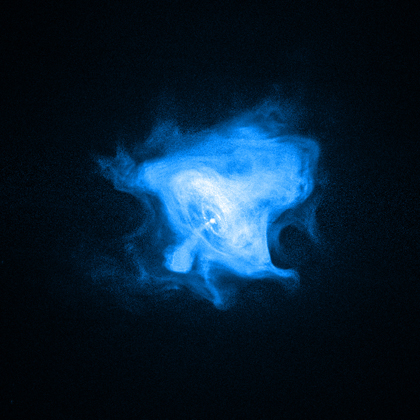
X-Ray (electromagnetic radiation emitted by electrons) image of the Crab Nebula, NASA Chandra X-Ray Telescope
Credit: NASA/CXC/SAO/F.Seward et al

Mel Acheson: The Consensus and the Crab.

Gravity is a weak force, and it can generate only a dribble of energy. Yet throughout the universe we see floods of energy.

The consensus of opinion among astronomers is that the energies of the universe can only come from gravitational mechanisms. Because the force of gravity, and therefore its energy, is directly related to mass, the floods of energy require enormities of mass.

Because the consensus opinion holds that magnitude of mass is equivalent to amount of matter, many of the floods of energy require more matter than can fit into the observed sizes of their sources. Consensus opinion takes recourse in boosting densities: by ignoring all that is known empirically and much that is known theoretically about the compression of matter, the consensus opinion can believe that however much matter is needed can be crammed into the available volume.

The coincidence of such super-densities with the requirements for gravitational production of observed energies is accepted as prima facie proof that the consensus opinion is, in fact, a fact, despite the circular reasoning.

This is the fact that makes the central star in the Crab Nebula’s inner x-ray structure (above image) a pulsar. The press release for this new image states matter-of-factly: “The nebula is powered by a rapidly rotating, highly magnetized neutron star, or pulsar (white dot near the center). The combination of rapid rotating [sic] and strong magnetic field generates an intense electromagnetic field that creates jets of matter and antimatter moving away from the north and south poles of the pulsar, and an intense wind flowing out in the equatorial direction.”

A neutron star has so much matter squeezed into it that the electrons have been squeezed into the nucleus to combine with the protons there and form neutrons. The uncharged neutrons are then packed together, as congested as commuters at rush hour. The pulsations of the pulsar are attributed to a hot spot on its surface that sends a flash of radiation with each rotation of the star. Its operation is analogous to a lighthouse light, back when such lights were mechanically rotating devices, before they were converted to electrically pulsed lamps.

The Crab Nebula’s pulsar pulses 30 times a second. This would mean that the star rotates 30 times a second. This would mean that the centrifugal force is stronger than the star’s gravity … which would mean that the star tore itself apart a long time ago, except that consensus opinion crammed in additional matter to bump up the mass sufficiently to increase the gravitational force enough to hold it together.

Of course, another possibility, one not considered by consensus opinion, is that, as with modern lighthouses, electrical oscillations make the pulsar blink. Super-dense matter and super-fast rotation aren’t needed. The x-ray structure—the jets and rings and sharp boundaries of the diocotron instability around the periphery—are common characteristics of plasma discharges … as is the strong magnetic field, the origin of which consensus opinion neglects to explain. Externally driven electrical circuits provide a unified and coherent explanation that is consistent with electromagnetic theory and laboratory investigations. It’s an explanation that doesn’t require exceptions, circular reasoning, or a consensus of opinion.

Thursday, November 20, 2008

Little Star Lost


Stephen Smith: Little Star Lost

Astronomical theories predict that a planetary nebula in the constellation Centaurus should harbor a white dwarf star at its center. However, such a star cannot be found.

NASA scientists are on the hunt for a missing star. A recent press release from researchers operating the Hubble Space Telescope has described SuWt 2 as a luminous ring of dust and gas with hourglass-shaped longitudinal discharges. Astrophysicists expected the nebular material to be shining because of extreme ultraviolet radiation from a white dwarf star at its center. However, no such star is there and the ultraviolet light has not been detected.

The nebular ring (or spherical shell) does contain a pair of stars in orbit about a common center of gravity, moving at a velocity of one revolution every five days. The stellar pair is more than 100 times brighter than the Sun and nearly three times hotter. Although the stars are so hot and shine so brightly, the radiation is not powerful enough to energize the nebula. As NASA investigators assume, only a flood of ultraviolet light, such as that from the missing white dwarf, could do that.

Since their initial discovery 200 or more years ago, planetary nebulae have demonstrated behaviors and characteristics that are not easy to explain. They exhibit helical loops, rings, bubbles, jets, lobes and many other features that seem to trump standard theories. They are said to be composed of hot gas and owe their morphology to the influence of shockwaves from exploding stars or the pressure from stellar winds blowing through them. In some cases, the nebular forms are described as “like a windsock” inflated by a strong breeze.

Astronomical theories do not yet have a mechanism for the nebular clouds and energetic emissions that have been found. They do not know how stars “shrug off” their outer layers or how they eject lobate structures from their polar axes. The reason for the misunderstanding is that nebulae are composed not of hot gas, but of plasma. Gases obey the laws of kinetic motion: molecules bump into each other due to thermal energy or they are accelerated by the impetus imparted by other fast-moving particles.

Plasma behaves in accordance with the laws of electricity rather than Newtonian physics. Stars are created within Birkeland currents that flow in a great circuit through the galaxy. The Bennett pinch effect squeezes plasma inside these cosmic “transmission lines” in space, igniting stars and forming toroidal currents around the stellar equators. It is actually the electrical current density that causes the plasma in nebular rings and shells to glow.

According to the Electric Universe hypothesis, SuWt 2 is actually an hourglass-shaped toroid viewed in perspective. The binary star in the center of the nebula generates a current sheet along the system’s equatorial plane that astronomers have misidentified as a stellar wind. The Birkeland currents pass through regions of greater density in the disc of gases around the twin stars, causing the disc to light up in a bright ring like a searchlight illuminating clouds in the sky. As the publicized observations have confirmed, the ring is not lit by ultraviolet radiation.
And here's another example of science getting it wrong: Ancient Galactic Magnetic Fields Stronger than Expected.

"It was thought that, looking back in the past, earlier galaxies would not have generated much magnetic field," Kronberg said. "The results of this study show that the magnetic fields within Milky Way-like galaxies have been every bit as strong over the last two-thirds of the Universe's age as they are now-and possibly even stronger then."

Serving as a looking glass into the past, the powerful telescope at the European Southern Observatory, adding to the radio RM data, allowed the scientists to make observations of high magnetic fields between 8 billion and 9 billion years ago for 70 intervening galaxies whose faint optical absorption spectra revealed them as "normal" galaxies. That means that several billion years before the existence of our own sun, and within only a few billion years of the Big Bang, ancient galaxies were exerting the tug of these strong magnetic fields.

This research suggests that the magnetic fields in galaxies did not arise due to a slow, large-scale dynamo effect, which would have taken 5 billion to 10 billion years to reach their current measured levels. "There must be some other explanation for a much quicker and earlier amplification of galactic magnetic fields," Kronberg said. "From the time when the first stars and galaxies formed, their magnetic fields have probably have been amplified by very fast dynamos. One good possibility is that it happened in the explosive outflows that were driven by supernovae, and possibly even black holes in the very earliest generations of galaxies."

This realization brings a new focus on the broader question of how galaxies form. Instead of the commonly held view that magnetic fields have little relevance to the genesis of new galaxies, it now appears that they are indeed important players.