Showing posts with label Magnetism. Show all posts

Sunday, February 21, 2010

Magnetic Star Formation


"He [Anaxagoras] asserted that the sun was a mass of burning iron...." -- Diogenes Laertius, historian, 3rd century

"The form of the corona and the motion of the prominences suggest that it [the sun] is a magnet." -- George E. Hale, astronomer, 1913

"Gravity has little if anything to do with the processes of star formation." -- Stephen Smith, writer, May 2009

Science Daily: Massive Stars’ Magnetically Controlled Diets.

ScienceDaily (Feb. 21, 2010) — A team of astronomers, led by Dr. Wouter Vlemmings at Bonn University, has used the MERLIN radio telescope network centred on the Jodrell Bank Observatory to show that magnetic fields play an important role during the birth of massive stars. Magnetic fields are already known to strongly influence the formation of lower-mass stars like our Sun. This new study reveals that the way in which high-mass and low-mass stars form may be more similar than previously suspected.

The scientists report their work in the journal Monthly Notices of the Royal Astronomical Society.

Friday, February 12, 2010

Mainstream Science Wrong Again


Thomas Wilson: A Magnetic Problem with “Protogalaxies”.

The accepted "mean-field-dynamo" theory held by establishment astronomers asserts that a magnetic field in a galaxy evolves from a “magnetic seed” and builds over the course of billions of years. Young galaxies have no coherent magnetic fields, but over time, a magnetic field “spins up” that spans the galaxy. The mechanism by which this occurs is not well formulated. However, this model predicts that galaxies observed at sufficient distances should have weak magnetic fields compared to our own galaxy.

This assumes a Universe that is about 13.7 billion years old, so that if we look at galaxies 6 to 8 billion light years away, they are comparatively young. Over the course of 2008 there were two separate reports (one in July, the other in early October) of galaxies 6-8 billion light years away with magnetic fields at least as powerful as that found in our own galaxy. In one report, the magnetic field in the distant “young” galaxy was about ten times the strength of that in the Milky Way. As usual, the reporting scientists expressed surprise at their findings.

The research teams actually used different approaches for measuring the magnetic field strength in the different galaxies. Simon Lilly’s group reporting in July performed analyses on a number of galaxies using Faraday Rotation data derived from the polarization of light from quasars behind the galaxies in question. Lilly used FR quasar measurements generated by Philipp Kronberg from the University of Toronto.

Alternatively, the group led by Arthur Wolfe measured the magnetic field in a single galaxy using the Zeeman Effect, where an absorbing gas in a magnetic field splits absorption lines symmetrically.

Some of Wolfe’s comments are interesting and indicative of a general mindset in the astronomical community. Here are excerpts from the October report:

"Astronomers have made the first direct measurement of the magnetic field in a young, distant galaxy, and the result is a big surprise.

Looking at a faraway protogalaxy seen as it was 6.5 billion years ago, the scientists measured a magnetic field at least 10 times stronger than that of our own Milky Way. They had expected just the opposite.

Thursday, January 14, 2010

Giant Magnetic Field Between Binary Star System


"The form of the corona and the motion of the prominences suggest that it [the sun] is a magnet." -- George E. Hale, astronomer, 1913

Science Daily: Giant Magnetic Loop Sweeps Through Space Between Stellar Pair.

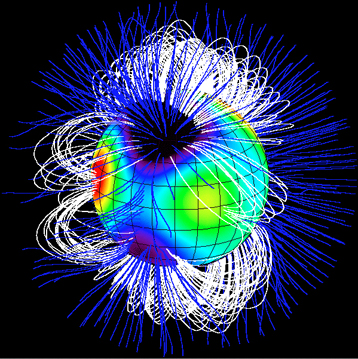
ScienceDaily (Jan. 14, 2010) — Astronomers have found a giant magnetic loop stretched outward from one of the stars making up the famous double-star system Algol. The scientists used an international collection of radio telescopes to discover the feature, which may help explain details of previous observations of the stellar system.

"This is the first time we've seen a feature like this in the magnetic field of any star other than the Sun," said William Peterson, of the University of Iowa.
The pair, 93 light-years from Earth, includes a star about 3 times more massive than the Sun and a less-massive companion, orbiting it at a distance of 5.8 million miles, only about six percent of the distance between Earth and the Sun. The newly-discovered magnetic loop emerges from the poles of the less-massive star and stretches outward in the direction of the primary star. As the secondary star orbits its companion, one side -- the side with the magnetic loop -- constantly faces the more-massive star, just as the same side of our Moon always faces the Earth.

Thursday, January 7, 2010

Magnetic Universe


"The example of the magnet I have hit upon is a very pretty one, and entirely suited to the subject; indeed, it is little short of being the very truth." -- Johannes Kepler, astronomer/mathematician, 1609

"It is therefore plausible, since the Earth moves the moon through its species and magnetic body, while the sun moves the planets similarly through an emitted species, that the sun is likewise a magnetic body." -- Johannes Kepler, astronomer/mathematician, 1609

"But come: let us follow more closely the tracks of this similarity of the planetary reciprocation [libration] to the motion of a magnet, and that by a most beautiful geometric demonstration, so that it might appear that a magnet has such a motion as that which we perceive in the planet." -- Johannes Kepler, astronomer/mathematician, 1609

There is a giant magnet at the center of the Milky Way. It is the "black hole" in the logic, or rather lack thereof, of gravitation.

Science Daily: Center of Milky Way's Magnetic Attraction Ten Times Stronger Than Rest of Galaxy.

ScienceDaily (Jan. 7, 2010) — An international research project involving the University of Adelaide has revealed that the magnetic field in the centre of the Milky Way is at least 10 times stronger than the rest of the Galaxy.

The evidence is significant because it gives astronomers a lower limit on the magnetic field, an important factor in calculating a whole range of astronomical data.

Researchers from the Max-Planck-Institute for Nuclear Physics, the University of Adelaide, Monash University and the United States have recently published their findings in Nature.

Dr Roland Crocker, the lead author, and Dr David Jones both worked on the project while based at Monash University and the University of Adelaide's School of Chemistry and Physics. The two physicists are now based at the Max-Planck-Institute for Nuclear Physics in Heidelberg, Germany.

"This research will challenge current thinking among astronomers," Dr Crocker says. "For the last 30 years there has been considerable uncertainty of the exact value of the magnetic field in the centre of the Milky Way. The strength of this field enters into most calculations in astronomy, since almost all of space is magnetised," he says.

Dr Jones says the findings will affect diverse fields, from star formation theory to cosmology.

"If our Galactic Centre's magnetic field is stronger than we thought, this raises additional questions of how it got so strong when fields in the early universe are, in contrast, quite weak. We know now that more than 10% of the Galaxy's magnetic energy is concentrated in less than 0.1% of its volume, right at its centre," he says.

Dr Jones completed his PhD at Adelaide, studying the Galactic Centre magnetic field under the supervision of Dr Raymond Protheroe, Associate Professor of Physics at the University of Adelaide, and Dr Crocker, a former postdoctoral researcher at the University.

"The Milky Way just glows in radio waves and in gamma-rays produced by collisions of energetic particles, and is brightest near its centre. Knowing the magnetic field there helps us understand the source of the radio and gamma-rays better," says Dr Protheroe.

The Australian Research Council provided funding for the project.
Is it my imagination or is Australia starting to dominate science?

Friday, October 16, 2009

Magnetic Levitation


"Diamagnetic substances include water, protein, diamond, DNA, plastic, wood, and many other common substances usually thought to be nonmagnetic." -- Martin D. Simon, professor, May 2000

New Scientist: Frog defies gravity.

USING a giant magnetic field, scientists at the University of Nottingham and the University of Nijmegen in the Netherlands have made a frog float in mid-air.

The levitation trick works because giant magnetic fields slightly distort the orbits of electrons in the frog's atoms. The resulting electric current generates a magnetic field in the opposite direction to that of the magnet. A field of 16 teslas created an attractive force strong enough to make the frog float—until it made its escape.

The team has also levitated plants, grasshoppers and fish. "If you have a magnet that is big enough, you could levitate a human," says Peter Main, one of the researchers.

He adds that the frog did not seem to suffer any ill effects: "It went back to its fellow frogs looking perfectly happy."
Simon, M.D., Geim, A.K.,. Diamagnetic Levitation: Flying Frogs and Floating Magnets (Invited), Journal of Applied Physics, Volume 87, Number 9, Pages 6200-6204, May 2000

Simon, M.D., Heflinger, L.O., and Geim, A.K., Diamagnetically Stabilized Magnet Levitation, American Journal of Physics, Volume 69, Number 6, Pages 702-713, Jun 2001

Thursday, October 8, 2009

Magnets Kill Cancer Cells


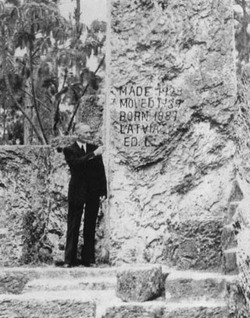
Edward Leedskalnin had advanced tuberculosis and was told he wouldn't live. He claims he used magnets to cure himself.

For the record: I do not believe levers and pulleys have anything to do with this.

Telegraph: Tiny magnets used to seek out and destroy cancer cells.

Just a few decades ago, it was the stuff of science fiction: tiny devices injected into the blood stream that can seek out and destroy cancer cells.

But now scientists believe techniques dreamt up in films such as the 1960s classic Fantastic Voyage and its remake Inner Space, could be viable within a decade.

Researchers have developed tiny magnets that can be attached to anti-body cells or stem cells that are programmed to seek out tumours in the body.

They then piggy-back their way through the blood stream before clumping themselves around the malignant tumour.

Another magnet outside the body is then used to heat them up and destroy the cancer cells.

The researchers said the fatal heating process works similarly to a microwave oven, but the temperature rises involved are much smaller (below 9 F) and the patient is unlikely to feel any pain.

British researchers have already successfully used the technique in animals and believe it could be available for use in humans within 10 years.

Wednesday, October 7, 2009

Edward Leedskalnin


"The earth itself is a great big magnet." -- Edward Leedskalnin, stone mason, 1945

"Magnetic current is the same as electric current. Current is [actually] a wrong expression. Really it is not one current, they are two currents, one current is composed of North Pole individual magnets in concentrated streams and the other is composed of South Pole individual magnets in concentrated streams, and they are are running one stream against the other stream in whirling, screwlike fashion, and with high speed." -- Edward Leedskalnin, stone mason, 1945

Leedskalnin, E., Magnetic Current, 1945

Following is the result of my two years' experiment with magnets at Rock Gate, seventeen miles Southwest from Miami, Florida. Between Twenty-fifth and Twenty-sixth Latitude and Eightieth and Eighty-first Longitude West.

First I will describe what a magnet is. You have seen straight bar magnets, U shaped magnets, sphere or ball magnets and Alnico magnets in many shapes, and usually a hole in the middle. In all magnets one end of the metal is North Pole and the other South Pole, and those which have no end one side is North Pole and the other South Pole.

Now about the sphere magnet. If you have a strong magnet you can change the poles in the sphere in any side you want or take the poles out so the sphere will not be a magnet any more. From this you can see that the metal is not the real magnet. The real magnet is the substance that is circulating in the metal. Each particle in the substance is an individual magnet by itself, and both North and South Pole individual magnets. They are so small that they can pass through anything. In fact, they can pass through metal easier than through the air. They are in constant motion, they are running one kind of magnet against the other kind, and if guided in the right channels they possess perpetual power. The North and South Pole magnets are cosmic force. They hold together this earth and everything in it.


Tuesday, October 6, 2009

Water Is Magnetic


"Tides are created because the Earth and the moon are attracted to each other, just like magnets are attracted to each other. " -- Keith Cooley, astronomer, 2002

Looks like water is also magnetic.

Physics World: Magnetic effects seen in water.

Physicists in Japan have discovered that the melting point of water increases slightly in a strong magnetic field. ...

Recently, it was discovered that the near infrared spectrum and refractive index of water can be affected by a strong magnetic field. Some researchers have suggested that the magnetic field somehow strengthens hydrogen bonds, but the exact mechanism behind these results remains a mystery.

Monday, October 5, 2009

Carbon Is Magnetic


The electron density of states on a grain boundary of defects. The arrows (pointing in the reader's direction) indicate the direction of the magnetic moments. (Credit: Kees Flipse, Eindhoven University of Technology)
No wonder we stick to the Earth.

Science Daily: Graphite Mimics Iron's Magnetism: New Nanotech Applications.

ScienceDaily (Oct. 5, 2009) — Researchers of Eindhoven University of Technology and the Radboud University Nijmegen in The Netherlands show for the first time why ordinary graphite is a permanent magnet at room temperature. The results are promising for new applications in nanotechnology, such as sensors and detectors. In particular graphite could be a promising candidate for a biosensor material. The results will appear online on 4 October in Nature Physics.
As usual, WikiAnswers is on the case.

Saturday, September 5, 2009

Magnetic Monopoles Detected


Physicist Paul Dirac was correct about the Expanding Earth and now it seems he was also correct about magnetic monopoles.

Science Daily: Magnetic Monopoles Detected In A Real Magnet For The First Time.

ScienceDaily (Sep. 4, 2009) — Researchers from the Helmholtz-Zentrum Berlin für Materialien und Energie have, in cooperation with colleagues from Dresden, St. Andrews, La Plata and Oxford, for the first time observed magnetic monopoles and how they emerge in a real material.

Results of their research are being published in the journal Science.

Magnetic monopoles are hypothetical particles proposed by physicists that carry a single magnetic pole, either a magnetic north pole or south pole. In the material world this is quite exceptional because magnetic particles are usually observed as dipoles, north and south combined. However there are several theories that predict the existence of monopoles. Among others, in 1931 the physicist Paul Dirac was led by his calculations to the conclusion that magnetic monopoles can exist at the end of tubes – called Dirac strings – that carry magnetic field. Until now they have remained undetected.

Friday, February 6, 2009

Johannes Kepler Didn't Believe In Gravitation


"The example of the magnet I have hit upon is a very pretty one, and entirely suited to the subject; indeed, it is little short of being the very truth." -- Johannes Kepler, astronomer/mathematician, 1609

"It is therefore plausible, since the Earth moves the moon through its species and magnetic body, while the sun moves the planets similarly through an emitted species, that the sun is likewise a magnetic body." -- Johannes Kepler, astronomer/mathematician, 1609

"But come: let us follow more closely the tracks of this similarity of the planetary reciprocation [libration] to the motion of a magnet, and that by a most beautiful geometric demonstration, so that it might appear that a magnet has such a motion as that which we perceive in the planet." -- Johannes Kepler, astronomer/mathematician, 1609

Martens, R., Kepler's Philosophy and the New Astronomy, 2000