Showing posts with label Edward Leedskalnin. Show all posts

Thursday, October 15, 2009

The Magnetic Monopole Model Vs. The Electron Model


"The electron as particle and the nebula as explosion have been useful theories. Eventually, there comes a time when it’s just time to die." -- Mel Acheson, natural philosopher, November 2009

Edward Leedskalnin: Magnetic Current Research.

Millions of people all over the world are being fooled by the non-existing electrons. Here is how the electrons came into existence. Thomson invented an imaginary baby and called it an electron. Rutherford adopted it and now the men with the long hair are nursing it. The electron has a brother and its name is proton, but it is heavy and lazy. It remains stationary in the middle, but the electron has to run around it. To the electrical engineers the positive electricity is everything, the negative electricity is nothing, but to the physicists the negative electricity is everything, and the positive electricity is nothing. Looking from a neutral standpoint they cancel each other, so we have no electricity, but we have something. If we do not know how to handle the thing that comes through a wire from a generator or a battery, we will get badly shocked. Read the booklet "Magnetic Current" then you will know what the thing is, and the way it runs through a wire.

The invention of an electron came by a tricky method in using electricity in a vacuum tube. Normally whether it be a generator or a battery, the positive terminal will have to be connected to the negative terminal, but in the vacuum tube two batteries with different strength were used, the smaller battery was connected normally, but the larger battery's negative terminal was connected to the smaller battery's negative terminal, and the positive terminal was left alone. That connection gave the negative terminal a double dose of strength, and so it became hotter and could push more. It was called cathode and the positive terminal anode, and the electricity that passed from the cathode to the anode was called electrons.

In case the inventor had used normally direct methods to find out what the electricity was he would have found out that the positive and negative electricity is in equal strength, and are running positive electricity against the negative electricity. That can be seen by connecting each of two pieces of soft iron wire with each terminal of a car battery and then by putting together and pulling away each loose end of the soft iron wire. More sparks can be seen coming out of the positive terminal than from the negative terminal. This direct method is more reliable than the tricky method in the vacuum tube. The trouble with the physicists is they use indirect and ultra-indirect methods to come to their conclusions.

If the inventor of electrons had a vacuum tube in which his electrons could run close to the top of the vacuum tube from the west side of the cathode to the east side of the anode and then would hang a vertically hanging magnet that is made from three-inch long hard steel fishing wire, and then hang one magnet pole at one time right on top in the middle of his stream of electrons, then he would have seen the north pole magnet swinging north, and the south pole magnet swinging south. The same thing will happen if the magnets are held above any wire where the electricity is running through. Those two vertically hanging magnets prove that the electricity is composed of two different and equal forces. Another way to prove this is to connect a flexible wire loop east end of the wire with positive battery's terminal, west end with negative terminal, raise the loop one inch above the floor. Put U shape magnet one inch from loop, north pole south side of the loop. The north pole magnet will pull in the loop. Put the south pole magnet in the same place. It will push the loop away. Put the south pole magnet north side of the loop, this time it will pull the loop in. Put the north pole magnet in the same place, it will push the loop away. This indicates that electricity the same as a magnet bar is composed of two equal forces, and each force is running one against the other in whirling right hand twist, but those forces in the wire have higher speed, and both forces are coming out across from the same wire. One of the forces is north pole magnets and the other is south pole magnets. They are the cosmic forces. Your electric motor is turned around on its axis by north and south pole magnets. Even you could not start your car without the north and south pole magnets.

If electricity is made with north and south pole magnets and the electric motor is turned around on its axis by the north and south pole magnets as is the fact, then this will bring up a question, where then are those Thomson electrons. They are not around the electric motor. The plain answer is they are non-existing.

Magnetricity


"Magnetic current is the same as electric current. Current is [actually] a wrong expression. Really it is not one current, they are two currents, one current is composed of North Pole individual magnets in concentrated streams and the other is composed of South Pole individual magnets in concentrated streams, and they are are running one stream against the other stream in whirling, screwlike fashion, and with high speed." -- Edward Leedskalnin, stone mason, 1945

BBC: 'Magnetic electricity' discovered. (Hat tip: David Lane)

Researchers have discovered a magnetic equivalent to electricity: single magnetic charges that can behave and interact like electrical ones.

The work is the first to make use of the magnetic monopoles that exist in special crystals known as spin ice.

Writing in Nature journal, a team showed that monopoles gather to form a "magnetic current" like electricity.

The phenomenon, dubbed "magnetricity", could be used in magnetic storage or in computing.

Magnetic monopoles were first predicted to exist over a century ago, as a perfect analogue to electric charges.

Monday, October 12, 2009

Scientists Rediscover Pepetual Motion


Science Daily: Physicists Measure Elusive 'Persistent Current' That Flows Forever.

ScienceDaily (Oct. 12, 2009) — Physicists at Yale University have made the first definitive measurements of “persistent current,” a small but perpetual electric current that flows naturally through tiny rings of metal wire even without an external power source.

The team used nanoscale cantilevers, an entirely novel approach, to indirectly measure the current through changes in the magnetic force it produces as it flows through the ring. “They’re essentially little floppy diving boards with the rings sitting on top,” said team leader Jack Harris, associate professor of physics and applied physics at Yale. The findings appear in the October 9 issue of Science.

The counterintuitive current is the result of a quantum mechanical effect that influences how electrons travel through metals, and arises from the same kind of motion that allows the electrons inside an atom to orbit the nucleus forever. “These are ordinary, non-superconducting metal rings, which we typically think of as resistors,” Harris said. “Yet these currents will flow forever, even in the absence of an applied voltage.”

Although persistent current was first theorized decades ago, it is so faint and sensitive to its environment that physicists were unable to accurately measure it until now.

Friday, October 9, 2009

Magnetic Resonance


M.R.I. technology demonstrates how magnetism and radio frequency pulses are used to rotate atomic nuclei.

Can this method also be used to rotate subatomic magnetic monopoles in the opposite direction of the Earth's magnetic field currents?

Wednesday, October 7, 2009

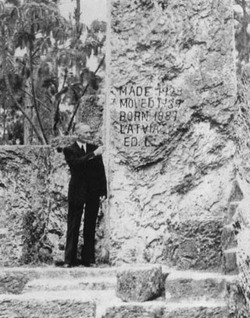
Edward Leedskalnin


"The earth itself is a great big magnet." -- Edward Leedskalnin, stone mason, 1945

"Magnetic current is the same as electric current. Current is [actually] a wrong expression. Really it is not one current, they are two currents, one current is composed of North Pole individual magnets in concentrated streams and the other is composed of South Pole individual magnets in concentrated streams, and they are are running one stream against the other stream in whirling, screwlike fashion, and with high speed." -- Edward Leedskalnin, stone mason, 1945

Leedskalnin, E., Magnetic Current, 1945

Following is the result of my two years' experiment with magnets at Rock Gate, seventeen miles Southwest from Miami, Florida. Between Twenty-fifth and Twenty-sixth Latitude and Eightieth and Eighty-first Longitude West.

First I will describe what a magnet is. You have seen straight bar magnets, U shaped magnets, sphere or ball magnets and Alnico magnets in many shapes, and usually a hole in the middle. In all magnets one end of the metal is North Pole and the other South Pole, and those which have no end one side is North Pole and the other South Pole.

Now about the sphere magnet. If you have a strong magnet you can change the poles in the sphere in any side you want or take the poles out so the sphere will not be a magnet any more. From this you can see that the metal is not the real magnet. The real magnet is the substance that is circulating in the metal. Each particle in the substance is an individual magnet by itself, and both North and South Pole individual magnets. They are so small that they can pass through anything. In fact, they can pass through metal easier than through the air. They are in constant motion, they are running one kind of magnet against the other kind, and if guided in the right channels they possess perpetual power. The North and South Pole magnets are cosmic force. They hold together this earth and everything in it.