Dylan Thuras: Of White Whales and Dark Energies.
It would appear that something is blasting our universe apart— an awkward situation, to say the least. As a resident of the universe, one feels as if he should have a say, a vote in the cosmic election. "Nay on Proposition Omega - The Blasting Apart of the Universe!" But alas, the universe is cruelly undemocratic. Despite one's uncomfortable feelings about it, the galaxies will continue to fly away from each other at an ever-increasing speed, and they will seemingly do so forever, until the universe turns cold and empty— a cosmic desert.Happy thanksgiving!
This is the standing theory anyway. To understand how we got here, to this strange and disconcerting flinging to pieces, we must go back (or at least I feel like taking us back) on a curious journey. A journey through rough seas and darkened basements, up mountain observatories and into the furthest reaches of dying starlight. We'll even learn about whales! We begin this tale one hundred and thirty years ago in Nantucket, with the unfortunate tale of a young whaler named Owen Coffin.
It was 1819 and seventeen year old Owen was bored of the Nantucket life. Bored. To. Tears. To escape his folks and enjoy a little adventure, Owen and his friend Charles took jobs aboard a whaling ship. It was a stroke of good fortune that Owen's cousin was George_Pollard_Jr, the captain of the Essex. He had gladly secured Owen and Charles positions on the ship. They were going to see the world! The intended voyage would be a two and half year trip around the west side of South America and into the South Pacific in search of Sperm Whale.
They had been out to sea for about a year, and things were going well. In fact, if things kept up at this pace, the crew of eighteen would be home, and rich, in no time at all. On the morning of November 20, 1820, whale spouts were spotted on the horizon. Three small whaling boats set out from the Essex. In the midst of the Sperm Whale hunt, a seemingly improbable disaster struck. The whale fought back.
The crew had already speared two sperm whales when, in a flash, an 85-foot bull whale 1 slammed its huge head into the side of the boat, causing the boat to rock violently "as if she had been struck by a rock," the first mate recalled. "We looked at each other with perfect amazement, deprived almost of the power of speech." As young Owen and the crew regained their footing, the whale struck the Essex again, this time staving in the bow of the huge ship. Nothing could be done. Within ten minutes, the 238-ton ship was underwater. The first mate wrote of the incident,
"Amazement and despair now wholly took possession of us. We contemplated the frightful situation the ship lay in, and thought with horror on the sudden and dreadful calamity that had overtaken us...To shed tears was all together unavailing, and withal unmanly; yet I was not able to deny myself the relief they served to afford me."
Melville wasn't kidding when he wrote "forehead to forehead I meet thee, this third time."
Two of the whaling boats were too far away to see what had occurred. When they returned to find the ship, it was nowhere to be found. Things only got worse for the crew of the Essex from there on out. Owen, George, and the rest of the crew survived in the three small whaling boats, before finding the uninhabited Henderson Island. They remained on land for a week, eating every available food source, until they had exhausted all natural resources. All the remaining crew but three set off on water in an attempt to make their way back to civilization. Back on open seas, many soon succumbed to exposure and starvation. Without some kind of sustenance, they would surely die. It was only a matter of time before they would have to answer the delicate question of which one it would be.
When Owen drew the black dot, he knew what it meant. His cousin George tried to take his place, as did his friend Charles, but Owen was steadfast. He drew the black dot and it was he who would be killed and eaten. In a cruel twist of fate, his friend Charles drew the black dot which decided who would be the one to kill Owen. Pollard pleaded with his cousin once more saying "My lad, my lad, if you do not like your lot, I'll shoot the first man that touches you," to which Owen lay down his head and replied "I like it as well as any other." Owen's 28-year-old cousin George and captain of the Essex, who had sworn an oath to protect Owen, looked on in horror as Charles shot his best friend Owen in the head. And then they ate. 2
Eventually, George and Charles were rescued along with a few other members of the crew. The ship's first mate went on to publish a book about his experiences titled Narrative of the Most Extraordinary and Distressing Shipwreck of the Whale-Ship Essex. You can be sure Melville read it with horrified delight, and the sinking of the Pequod is based largely on the tale. 3
Horrible as it was, Owen Coffin's death was not in vain. Besides saving the lives of his fellow shipmates— albeit in a horrible and gruesome manner— and inspiring Moby Dick, there is another legacy that can be found in the tale. In a funny roundabout way, the way in which I am taking you on this strange tale, Owen, and other whalers like him, were of significant importance to the advancement of modern physics. Without whalers like Owen, we might not have achieved one the great discoveries of physics or been lead to one of the greatest scientific mysteries of our day.
Albert Abraham Michelson also once served on a ship in the US Navy. Born in Poland, but raised in the rough-and-tumble mining towns of California, the Jewish Albert had to work twice as hard to get by. While serving in the Navy, he had shown great skill in the fields of optics and heat. Now in his thirties, he was working as a scientist at the Case School in Cleveland, Ohio. One thing in particular interested Albert Michelson: He was obsessed with light and how it got where it was going. The year was 1887, and Michelson had just met another scientist named Edward Morley, who was also curious about light and the substance that carried it across the universe. They called it "the luminous ether."
Waves move through water as sound does through air. They knew there was no water or air in the vacuum of space, but there had to be something, some kind of medium in which light waves could propagate. That something was the ocean that made up all of space, it was ether, and together Michelson and Morley were going to measure it. The basic idea was that the Earth, sun, everything was spinning and moving in this ethereal stuff, like apples in a bobbing bucket. As the Earth spun in the ether it would create an ether wind, and the speed of the light aligned with the direction of the ether. Wind would be faster, like a runner with a breeze at his back. To measure this, they would use a curious instrument which Michelson had been perfecting for the past 10 years.
An inferometer is a delicate device. It is made of a steady light source, a half silvered mirror, two (or more) regular mirrors, and a "detector" or something for the light to shine onto. To detect the ether, a beam of light is sent to the half silvered mirror, a mirror that lets half of the light through and reflects the other half, split at a right angles. Then using the normal mirrors, the beam was sent back to the half silvered mirror where it would recombine into one beam and shine onto the detector.4 The speed of the light would change depending on how the Earth was positioned to the ether wind, and this difference would be shown in a tell-tale pattern on the detector. Measure this, and you'd measure the ether.
Michelson and Morley often had to wait to do their experiments until late in the evening, when the city had quieted down, to make sure there would be no disrupting vibrations. To protect against vibrations and interference, the inferometer was kept in a basement and built on a massive slab of marble, which was then floated on a pool of mercury. One can picture them now, sitting there, bowler-hatted and mustachioed in a dark basement, ready to use the apparatus. All they needed was a steady and reliable light source. For this they looked to the sea.
And here is where the whales come back in. Are you ready to learn more about whales? Here goes. Physeter macrocephalus, or the Sperm Whale, is a remarkable creature. They have the largest brain 5 ever to exist in any known animal; they can survive in a huge range of environments and are found from the Arctic to the equator; they feed primarily on giant and colossal squid (and have been known to snack on Great Whites); they collectively eat more tonnage of seafood then the entirety of humanity; the bull males have no natural predators and are the largest living toothed animal; they use echolocation to help see and find mates; they produce the loudest sounds known in nature; and they can live for over 70 years! Whew! Sperm Whales are bizarre, majestic, and truly fantastical creatures.
To the people of the 19th century, whales were a lot like a floating Wal-Marts; huge, ugly, and full of desirable products. Whale bone was used in clothing and as decoration, whale meat could be eaten (though it rarely was 6) or used as feed for animals, and whale teeth were carved into artful decorations called scrimshaw. Even more valuable was whale fat, used in soaps, cosmetics, and as machine lubricant. A foul-smelling mass called ambergris, when aged, was worth almost its weight in gold and was used as an ingredient in expensive perfumes7. But more than anything, Sperm Whale hunters were after spermaceti.
Today the finite [sic] resources of petroleum pose a major problem, but in those days, they had a different kind of dependence on foreign oil. The head of a Sperm Whale is one fourth the length of it's entire body, and it is filled with a waxy white substance known as spermaceti. It is used by the whales as ballasts. When the fluid was first discovered in the 1700s, it reminded whalers of sperm, hence the name Sperm Whales. 8 To collect this liquid, the whale's head would be cut off and lashed to the side of the ship. A whaler would then bore a man-sized hole in the whale's head and climb inside, chest deep in spermaceti, and hand out buckets— often up to three tons— of the of the waxy liquid. This messy job was done because spermaceti proved to have one exceedingly valuable property. It burned brightly, and it burned evenly. 9
Candles were a big business in the 19th century. William Procter and his brother-in-law James Gamble (you might recognize their last names) made their fortune selling candles. During the Middle Ages, candles were made of either animal fat (known as tallow) or beeswax. Tallow candles were smoky, the light was uneven, and they smelled of seared flesh as they burned. The more expensive beeswax candles burned better, but spermaceti candles proved to be the best. They burned brightly and evenly— evenly enough so that they could be used to produce a standard measurement of light, something of great importance to anyone that might, for example, be trying to control the variables in physics experiments.
Let's take a moment here to talk about units of measurement. It may not seem like it, but units of measurement are fascinating and really quite wacky. The cubit, span, yard, fathom, handbreadth, and foot all measure the same thing: length. In a 1958 MIT fraternity prank, members used their fraternity brother Oliver R. Smoot to measure the length of the Harvard Bridge in a unit of measurement they termed "smoots." They layed Smoot end over end across the entire bridge. (The bridge's length was measured to be 364.4 smoots plus or minus one ear 10.) So really, anything can be a unit of measurement, as long as it is agreed upon. But of course, they weren't agreed upon at all until recently. An "inch" was measured as the width of a man's— any man's— thumb, and the weight of a pound was based on the weight of grain, which was different in each town. Uniformly agreed-upon units of measurement are extremely important, because without them, activities like building a house, paying someone for a bag of feed, or asking someone how far to the next town become very, very difficult. So when people did manage agree on a new unit of measurement, it was worth noting.
And so it was defined in 1860 that a unit of candlepower was the light produced by "a pure spermaceti candle weighing one-sixth of a pound, burning at a rate of 120 grains per hour." Spermaceti candles weren't just an excellent source of oil, but were now a scientific instrument as well. When Michelson and Morley lit their spermaceti oil-filled lamps, they understood that it burned at a scientifically calibrated rate of eight candlepower units per hour.
But what Michelson and Morley didn't understand was why they couldn't see the ether. They tried the experiment again and again, but they couldn't seem to measure anything substantial. What they did measure was 1/40th of what they expected— so small, in fact, as to fall within the margin of error. It was almost as if the ether didn't even exist. But that couldn't be right, for if the ether didn't exist and light traveled at a constant speed... well, it would mean that Newton, Galileo, and the entire basis of physics was wrong! The lack of an ether was a shocking discovery, and the Michelson-Morley experiment became known as the most famous failed experiment. This is not to say it wasn't valuable; indeed, it may have been one of the most important physics experiments ever conducted. Michelson went on to receive the Nobel Prize for his work on the experiment. (For his part, Morley never fully believed the results of his own experiment, and he went on to test for the ether in several more experiments.) But there was one young man who became sure the experiment had been a success. He was only eight years old at the time of the Michelson-Morely experiment, busy reading geometry books, and it would be another eighteen years before he would say exactly how they were wrong. But when he did explain, the world took notice.
Albert Einstein was positive the inferometer had worked. He was sure that it proved there was no ether. As it turns out, ether is kind of unwieldy. If you consider a universe governed by a mysterious and unmeasurable substance and a universe without it, this mysterious ether quickly seems like a bizarre assumption. All you needed to do was forgot all your assumptions and imagine a universe without ether, which Einstein promptly did. 11 Einstein developed this idea further, saying that the results of the Michelson-Morley experiment meant that light traveled in all directions, at once, at a constant speed. Einstein slowly began to realize that even if Michelson and Morely had been doing the same test while flying through space at half the speed of light, their results would have been the same. There was no light faster then light, no light slower than light— there was only the speed of light and it was a constant. 12 Einstein called this idea his special theory of relativity and it was to turn the world of physics upside down.
Ninety some years later, Einstein's special theory of relativity, with all it's strange space-time implications 13, as well as his general theory of relativity have been established as tried and true physics and the basis for modern cosmology. At first Einstein fitted the universe with what he called the cosmological constant, a sort of antigravity ether of his own devising. Einstein was embarrassed by the cosmological constant, as it was an awful lot like the ether, but his belief was that the universe was static and the anti-gravitational constant was a way of explaining why gravity hadn't simply crushed everything. But when Einstein was confronted with evidence that the universe was expanding, he took back his cosmological constant, calling it the biggest blunder of his life. The stars, it seemed, would not allow for a static universe.
Galaxies have a color, some are red and some are blue. To us humans at least. This sounds a bit whimsical, but these colors are how we first realized that the universe was doing more then just sitting around, hanging out. Discovered by a shy and secretive astronomer named Vesto Slipher and made famous by braggart Edwin Hubble, astronomers realized that by measuring the colors of galaxies, they could tell which way the universe was moving. In the spectrum of light, blue light is more energetic (shorter wavelengths) and red light is less energetic (longer wavelengths). When light moving through the galaxy is all scrunched up and moving toward us, it appears blue, known as a "blue shift," and when the light is all stretched out and moving away from us, it appears red, known as a "red shift." 14
Slipher and Hubble clearly saw that things in the universe were, by and large, very red. Not only that, but the red shift coming from distant galaxies was proportional to the distance. Most galaxies were red, and the further away the galaxy, the redder it appeared. This meant that the universe was indeed expanding, and the Big Bang Theory was born shortly thereafter. High fives were had, and it seemed, for a while at least, that cosmology was really beginning to make some sense. That is, until astronomers watched a star explode. There were still some very big surprises in store for physicists, involving another measurable unit of light or "standard candle" as well. This candle, however, would be even more exotic than the one crafted from spermaceti.
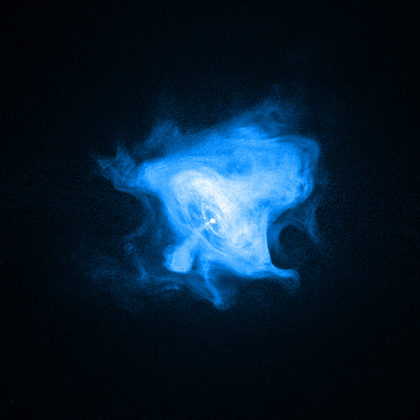
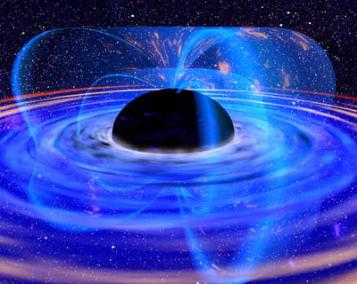
And this is where we learn about giant, fiery, exploding stars! Imagine a star, the sun for example. It is a huge, massively gigantic fireball, capable of fitting roughly 1.3 million Earths inside. Now imagine it exploding... are you picturing it? If what you see isn't cool, you are not imagining it right. As the star explodes, the explosion rips through its solar system, destroying everything in its path. Planets are incinerated like garbage, moons are vaporized, all in its path ceases to be. It is a big damn explosion. Stars go supernova when the star suddenly has too much (or not enough) energy to remain stable. Sometimes the star's core abruptly turns off and the star collapses into a black hole, releasing massive waves of energy. The other and even more spectacular result is when, like someone who eats himself to death 15, a star sucks up too much fuel from a neighboring star and undergoes "runaway nuclear fusion," literally blowing itself to smithereens.
It probably goes without saying that supernovae are also extremely bright. Five billion times brighter than the sun kind-of bright. In 1006, a supernova occurred that was seen around the world. Chinese, Arab, and Native American astronomers all recorded the stellar event, and it was bright enough that, according modern astronomer Frank Winkler, "people could probably have read manuscripts at midnight by its light." A single supernovae can emit as much light in a couple of weeks as our sun will in its entire 4.5 billion-year life span. Really. Really. Bright. Lucky for us they are also very far away. For astronomers looking to gauge the rate at which the universe was expanding, something really, really bright and really, really far away was just what they needed.
Astronomers knew that the universe was expanding. Slipher and Hubble had already proven this, but what they didn't know was how fast it was happening. Measuring the red shift of galaxies to find the rate was problematic due to interfering light from other galaxies. In the words of astrophysicist and writer Michael Brooks "it is like trying to measure the properties of human speech by listening to a soccer crowd." No, to figure out the the speed of the universe's expansion, they needed something of uniform extreme brightness, a "standard candle" as they called it. Enter the supernova.
Set on mountaintops in Chile, Hawaii, and Arizona are three observatories with exceedingly powerful telescopes. In 1996, they were all trained on an exploding star in the far reaches of space. Like the spermaceti candle before it, certain types of supernova have a uniform brightness, so they can be used as a unit of measurement to calculate the distance and acceleration in the farthest reaches of the cosmos 16. By measuring the rate at which the light from these massively bright star explosions shifts red, the astronomers would be able to tell the rate at which the universe was expanding. From that, they could project when they thought the expansion would end. The general assumption was that 13.5 billion years after the Big Bang, the universe should be getting tired and slowing down a bit. It would still expand, but slower and slower. Eventually, astronomers agreed, it would stop expanding and begin contracting in a process known as "the big crunch." But in 1996, as the research teams watched a star explode and looked at the data from the supernova, they saw something no one had expected.
One head researcher, when looking at the data, said his reaction was "somewhere between horror and amazement." Just like Michelson and Morley, they looked through the data again and again, knowing it couldn't be correct. It all pointed to one impossible thing. The supernova was further away than they thought it to be, and the red shift was much greater than they expected. And it was increasing exponentially. The universe was not just expanding, the expansion was growing faster and faster; the cosmos, in the words of Michael Brooks, was literally "blowing itself apart."
This was a fate was not only terrifying, but it made no sense. For the universe to be exponentially expanding, something, some energy— you might even say some sort of ether— must be pushing it. When the astronomers tried to account for this by calculating the quantum energy in the vacuum of space, they got an even more confusing answer. It suggested that the vacuum energy was 1 followed by 120 zeros larger than the expansion of the universe, which meant the universe should have effectively ripped itself into pieces in the first microseconds of its existence. On the one hand, you had a universe accelerating for no reason, making no sense in the context of the Big Bang, and on the other, there was a number derived from quantum physics that suggested we shouldn't even have a universe to watch accelerate in the first place. Into this unpleasant void stepped a theory, or more accurately, a name for something— the something that has no explanation, but fills the cosmos and is pushing it apart with untold force. Luminous ether, meet your evil twin: dark energy 17.
And that is how we, and this tale told via Owen Coffin, whale attacks, cannibalism, Moby Dick, spermaceti, the weird history of the ether, inferometers, smoots, relativity and time dilation, red shifts, and exploding stars, have arrived at the rather problematic cosmological situation we are in. No one knows what dark energy is, or how it works, or what it is made up of. But we know that without it, our current understanding of the universe ceases to function. Like the debunking of the ether, the accelerating universe has left a smoking theoretical hole in the cosmological underpinnings of our universe, and we humans are in the odd position of living in a frightening universe where everything is constantly getting further from everything else. But scientific confusion makes for opportunity, and the unexplainable often leads to entirely new scientific paradigms. Perhaps somewhere out there, there is an eight-year-old child studying geometry books, a child who will one day turn the world of astrophysics on its head and present humanity with an entirely new model of creation.
Whales live an exceedingly long time. Some, like the Bowhead Whale, can live for more than 200 years. A whale that could have been a baby swimming in the Artic Ocean in 1820 when the Essex was sunk and Owen Coffin drew the black dot, a teenager when Moby Dick was published, a young adult in 1887 when Michelson and Morley disproved ether and Einstein presented the theory of special relativity in 1905, and reaching old age when we humans discovered that the universe was flying to pieces in 1996— that whale, that aged and magnificent creature, may yet still live to see yet another revolution in physics. Hopefully, this time, it won't come at the cost of his head.









-759725.jpg)