Showing posts with label Jupiter. Show all posts

Thursday, April 21, 2011

The Eye of Zeus


"The wondrous thing is: how could Kepler have known of the red spot in Jupiter, then not yet discovered? It was discovered by J. D. Cassini in the 1660’s, after the time of Kepler and Galileo. Kepler’s assumption that Galileo had discovered a red spot in Jupiter amazes and defies every statistical chance of being a mere guess. But the possibility is not excluded that Kepler found the information in some Arab author or some other source, possibly of Babylonian or Chinese origin. Kepler did not disclose what the basis of his reference to the red spot of Jupiter was — he could not have arrived at it either by logic and deduction or by sheer guesswork. A scientific prediction must follow from a theory as a logical consequence. Kepler had no theory on that. It is asserted that the Chinese observed solar spots many centuries before Galileo did with his telescope. Observing solar spots, the ancients could have conceivably observed the Jovian red spot, too. Jesuit scholars traveled in the early 17th century to China to study Chinese achievements in astronomy." -- Immanuel Velikovsky, polymath, On Prediction in Science, ~1960-70

Jupiter's red spot: to the Egyptians it was "the eye of Horus."

Hesiod called Jupiter's famous red spot "the eye of Zeus."

"The eye of Zeus, seeing all and understanding all...." -- Hesiod, poet, Works and Days, 8th century B.C.

Hesiod deliberately says eye of Zeus (singular) not eyes of Zeus (plural).

The playwrights Aeschylus and Euripides refer to "the eye of Zeus" as well.

"... glancing down on thee the Father's [Zeus's] eye ...." -- Aeschylus, playwright, Prometheus Bound, 430 B.C.

"... on the eye of Zeus may fall the balm that shall assuage desire." -- Aeschylus, playwright, Prometheus Bound, 430 B.C.

And again.

"... Zeus, whose awful eye is over all." -- Euripides, playwright, Hippolytus, 428 B.C.

In addition, Hesiod describes the giant gaseous planets as stones wrapped tight in cloud bands, like a mummy.

"... to the mightily ruling son of Heaven, the earlier king of the gods [Saturn], she gave a great stone wrapped in swaddling clothes [cloud bands]." -- Hesiod, poet, Theogony, The Children of Cronus, 8th century B.C.

Lucian relates that Homer referenced the striped bands of Jupiter.

"In Homer and Hesiod particularly many things are found that have reference to the astrology of the remote periods. As, for example, what Homer says respecting the golden chain of Jupiter...." -- Lucian, author, Of Astrology, 2nd century

Hesiod and the ancients also observed the rings of Saturn.

"But the bright and glorious star Tishtrya [Ishtar] keeps that Pairika [Saturn] in bonds, with twofold bonds, with threefold bonds, that cannot be overcome...." -- Avesta

"To you, O Saturn, Zoilus dedicates these chains and these double fetters, his first rings." -- Marcus V. Martialis, poet, Epigram XXIX, 1st century

"... and yet the King of Gods, the first and eldest one, is in bonds [rings], they say, if we are to believe Hesiod and Homer and other wise men who tell this tale about Cronus [Saturn]...." -- Dio Crysostom, philosopher, Fourteenth Discourse, 21, 1st century

"... they say he [Saturn] stands bound in chains [rings]." -- Lucian, author, Of Astrology, 2nd century

"... Saturn is bound..." -- Porphyry, philosopher, On the Cave of Nymphs, 3rd century

"There is a singular agreement between what is mythologically asserted of Jupiter, the Demiurgus of the universe, by ancient theologists, and what modern observations, through the telescope, have found of the planet Jupiter.... The remarkable agreement I allude to, and which has I believe been hitherto unnoticed by all modern writers, is this, that Jupiter the Demiurgus is said by ancient theologists, to have put his father Saturn in chains, and also to have surrounded himself with bonds; and that the moderns have found the body of the planet Jupiter to be surrounded by several substances resembling belts or bands, and likewise that there is the faint resemblance of a belt about the planet Saturn." -- Thomas Taylor, classicist, On the Coincidence Between the Belts of the Planet Jupiter and the Fabulous Bonds of Jupiter the Demiurgus, The Classical Journal, Volume XX, Pages 324-326, Sep/Dec 1819

"It has, indeed, been suggested that the proper name Assir, represents the name of Osiris [Saturn]. ... the best interpretation of 'assir' is prisoner." -- A.S. Yahuda, polymath, The Osiris Cult and the Designation of Osiris Idols in the Bible, Journal of Near Eastern Studies, Volume 3, Number 3, Pages 194-197, Jul 1944

"We must take note how philosophy, like myth, has proceeded as a sublimation of catastrophic memory. It is fairly certain, then, that the cloud bands and belts of Jupiter were well-known in the earliest times." -- Alfred De Grazia, philosopher, The Bonds of Saturn and Jupiter, 1977

Friday, June 11, 2010

How Jupiter Falsifies the Big Bang


"There's no explanation at all of the cosmic microwave background in the Big Bang Theory. All you can say for the theory is that it permits you to put it in if you want to put it in. So you look and it's there so you put it in. That's it; it isn't an explanation." -- Fred Hoyle, cosmologist, 2000

New Scientist: Has Jupiter sent cosmology down a false trail?

It's supposed to be the "gold standard" of evidence supporting the standard model of cosmology – including dark matter, dark energy and the exponential expansion after the big bang known as inflation.

But could it be wrong? Might misleading measurements by NASA's Wilkinson Microwave Anisotropy Probe (WMAP) have been leading us towards the wrong theory of cosmology? One astrophysicist thinks so, and he says the planet Jupiter is to blame

Wednesday, July 22, 2009

Jupiter Gets Owned Again


"Dr. Velikovsky pointed out that the collisions were not independent; in fact, if two bodies orbiting the Sun under the influence of gravity collide once, that encounter enhances the chance of another, a well known fact in celestial mechanics. Professor Sagan's calculations, in effect, ignore the law of gravity. Here, Dr. Velikovsky was the better astronomer." -- Robert Jastrow, astrophysicist, December 1979

15 years after the Shoemaker-Levy catastrophe, another catastrophe. This confirms the scientific teachings of Democritus, Plato, and Immanuel Velikovsky.

This impact event was discovered by an amateur. Professional scientists and mathematicians were clueless. They were totally unprepared and had no idea this was coming.

If it hadn't been pointed out to them by an amateur, it is likely scientists would have never known about this. Some scientists are in denial of catastrophism even after the facts have been pointed out to them: Jupiter Pummeled, Leaving Bruise The Size Of Pacific Ocean.

ScienceDaily (July 21, 2009) — Scientists have found evidence that another object has bombarded Jupiter, exactly 15 years after the first impacts by the comet Shoemaker-Levy 9.

Following up on a tip by an amateur astronomer, Anthony Wesley of Australia, that a new dark "scar" had suddenly appeared on Jupiter, this morning between 3 and 9 a.m. PDT (6 a.m. and noon EDT) scientists at NASA's Jet Propulsion Laboratory in Pasadena, Calif., using NASA's Infrared Telescope Facility at the summit of Mauna Kea, Hawaii, gathered evidence indicating an impact.

Thursday, April 23, 2009

Shedding Some Electricity On Jupiter


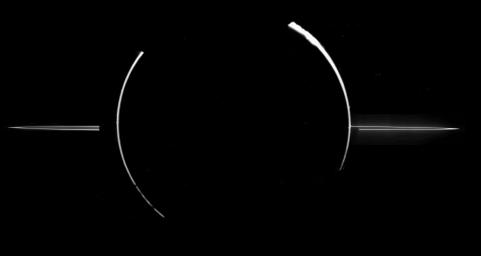
Planetary rings are electromagnetic and not gravitational.

Planetary rings orbit in a flat plane perpindicular to the lines of force of the local magnetic field.

Stephen Smith: Shedding Some Light On Jupiter.

Jupiter’s rings were unknown until about thirty years ago [Voyager 1]. Recent data analysis from the Galileo spacecraft reveals electric currents flowing around the planet, just as EU theorists predicted.

A recent announcement by scientists from the Jet Propulsion Laboratory, NASA and the University of Maryland states that Jupiter’s rings are actually electrically charged. Douglas Hamilton, a planetary scientist from the University of Maryland wrote:

"On Jupiter's day side, the sunlight charges the dust particles positively, while on the night side the particles carry a negative charge. Different charges react differently to Jupiter's magnetic field, leading to changes in particle orbits, and when conditions are right, even the tilt or inclinations of the ring particles change.”
Said plainly, orbits are controlled by electromagnetism and not gravitation.

Jupiter's rings are formed out of a thin sheet of material encircling the planet. The ring structure is quite diffuse, making observations difficult unless they are in correct alignment with the Sun. The outer radius begins at 129,000 kilometers, almost the same distance as the moon Adrastea. The four small moons, Metis, Adrastea, Amalthea and Thebe, are said to influence the structure of Jupiter’s rings in the same way that the “shepherd moons” of Saturn govern the shape of its huge ring formation.

More than four years ago Picture of the Day articles addressed the "volcanic" plumes on Jupiter's moon Io and demonstrated that they are plasma discharges from the moon to the gas giant. Some planetary scientists later began to acknowledge the electrical connection between them when Io's "footprint" was seen in the polar aurora on Jupiter. In fact, all four of Jupiter’s largest moons were discovered to leave their marks in the aurora in the shape of “tails” flowing within the plasma column. Later, when NASA launched New Horizons on a mission to study Pluto and Charon, the “plumes” of Tvashtar, a gigantic volcano on Io, were found to be filamentary in structure with indications that they are actually corona arc discharges from the electric “hot spots” linking the moon with Jupiter.

Astronomers suggested that “tides” on Io from the “kneading” effect of Jupiter’s gravity cause the charged particles to be released in the "volcanic" plumes. The particles then flow as an electric current to Jupiter. Since electricity does not flow in one direction the one-way connection cannot be correct, so how is the electricity moving between Io and Jupiter?

Conventional theories assume that the universe is electrically neutral, so when observational evidence confirms electrically active plasma for instance, localized phenomena no matter how improbable are invoked. Tidal forces and volcanoes are presented as the cause for the activity seen on Io and the evidence for electric circuits is ignored. In the case of Jupiter’s rings, the same thing is happening. The ring charge is said to be caused by sunlight and shadow rather than by an electrically active circuit between Jupiter and the Sun.

Jupiter is connected with the Sun and the Sun is connected with the Milky Way – and the Milky Way is probably connected with the Local Group and then with the Cluster and so on and so on. That idea is what forms the basis of Electric Universe Theory that all things throughout the cosmos are composed of electrically quasi-neutral conducting plasma - extremely diffuse on the large-scale but capable of transmitting currents powerful enough to energize stars and the galaxies.

An electrical interaction between Jupiter and its moons means that they are charged bodies and are not electrically neutral. Jupiter exists in a dynamic electrical relationship to the Sun and it is now known that charged particles from the Sun and not “electric dynamos" power the planetary aurorae. Just like the aurorae, the ring system on Jupiter is probably behaving in similar fashion to what is seen on Saturn, so a similar explanation is most likely correct.

The gas giant planets all have rings in some form or another. The plasma torus that surrounds each of them and the electric currents flowing along the polar axes and then out the equatorial plane are the likely cause for their persistence. No one knows for sure how planetary ring systems are formed and maintained, but rather than seeking the answer in strictly mechanical action electricity and current flow through dusty plasma will provide more reasonable explanations.

Thursday, February 26, 2009

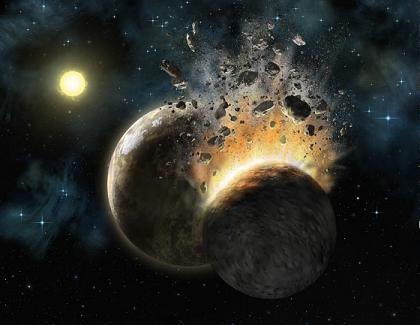
Jupiter and Saturn Collided With Other Worlds


"The environmental anagram that is geology, is a brew of violence. Degradation by cometary wrecking balls...." -- C. Warren Hunt, geologist, 1989

Worlds in Collision: Jupiter, Saturn Plowed Through Asteroids. (Hat tip: Anaconda)

The asteroid belt has long been known to harbor gaps, called Kirkwood gaps, in distinct locations. Some of these gaps correspond to unstable zones, where the modern-day gravitational influence of Jupiter and Saturn eject asteroids. But for the first time, Minton and Malhotra have noticed that some clearings don't fit the bill.

"What we found was that many regions are depleted in asteroids relative to other regions, not just in the previously known Kirkwood gaps that are explained by the current planetary orbits," Minton wrote in an email. In an editorial accompanying the paper, author Kevin Walsh added, "Qualitatively, it looks as if a snow plough were driven through the main asteroid belt, kicking out asteroids along the way and slowing to a stop at the inner edge of the belt."

Thursday, September 25, 2008

Petrobras: Jupiter Is "Tupi-Sized"


Another 8 billion barrels: Galp Rises; Petrobras Confirms `Large' Deposit at Jupiter Find.

Sept. 25 (Bloomberg) -- Galp Energia SGPS SA, Portugal's biggest oil company, climbed as much as 3.6 percent in Lisbon trading after Petroleo Brasileiro SA said tests confirmed a ``large'' deposit of natural gas and light crude oil in the Brazilian offshore well known as Jupiter.

Lisbon-based Galp advanced as much as 45.5 cents to 13.255 euros, and traded at 13.01 euros as of 9:58 a.m. in the Portuguese capital. The stock has dropped 29 percent this year for a market value of 10.8 billion euros ($16 billion).

Petrobras, as Brazil's state-controlled oil company is known, last night said it will be able to provide a more- detailed estimate of oil reserves in the 1-BRSA-559A-RJS well after further analysis. Petrobras said Jan. 21 that the Jupiter deposit appeared to be ``Tupi-sized,'' a reference to a nearby prospect that it estimates may have 8 billion barrels of oil.