skip to main |
skip to sidebar
Science Daily:
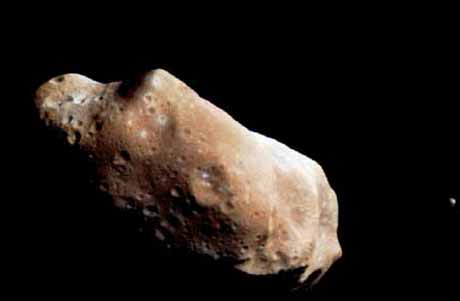
Solar Wind Tans Young Asteroids.
ScienceDaily (Apr. 27, 2009) — A new study published in Nature this week reveals that asteroid surfaces age and redden much faster than previously thought — in less than a million years, the blink of an eye for an asteroid. This study has finally confirmed that the solar wind is the most likely cause of very rapid space weathering in asteroids.

James Anthony Phillips:
Solar Flare Surprise.
Dec. 15, 2008: Solar flares are the most powerful explosions in the solar system. Packing a punch equal to a hundred million hydrogen bombs, they obliterate everything in their immediate vicinity. Not a single atom should remain intact.
At least that's how it's supposed to work.
"We've detected a stream of perfectly intact hydrogen atoms shooting out of an X-class solar flare," says Richard Mewaldt of Caltech. "What a surprise! These atoms could be telling us something new about what happens inside flares."
The event occurred on Dec. 5, 2006. A large sunspot rounded the sun's eastern limb and with little warning it exploded. On the "Richter scale" of flares, which ranks X1 as a big event, the blast registered X9, making it one of the strongest flares of the past 30 years.
NASA managers braced themselves. Such a ferocious blast usually produces a blizzard of high-energy particles dangerous to both satellites and astronauts. Indeed, moments after the explosion, radio emissions from a shock wave in the sun's atmosphere signaled that a swarm of particles was on its way.
An hour later they arrived. But they were not the particles researchers expected.
NASA's twin STEREO spacecraft made the discovery: "It was a burst of hydrogen atoms," says Mewaldt. "No other elements were present, not even helium (the sun's second most abundant atomic species). Pure hydrogen streamed past the spacecraft for a full 90 minutes."
Read the whole thing.