"But why, my dear Crito, should we care about the opinion of the many? Good men, and they are the only persons who are worth considering, will think of these things truly as they happened." -- Socrates in Plato, Crito, 360 B.C.
Prisca Sapientia, Science in Cryptomnesia, Dissident and Heretical Natural Philosophy, Abiotic Hydrocarbon Origin, Infinite Oil, The Cold Mantle, Expansion Tectonics, Pacific Biogeography, Euclidean Geometry, Electric Universe, Electromagnetic Gravity, Colliding Worlds, The Birth of Venus, The Reversal of Retrograde Rotation, Catastrophism, Global Pyramids, Atlantis In Antarctica, Extreme Human Antiquity, Ancient Technology, Giants and Dragons, Alien Astronauts, & Intelligent Design

Scarce twleve strong men of later mouldthus declaring his opinion that the earth then produced mightier men. And if in the more recent times, how much more in the ages before the world-renowned deluge? But the large size of the primitive human body is often proved to the incredulous by the exposure of sepulchres, either through the wear of time or the violence of torrents or some accident, and in which bones of incredible size have been found and rolled out. I, myself, along with some others, saw on the shore at Utica a man's molar tooth of such size, that if it were cut down into teeth such as we have, a hundred, I fancy, could have been made out of it. But that, I believe, belonged to some giant. For though the bodies of ordinary men were then larger than ours, the giants surpassed all in stature. And neither in our own age nor any other have there been altogether wanting instances of of gigantic stature, though they may be few. The younger Pliny, a most learned man, maintains that the older the world becomes, the smaller will be the bodies of men. And he mentions that Homer in his poems often lamented the same decline; and this he does not laugh at as a poetical figment, but in his character of a recorder of natural wonders accepts it as historically true. But, as I said, the bones which are from time to time discovered prove the size of the bodies of the ancients [See the account given by Herodotus (BK. I. 67) of the discovery of the bones of Orestes, which, as the story goes, gave a stature of seven cubits], and will do so to future ages, for they are slow to decay." -- St. Augustine, City of God, XV, 9
That weight could on their necks uphold,

ScienceDaily (Aug. 18, 2011) — Using data collected by NASA's STEREO spacecraft, researchers at Southwest Research Institute and the National Solar Observatory have developed the first detailed images of solar wind structures as plasma and other particles from a coronal mass ejection (CME) traveled 93 million miles and impacted Earth.

The research team, which includes scientists from the Natural History Museum of Denmark, Lawrence Livermore National Laboratory, Carnegie Institute's Department of Terrestrial Magnetism and Université Blaise Pascal, used newly-refined techniques to determine the age of the sample of a FAN that was returned by the Apollo 16 mission and has been stored at the lunar rock collection at the NASA Johnson Space Center.
The team analysed the isotopes of the elements lead and neodymium to place the age of a sample of a FAN at 4.36 billion years. This figure is significantly younger than earlier estimates of the Moon's age that range to nearly as old as the age of the solar system itself at 4.567 billion years. The new, younger age obtained for the oldest lunar crust is similar to ages obtained for the oldest terrestrial minerals -- zircons from Western Australia -- suggesting that the oldest crust on both Earth and the Moon formed at approximately the same time.
This study is the first in which a single sample of FAN yielded consistent ages from multiple isotope dating techniques. This result strongly suggests that these ages pinpoint the time at which this sample crystallised. The extraordinarily young age of this lunar sample either means that the Moon solidified significantly later than previous estimates -- and therefore the moon itself is much younger than previously believed -- or that this sample does not represent a crystallisation product of the original magma ocean. Either scenario requires major revision to previous models for the formation of the Moon.

Early manlike creatures may have been smarter than we think. Recent archaeological finds from the Mediterranean show that human ancestors traveled the high seas.
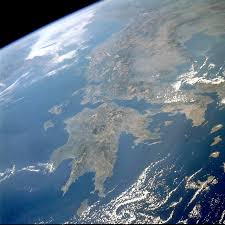
A team of researchers that included an N.C. State University geologist found evidence that our ancestors were crossing open water at least 130,000 years ago. That's more than 100,000 years earlier than scientists had previously thought.
Their evidence is based on stone tools from the island of Crete. Because Crete has been an island for eons, any prehistoric people who left tools behind would have had to cross open water to get there.
The tools the team found are so old that they predate the human species, said Thomas Strasser, an archaeologist from Providence College who led the team. Instead of being made by our species, Homo sapiens, the tools were made by our ancestors, Homo erectus.
The tools are very different from any others found on Crete, Strasser said. They're most similar to early Stone Age tools from Africa that are about 700,000 years old, he said.
Initially the team didn't have any way to date the tools.
That's where NCSU geologist Karl Wegmann came in.
At the time, Wegmann didn't know much about archaeology, but he did know quite a bit about Crete's geology. He had been figuring out the ages of Crete's rock formations to study earthquakes.
A few of the stone tools the team had discovered were embedded in those same rock formations. Those rocks were formed from ancient beach sands, Wegmann said.
Today, the rocks and the tools embedded in them are hundreds of feet above the shore.
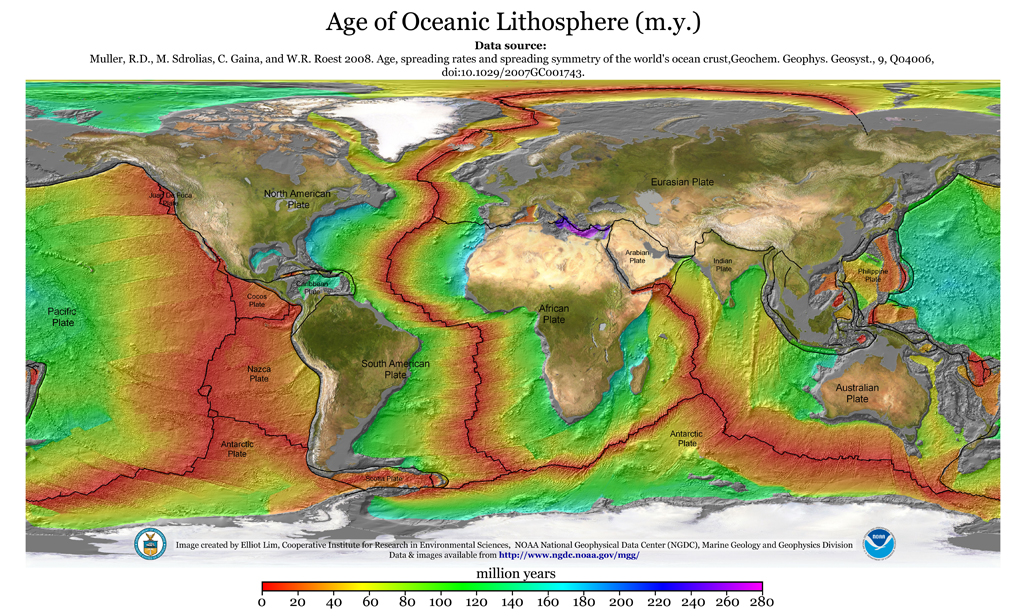
The same process that drives the region's strong earthquakes - colliding continents - is pushing Crete upward out of the sea at a rate of less than 1/20 of an inch every year.
The island's slow rise has preserved beaches from many eras as terraces along the coast.
The lower terraces are the easiest to date. Scientists can measure the age of seashells embedded in the rock using radioactive carbon dating.
This method estimates the age of those terraces at about 45,000 and 50,000 years old.
"We know that (the tools) are tens of meters above the terrace we dated at 50,000 years old, so we know right off the bat that they have to be at least that old," Wegmann said.
But 50,000 years ago is carbon dating's limit. Anything older has to be dated using another method.
Dating by terraces
Crete's rise from the sea gives a fairly simple way of doing that. Once they know the age of lower terraces, geologists can calculate the age of higher terraces just by measuring the difference in the beaches' elevation.
If geologists know how much farther the older terrace traveled upward from the newer, and they know how fast it was going, they can figure out how long it took to get there.
Or, in other words, its age, in this case a record-smashing 130,000 years old.
"The thing to me that really makes this unique and exciting is ... these other sister species maybe weren't entirely stupid like we portray them," Wegmann said. "They were capable of really complex things."