Tuesday, September 30, 2008

The Myth of Subduction


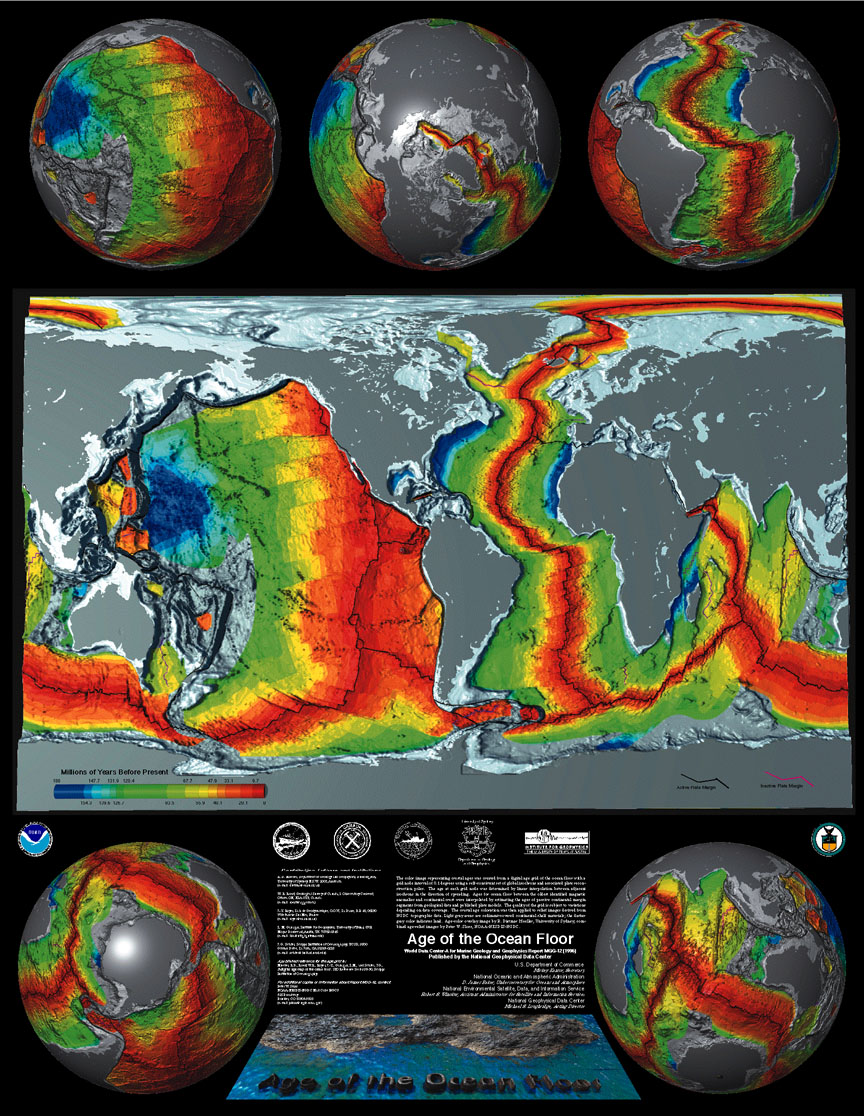
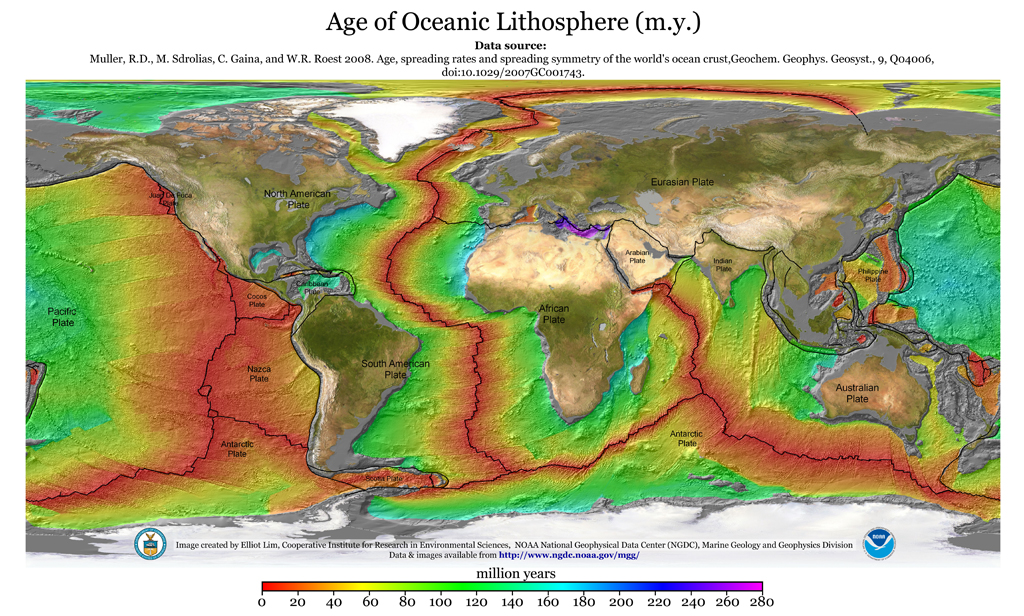
The significance of this map is that it shows subduction and plate tectonics are myths.

The oceanic lithosphere has been zircon dated by the National Geophysical Data Center. No part of the ocean floor is older than ~180-200 million years old.

If the so-called "plates" were subducting, the rifts would be the oldest part of the lithosphere, not the youngest.

There is no subduction. What you see here is called oceanic seafloor spreading.

Every rift above is a divergent spread as indicated by zircon dating.

There is drift, but it's not random, it's temporally diverging away from the rifts and causing spreads.

If there were subduction going on at continental margins wouldn't people on the beach in Oregon and California be sucked into the earth during earthquakes? So far as I know that has never happened. I'm from California; I grew up with the San Andreas fault.

The Earth is growing.

EMST: An Explanation For Gravity?


Tassos: In the Pacific and Any Other Tectonic Belt, Seismic and Volcanic Activity Relate To Positive Gravity

Therefore, iron having the highest nuclear binding energy of all the elements, 8.8 MeV per nucleon, should be the last element to form, and the fact that the bulk of iron rich rocks is younger than about 200 m. y. is supportive of that reasoning, and of the juvenility of oceanic crust. Another important property of iron is that under high pressure its 4s orbital is brought down to the 3rd orbital that can be filled with 10 electrons, 5 more than without compression, forming the Fe(21) anion. The newly formed in the outer core atoms that constitute Excess Mass (EM) relative to the overlying mantle and crust, and emplaced atom by atom, the great bulk concentrically and the active part vertically, in the preexisting "old" continental granitic crust, and cause it's oxidation, and all other geodynamic phenomena.

21st Century Seismology


Dr. Tassos disagrees with accretion as the mechanism and here is his proposal: An Integrated Alternative Conceptual Framework to Heat Engine Earth

An Integrated Alternative Conceptual Framework to Heat Engine Earth, Plate Tectonics, and Elastic Rebound

Starvros T. Tassos Institute of Geodynamics, National Observatory of Athens, P.O. Box 200 48, 118 10 Athens, Greece & David J. Ford 2/22 Mitchell St.,Townsville, N.Q., Australia 4810

Abstract -- Physical evidence indicates that a thermally driven Earth, plate tectonics, and elastic rebound theory violate fundamental physical principles, and that Earth is a quantified solid body, the size of which possibly increases with time. Earth's core is considered as a low-temperature, high-energy/high-frequency, high-tension material, wherein new elements form, constituting the Excess Mass (EM), which is then added atom-by-atom to the overlying mantle. Iron, with the highest nuclear binding energy of 8.8 MeV, should be the last element to form. Due ultimately to cosmic stretching, the internal pressure gradient is from the center, toward the surface; so EM ascends as solid state "wedges," which upon encountering an anisotropic obstacle, then accumulates due to its blockage. Iron ascends in the from of reduced high pressure Fe 2- , to a depth of about 700 km. At shallower depths it then releases 4-5 electrons whilst oxidizing and decompressing at reducing confining pressures. Some of the released excess mass electrons travel as free electrons, and thereby cause microcracks to form when the electron concentration exceeds the threshold of >10 18 electrons/m 2 ; these microcracks enlarge as their concentration increases and their cumulative internal electron pressure builds up; via this self-repulsive electron pressure a great mass of rock is uplifted over time. Microcracks serve both as resonant cavities for "old" metallic bond electrons from Fe 2,3+ and "new" electrons from Fe 2- , radiating at the infrared, and as electrical capacitors, producing effective semiconductor behavior. If and when the concentration of electrons in the microcavity and of p-holes at the rock-microcrack interface surpasses the necessary electro-motive force potential, the electrical impedance to electron flow is attrited and dielectric breakdown occurs, i.e., the transient discharging of electrons very rapidly empties the network of cavities, causing an implosive collapse of the regional network of parallel microcavities. This high-energy implosion coerces the otherwise plastic surrounding rocks to repond instantaneously elastically, and an earthquake is thus generated. The same implosion that caused the earthquake can also produce a fault rupture of the rocks if its transient dynamic shock pressure exceeds the rock's bonded strength. The magnitude of an earthquake depends on the size of the active volume of almost concurrently discharging microcavities. Hence, we are referring to an electromagnetic self-organized criticality, a direct implication of whch is the inherent non-predictability of any earthquake's timing or energy release. ...
PDF full text of article is: here.

Monday, September 29, 2008

A New Gravity Hypothesis?


I just wrote Herndon and Tassos the following letter:

If you would be so kind.

In the context of gravity, astronomical collisions, mass accretion, and planetary growth, what do you think of the following quote?

"My research, based on irrefutable evidence of constant accretion of meteorites and meteor dust, concludes that Earth began as an asteroid remnant of an earlier comet captured by the Sun. The proto-planet then grew over uncountable years (possibly many more than the 4.5 Ga now believed) in an accretion process that is still underway and will continue into the future at an accelerating pace because of Earth’s constantly increasing mass and gravitational power." -- Lawrence S. Myers, cryptologist/geoscientist, 2005

Furthermore, as an alternative mechanism for mass accumulation and growth, what do you think of pair production?

"The creation of electron–positron pairs constitutes an example for the conversion of energy into mass." -- Jörg Eichler, physicist, March 2005

Is it possible that gravity is caused by positron pair production in astronomical cores?

The positrons act as an oppositely charged magnetic pole and hold the electrons (negatrons) in place?

Thus the center of the Earth, and all astronomical bodies, act as giant magnets and this accounts for the existence of gravitational force?

The missing so-called Dark Matter (anti-particles) are the positrons in all astronomical cores?

Absurd? What say you?

-- September 30, 2008

Mass Accretion On Mars: More Evidence For Growth


Scientists have identified iron (Fe), the sixth most adundant chemical element in the universe, all over the surface of Mars. Iron is one of the heaviest elements which do not require a Supernova for their creation. Scientists recognize that Mars is accreting mass, as all astronomical bodies must do because of gravity, (in the form of iron) from meteorites, thus growing. The New Scientist: Mars iron is ideal for building future bases.

FUTURE colonisers of Mars needn't worry about lugging materials from Earth to build their bases - the most widely used building material on Earth, steel, could be manufactured on the Red Planet.

The rover Opportunity has found elemental iron - a key ingredient of steel - peppered across the Martian surface as a result of collisions with iron-rich meteorites.
They also say mass accretion contributed to Mars's unique magnetic field: Giant impact explains Mars's wonky magnetic field.

The strange magnetic field of Mars, which is concentrated in the planet's southern hemisphere, could have been caused by a giant impact.

The finding clears up one of the biggest remaining mysteries about the planet.

The study, led by Sabine Stanley of the University of Toronto, has shown that the asymmetric field could be linked to the planet's strange surface features.

The relatively smooth, flat surface of Mars' northern hemisphere lies around 6 kilometres lower than the more mountainous surface of the southern hemisphere. Earlier this year, researchers proposed that this "Mars dichotomy" can be explained if a huge object, almost as big as Earth's moon, hit the northern hemisphere of Mars at a shallow angle.

It has long been known that the planet's oddly shaped magnetic field – first observed by the Mars Global Surveyor in 1985 – originated about the same time as the Mars dichotomy.
And Mars was decapitated (and killed?) by the biggest impact in the system: Almighty smash left record crater on Mars.

EVERY scar tells a story, yet a huge gash on Mars has long proven very hard to read. Now a peek beneath the planet's surface reveals that the scar is the largest known impact structure in the solar system - gouged out by a collision that reshaped the Red Planet.
"My research, based on irrefutable evidence of constant accretion of meteorites and meteor dust, concludes that Earth began as an asteroid remnant of an earlier comet captured by the Sun. The proto-planet then grew over uncountable years (possibly many more than the 4.5 Ga now believed) in an accretion process that is still underway and will continue into the future at an accelerating pace because of Earth’s constantly increasing mass and gravitational power." -- Lawrence S. Myers, cryptologist/geoscientist, 2005

Saturday, September 27, 2008

The Expanding Universe


Adam G. Riess and Michael S. Turner via Scientific American: The Expanding Universe: From Slowdown to Speed Up.

From the time of Isaac Newton to the late 1990s, the defining feature of gravity was its attractive nature. Gravity keeps us grounded. It slows the ascent of baseballs and holds the moon in orbit around the earth. Gravity prevents our solar system from flying apart and binds together enormous clusters of galaxies. Although Einstein’s general theory of relativity allows for gravity to push as well as pull, most physicists regarded this as a purely theoretical possibility, irrelevant to the universe today. Until recently, astronomers fully expected to see gravity slowing down the expansion of the cosmos.

In 1998, however, researchers discovered the repulsive side of gravity. By carefully observing distant supernovae—stellar explosions that for a brief time shine as brightly as 10 billion suns— astronomers found that they were fainter than expected. The most plausible explanation for the discrepancy is that the light from the supernovae, which exploded billions of years ago, traveled a greater distance than theorists had predicted. And this explanation, in turn, led to the conclusion that the expansion of the universe is actually speeding up, not slowing down. This was such a radical finding that some cosmologists suggested that the falloff in supernova brightness was the result of other effects, such as intergalactic dust dimming the light. In the past few years, though, astronomers have solidified the case for cosmic acceleration by studying ever more remote supernovae.

But has the cosmic expansion been speeding up throughout the lifetime of the universe, or is it a relatively recent development— that is, occurring within the past five billion years or so? The answer has profound implications. If scientists find that the expansion of the universe has always been accelerating, they will have to completely revise their understanding of cosmic evolution. But if, as cosmologists expect, the acceleration turns out to be a recent phenomenon, researchers may be able to determine its cause—and perhaps answer the larger question of the destiny of the universe—by learning when and how the expansion began picking up speed.

Thursday, September 25, 2008

Petrobras: Jupiter Is "Tupi-Sized"


Another 8 billion barrels: Galp Rises; Petrobras Confirms `Large' Deposit at Jupiter Find.

Sept. 25 (Bloomberg) -- Galp Energia SGPS SA, Portugal's biggest oil company, climbed as much as 3.6 percent in Lisbon trading after Petroleo Brasileiro SA said tests confirmed a ``large'' deposit of natural gas and light crude oil in the Brazilian offshore well known as Jupiter.

Lisbon-based Galp advanced as much as 45.5 cents to 13.255 euros, and traded at 13.01 euros as of 9:58 a.m. in the Portuguese capital. The stock has dropped 29 percent this year for a market value of 10.8 billion euros ($16 billion).

Petrobras, as Brazil's state-controlled oil company is known, last night said it will be able to provide a more- detailed estimate of oil reserves in the 1-BRSA-559A-RJS well after further analysis. Petrobras said Jan. 21 that the Jupiter deposit appeared to be ``Tupi-sized,'' a reference to a nearby prospect that it estimates may have 8 billion barrels of oil.