Showing posts with label Plate Tectonics Mythology. Show all posts

Tuesday, September 1, 2009

Plate Tectonics Subducted


"It is established fact, however, that there is not any physically observed discontinuity between deep crust and upper mantle at around 100 km depth, and the continents are observed to have continuous mantle rock roots extending as deep as 600 km (Grand, 1987; Grand et al., 1997). So the question is naturally raised: How is it possible for the upper 100 km of a continent, e.g., North America, to move horizontally by several thousand kilometers at all, under any circumstances, when global seismic tomography data indicate deep continuous roots from the surface down to 600 km depth?" -- Stavros T. Tassos (seismologist) and David J. Ford (geologist), 2005

"Subduction leads to mythology." -- Me, noob, March 2009

Via Louis Hissink's Crazy World: Plate tectonics subducted. (Hat tip: Anaconda)

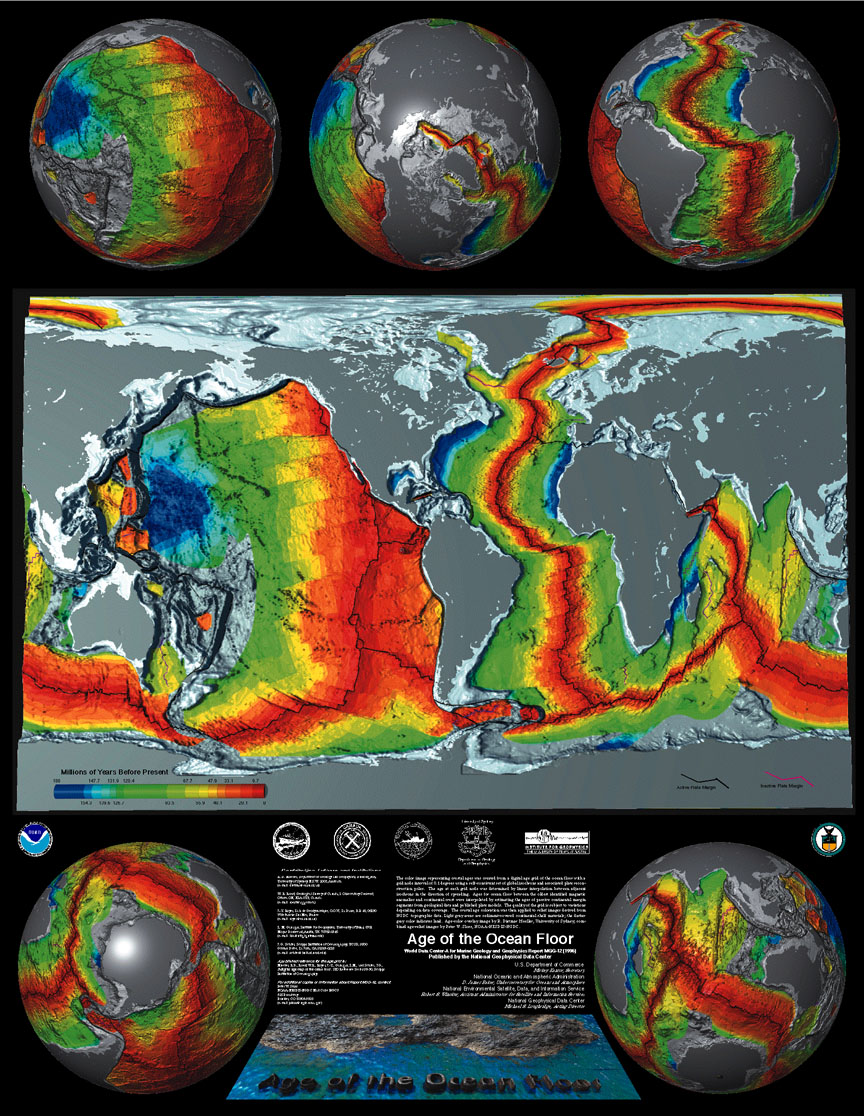
“This tomographic image alone,” says Choi, “is enough to bury the subduction models.”

Wednesday, December 3, 2008

Another Geological Myth Refuted


Geological science fiction refuted: A ‘cool’ new picture of early Earth.

The first 700 million years of Earth’s 4.5-billion-year existence are known as the Hadean period, after Hades, or, to shed the ancient Greek name,
Hell.

That name seemed to fit with the common perception that the young Earth was a hot, dry, desolate landscape interspersed with seas of magma and inhospitable for life. Even if some organism had somehow popped into existence, the old story went, surely it would soon have been extinguished in the firestorm of one of the giant meteorites that slammed into the Earth when the young solar system was still crowded with debris.

Over the last decade, the mineralogical analysis of small hardy crystals known as zircons embedded in old Australian rocks has painted a picture of the Hadean period “completely inconsistent with this myth we made up,” said T Mark Harrison, a professor of geochemistry at the University of California, Los Angeles.
Those same zircon crystals also show that the modern oceans didn't exist in the Triassic and the Earth was half it's present diameter. Maybe now people can start to realize the mantle is also cold and therefore mantle convection is a myth.

Monday, November 24, 2008

Marsupials Vs. Plate Tectonics


According to plate tectonics, this is what the Earth looked like during the Cretaceous period, 125 million years ago.

Here it is more clearly from the same source (Northern Arizona University) as the crude maps above.


At the risk of beating a dead horse, the paleomaps based upon plate tectonics are utterly absurd and totally contradicted by observation and logic.

Why?

Because marsupials "evolved" in Northern China.


A mouse-sized fossil found in China may be the oldest ancestor of modern marsupials - the mammal family that includes kangaroos and koalas.

The creature, which was unearthed in Liaoning province, extends the ancestry of marsupials by 50 million years.

The stunning specimen preserves an imprint of the animal's coat of hair and analysis of its feet suggests it was adapted to climbing in trees.

Details of the find are reported in the latest edition of the journal Science.

Sinodelphys szalayi, as the new species has been named, lived alongside the dinosaurs in the early Cretaceous Period.

The 125-million-year-old creature has close affinities with the family of mammals known as metatherians, which includes the marsupials.
Question: if marsupials evolved in China 125 million years ago, how did they teleport to Australia and South America? I guess since banded iguanas have no problem rafting 7,000 miles to Fiji-Tonga, kangaroos have no problem hopping across the Pacific Ocean?

Wednesday, October 8, 2008

PT Says Earth Is Unique In The Universe


Get this: according to Plate Tectonics mythology, Earth is the only planet in the universe with subduction zones.

Why does plate tectonics occur only on Earth?

Abstract. Plate tectonics [allegedly] governs the topography and motions of the surface of Earth, and the loss of heat from Earth's interior, but appears to be found uniquely on Earth in the Solar System. Why does plate tectonics occur only on Earth? This is one of the major questions in earth and planetary sciences research, and raises a wide range of related questions
UT Dallas Geosciences Faculty Profile: Robert Stern

“Earth is the only planet with plate tectonics. That means it’s special in space, and it’s probably special in time, too. There must have been a time when the Earth didn’t have plate tectonics. The Earth had a very different tectonic, geologic style. There were no mid-ocean ridges with continents moving apart. There were no subduction zones where oceanic crust would have been going down,” Stern explained.
LOL. Wow they are really desperate now.