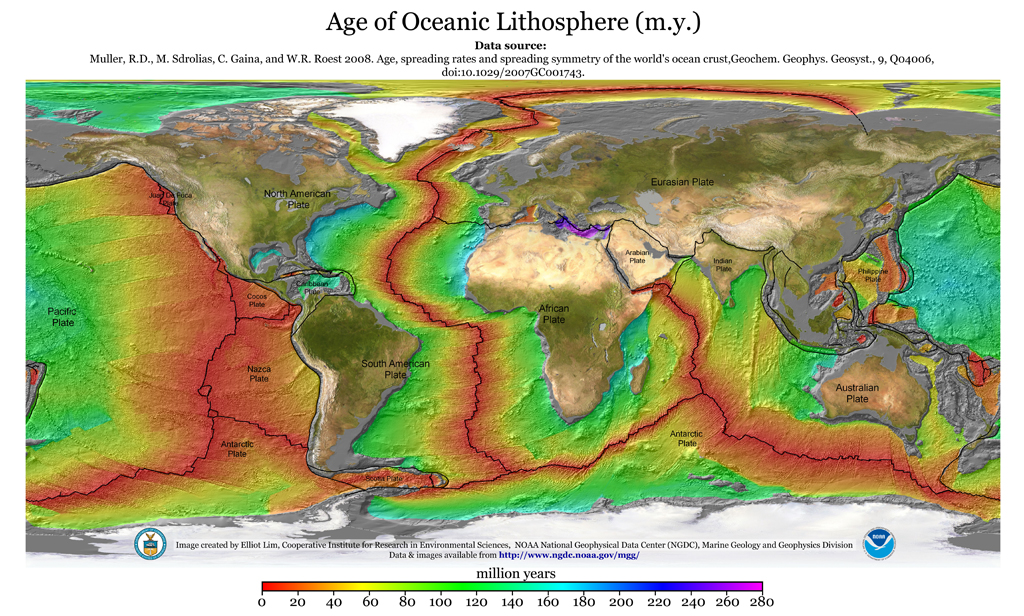
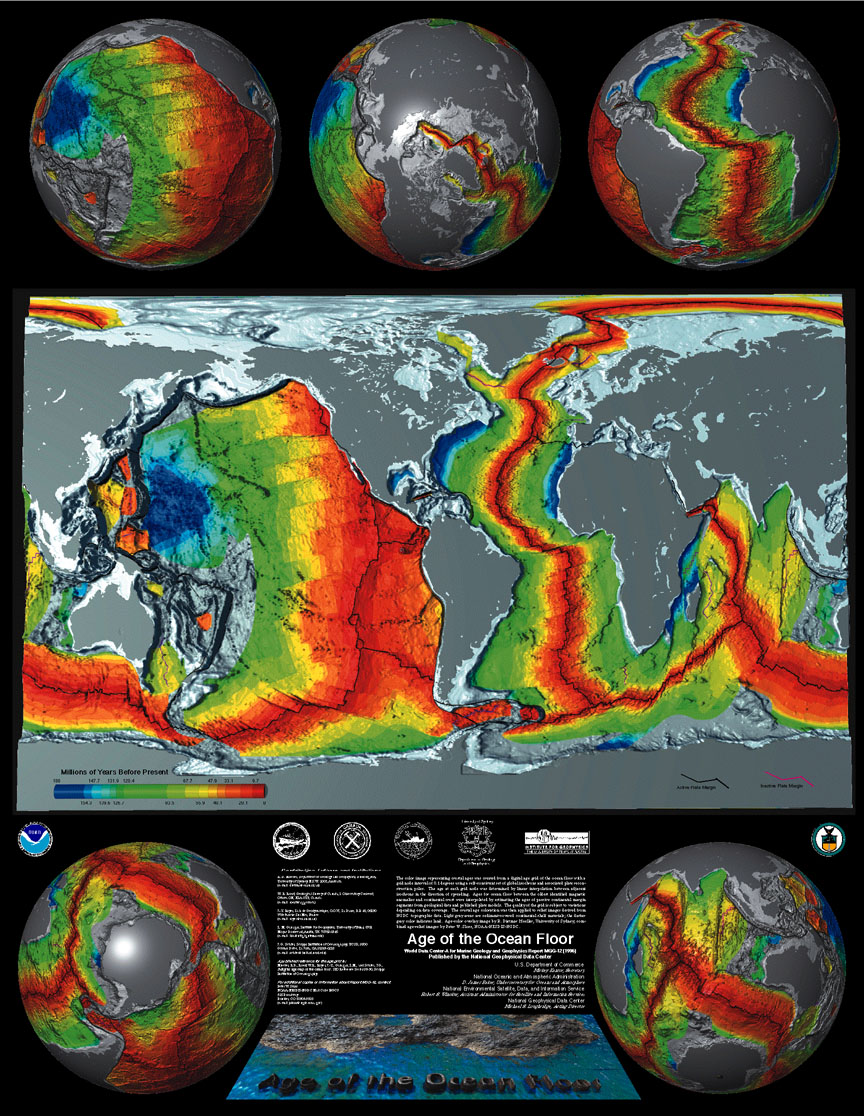
Above: The Late Cretaceous World of Meinong's Jungle According to Plate Tectonics
(It's dominated by gravitation which allows
pterosaurs the size of giraffes to defy it, and by Dark Matter of course)
Vs.
Below: The Real World of Biogeography and
Dennis J. McCarthy (Yeah yeah, another McCarthy puff piece I know...:P)
Vicariance: The separation or division of a group of organisms by a geographic barrier, such as a mountain or a body of water, resulting in differentiation of the original group into new varieties or species.
"The notion of random, and sometimes two-way, 'rafting' across the wide oceans ... evinces, however, a weakening of the scientific outlook, if not a confession of doubt from the standpoint of organic evolution." -- Alexander Du Toit, geologist, 1844
Chilean Flat OysterOstrea chilensis is endemic to Chile and New Zealand.
"Currently, a significant number of distributional facts, particularly involving oceanic disjunctions of poor-dispersing taxa, are in direct conflict with conventional paleomaps of the Mesozoic Pacific and Tethys."
McCarthy, D.J.,
Biogeographical and Geological Evidence for a Smaller, Completely-Enclosed Pacific Basin in the Late Cretaceous, Journal of Biogeography, Volume 32, Issue 12, Pages 2161 - 2177, 2005
"Many researchers have dealt with these inconsistencies by ignoring basic biogeographical realities and positing a radical cross-ocean rafting dispersal hypothesis to explain the problematic disjunctions."
Foighil, D.O., et al.,
Trans-Pacific Range Extension by Rafting Is Inferred for the Flat Oyster Ostrea chilensis, Molecular Biology and Evolution, Volume 13, Pages 1087-1105, 1996
However, the flat oyster, Ostrea chilensis, does not have an extended pelagic phase suggesting alternative tectonic theories.
McCarthy, D.J.,
Biogeography and Scientific Revolutions, The Systematist, Number 25, Pages 3-12, 2005
Sphenodon (Tuatara)
"Sphenodontian reptiles successfully radiated during Triassic and Jurassic times, but were driven almost to extinction during the Cretaceous period."
Apesteguía, S., and Novas, F.E.,
Large Cretaceous Sphenodontian From Patagonia Provides Insight Into Lepidosaur Evolution In Gondwana, Nature, Volume 425, Pages 609-612, Oct 2003
Miller, H.C., Belov, K., and Daugherty, C.H.,
Characterization of MHC Class II Genes From An Ancient Reptile Lineage, Sphenodon (Tuatara), Immunogenetics, Volume 57, Number 11, Pages 883-891, Nov 2005
Miller, H.C., Belov, K., and Daugherty, C.H.,
MHC Class I Genes in the Tuatara (Sphenodon spp.): Evolution of the MHC in an Ancient Reptilian Order, Molecular Biology and Evolution, Proceedings of the SMBE Tri-National Young Investigators' Workshop, 2005
"The fossil record of sphenodontids in the Southern Hemisphere is much longer than in Laurasia, where they became extinct after Early Cretaceous times."
Apesteguía, S.,
A Late Campanian Sphenodontid (Reptilia, Diapsida) From Northern Patagonia, Comptes Rendus Palevol, Volume 4, Issue 8, Pages 663-669, Dec 2005
"At the end of the Early Cretaceous the once abundant sphenodontians vanished from the Laurasian record and were thought to have become virtually extinct."
Apesteguía, S., and Rougier, G.W.,
A Late Campanian Sphenodontid Maxilla from Northern Patagonia, American Museum Novitates, Volume 3581, Pages 1-11, 2007
"Recent works demonstrated the persistence of at least eilenodontine sphenodontids until the ‘mid’-Cretaceous of Patagonia."
Apesteguía, S.,
A Late Campanian Sphenodontid (Reptilia, Diapsida) From Northern Patagonia, Comptes Rendus Palevol, Volume 4, Issue 8, Pages 663-669, Dec 2005
"The most recent fossil relatives of the only living sphenodon, New Zealand's lizard-like Tuatara, are the Late Cretaceous sphenodontians of Patagonia."
Apesteguía, S., and Novas, F.E.,
Large Cretaceous Sphenodontian From Patagonia Provides Insight Into Lepidosaur Evolution In Gondwana, Nature, Volume 425, Pages 609-612, Oct 2003
said lead study author Marc Jones, a postdoctoral fellow at University College London. "If we look at the transoceanic capabilities of the modern [tuatara], it can swim but only short distances. It is able to survive without food for several months, but dehydration would be a serious problem for a long journey."
Paleontologist Ewan Fordyce, a professor at the University of Otago who was not involved in the study, said another problem with the theory is an apparent lack of a mainland tuatara population that could have recolonized the islands.
"If tuatara had actually migrated here after [Zealandia went underwater], we would expect to find a fossil record in nearby land areas like Australia," he said, "and they're just not there."
Hansford, D.,
Tuatara Ancestor Adds to "Sunken New Zealand" Debate, National Geographic News, Jan 2009
So the question is naturally raised, if the Paleomaps of the Late Cretaceous are correct, how did the tuatara teleport from Patagonia to New Zealand in the Late Cretaceous, without leaving a single descendant in between if they were separated by the Pacific Ocean?
McCarthy, D.J.,
Biogeographical and Geological Evidence for a Smaller, Completely-Enclosed Pacific Basin in the Late Cretaceous, Journal of Biogeography, Volume 32, Issue 12, Pages 2161 - 2177, 2005
McCarthy, D.J.,
Biogeography and Scientific Revolutions, The Systematist, Number 25, Pages 3-12, 2005
Fiji Banded Iguana
Fiji's banded iguana Brachylophus is closely related to the Fiji crested iguana and the two are related to the Californian iguanid Dipsosaurus better known as the desert iguana and possibly also the green iguana.
Sites, J.W., Jr., et al.,
Character Congruence and Phylogenetic Signal In Molecular and Morphological Data Sets: A Case Study In The Living Iguanas (Squamata, Iguanidae), Molecular Biology and Evolution, Volume 13, Pages 1087-1105, 1996
How they arrived on the shores of Fiji and other Pacific islands is a puzzle. One theory is that they rafted some 13-million years ago.
Hello Hello: New Species Found In Fiji, New Zealand Associated Press, Sep 2008
The disjunction of the Fijian banded iguana and its California sister requires, according to conventional paleomaps, an 8000 - 12000 km rafting trip, mostly over hypothetical (i.e. currently nonexistent) seafloor. This is more than three times longer than the now forsaken trans-Atlantic rafting trips put forth to save continental stabalism. This hypothetical trip would be the greatest oceanic jaunt of any taxon in the history of terrestrial vertibrates - and by far. Yet the banded iguana is restricted to Fiji-Tonga and appears on no other oceanic islands.
McCarthy, D.J.,
Biogeography and Scientific Revolutions, The Systematist, Number 25, Pages 3-12, 2005
If a one month rafting trip for green iguanas is stretching the limits of hydration and imagination then surely a two year rafting trip is impossible.
Rivera, R.,
Rafting Iguanas, Science World, Jan 1999
Marsupials
The discovery of Chinese marsupials, particularly the oldest known marsupial Sinodelphys szalayi which lived in China 125 million years ago, is a deathblow to plate tectonics. How did marsupials teleport from China to South America?
Rincon, P.,
Oldest Marsupial Ancestor Found, BBC, Dec 2003
Pickrell, J.,
Oldest Marsupial Fossil Found in China, National Geographic, December 2003
Klinger, M.A.,
Sinodelphys szalayi, Carnegie Mellon Natural History, 2003
Monkeys
"Monkeys do not appear on any oceanic island so if they do have the ability to raft across oceans, it is apparently a talent they do not like to flaunt."
Mittermeier, R.A., et al., Nowak (ed)
Walker's Primates of the World, Johns Hopkins University Press, 1999
McCarthy, D.J.,
Biogeography and Scientific Revolutions, The Systematist, Number 25, Pages 3-12, 2005
Cichlids
The only study done on saltwater tolerance of Malagasy cichlids confirmed that their exposure to saltwater was 100% fatal after 12 hours. Cichlids have been unable to reach any oceanic island and have a predominantly Gondwanan distribution, showing the precise sister relationships predicted by vicariance: Africa-South America and India-Madagascar. The dispersal hypothesis requires freshwater cichlids to have negotiated thousands of kilometers of open ocean between India and Madagascar without colonizing any other island or, for that matter, crossing the Mozambique Channel to Africa. Apparently, these taxa like to confine their oceanic jaunts between regions that were once connected. Chakrabarty concludes from his review of phylogenetic analyses that vicariance is the only explanation.
Chakrabarty, P.,
Cichlid Biogeography: Comment and Review, Fish and Fisheries, Volume 5, Issue 2, Pages 97-119, May 2004
McCarthy, D.J.,
Biogeography and Scientific Revolutions, The Systematist, Number 25, Pages 3-12, 2005






-759725.jpg)