Showing posts with label Cosmos Without Gravitation. Show all posts

Tuesday, July 13, 2010

Presumptive Proplyds


Steve Smith: Presumptive Proplyds.

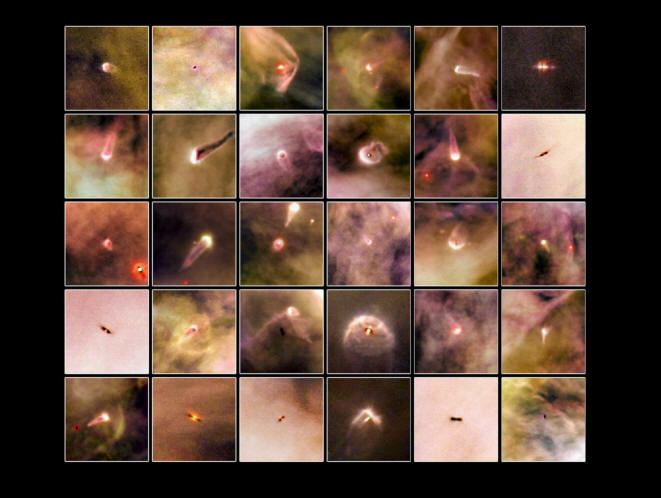
Are the elongated blobs of gas and dust observed within various nebulae the signature of star-birth?

A recent press release from the European Space Agency (ESA) highlights images from the Hubble Space Telescope that are said to reveal "baby stars" called proplyds (PROto-PLanetarY Disk) within the Orion Molecular Cloud complex. Such dusty aggregations are thought to be where gravity is pulling wispy gases together until they reach pressures sufficient to ignite thermonuclear fusion.

According to the Nebular Hypothesis, the remaining clumps of dust and gas that are not absorbed by the newly minted star swirl around, attracting more stray bits, until they also condense, but this time into planets. It is said that our own Solar System was created in a similar "stellar nursery" billions of years ago.

A previous announcement from ESA's XMM-Newton x-ray telescope revealed “flowing plasma” at over one million Kelvin, along with x-ray emissions, in the same regions where the supposed star factories are located. Astronomers were surprised by the discovery, because no one expected to find “hot gas” within a cloud of cold vapor.

At last count, over 700 new stars are said to be forming inside the nebula. Although stars of any class are thought to be x-ray sources, no nebula is supposed to possess the intrinsic energy necessary to generate them.

The investigators believed that they knew where the plasma and x-rays came from, the collision of “high velocity winds emitted by stars.” In other words, in the heart of the nebula, stellar winds cause “shock waves” to raise the temperature in the environment to millions of degrees. The plasma they identified is really meant to refer to hot gas with no reference to its electrically active component.

Star-forming regions are conventionally associated with high frequency light from their active regions. Gamma rays, x-rays, and extreme ultraviolet shine from the "cosmic eggs", and appear to be the glowing tips of condensed gas balls. One of the most iconic images in modern astrophotography is the famous "Pillars of Creation" in the Eagle Nebula. The tops of the clouds, with their Q-tip structures, x-ray radiation, and compact shapes are also deemed to be stellar nurseries, where standard theories meet colorful pictures.

That gas can be heated until it gives off x-rays without stripping electrons from the nuclei, or that a “wind” of ionized particles is not an electric current, or that the only way for charged particles to accelerate is through shock waves is seriously limiting. It betrays a reactionary viewpoint despite the evidence of observations.

The Electric Star hypothesis resolves many of the distorted opinions that arise from misunderstanding the role of plasma and electric fields in space. Rather than kinetic activity (heated gas), the Orion Nebula’s radiant emanations result from electric currents.

Electric discharges in a plasma cloud create double layers, or sheaths, along the current axis. Positive charge builds up on one side and negative charge on the other. An electric field develops between the sides, and if enough current is applied the sheath glows, otherwise it is invisible. Electric currents flow along the sheaths. In plasma, the currents spiral into filaments, or double layer tubes. The filaments attract each other, but rather than merging they spiral around, gradually pinching down into arc mode discharges.

Electric sheaths that are normally invisible are "pumped" with additional energy from galactic Birkeland currents in which they are immersed. The excess input power pushes them into "glow mode", while increased flux density draws matter from the surrounding space into filaments that ignite the nebular "gases" electrically.

It is in this way that stars are born. Gravity, although it plays a small role in stellar evolution, is far too weak a force when compared to an electric field and ionized particles.

Friday, October 16, 2009

Zero Gravity Mice


Gravitation is not universal.

Gravity is magnetic: Mighty Mouse takes off – thanks to magnets.

With the aid of a strong magnetic field, mice have been made to levitate for hours at NASA's Jet Propulsion Laboratory (JPL) in Pasadena, California. The floating rodents could provide a valuable insight into how astronauts are affected by extended spells in zero gravity.

Strawberries and frogs have previously been levitated using the same method. It works because a strong magnetic field distorts the movement of electrons in water molecules, which in turn produces a magnetic field that opposes the one applied. The net result is a repulsive effect which, if suitably oriented and strong enough, can overcome the pull of gravity.

Yuanming Liu and colleagues at JPL in Pasadena, California, used a purpose-built levitation device containing a coil of wire, or solenoid, cooled to a few degrees above absolute zero so that it became superconducting. Running a current through the solenoid creates a magnetic field of 17 teslas, about 300,000 times that of the Earth.

The magnetic field varies along the length of the coil. A water-containing object placed at the base of the coil develops an opposing magnetic field that generates a force twice that of Earth's gravity at the bottom, Earth-like gravity in the middle, and zero gravity at the top. Liu's system can levitate water-based objects for hours or even days at a time.

Saturday, December 6, 2008

Cosmos Without Gravitation


"I have long held an opinion, almost amounting to conviction, in common I believe with many other lovers of natural knowledge, that the various forms under which the forces of matter are made manifest have one common origin; or, in other words, are so directly related and mutually dependent, that they are convertible, as it were, one into another, and possess equivalents of power in their action. In modern times the proofs of their convertibility have been accumulated to a very considerable extent, and a commencement made of the determination of their equivalent forces." -- Michael Faraday, physicist, 1845

"The long and constant persuasion that all the forces of nature are mutually dependent, having one common origin, or rather being different manifestations of one fundamental power, has often made me think on the possibility of establishing, by experiment, a connection between gravity and electricity …no terms could exaggerate the value of the relation they would establish.'' -- Michael Faraday, physicist, 1865

"What we call mass would seem to be nothing but an appearance, and all inertia to be of electromagnetic origin." -- Henri Poincaré, physicist, 1908

"Gravitation is an electromagnetic phenomenon." -- Immanuel Velikovsky, cosmologist, 1946

Velikovsky, I., Cosmos Without Gravitation: Attraction, Repulsion and Electromagnetic Circumduction in the Solar System, 1946

1. The ingredients of the air—oxygen, nitrogen, argon and other gases—though not in a compound but in a mixture, are found in equal proportions at various levels of the atmosphere despite great differences in specific weights. ... Why, then, do not the atmospheric gases separate and stay apart in accordance with the specific gravities?

2. Ozone, though heavier than oxygen, is absent in the lower layers of the atmosphere, is present in the upper layers ... Nowhere is it asked why ozone does not descend of its own weight or at least why it is not mixed by the wind with other gases.

3. Water, though eight hundred times heavier than air, is held in droplets, by the millions of tons, miles above the ground. Clouds and mist are composed of droplets which defy gravitation.

...

7. Cyclones, characterized by low pressure and by winds blowing toward their centers, move counterclockwise in the northern hemisphere and clockwise in the southern hemisphere. This movement of air currents in cyclonic vortices is generally explained as the effect of the earth’s rotation.

Anticyclones, characterized by high pressure and by winds blowing from their centers move clockwise in the northern hemisphere and counterclockwise in the southern hemisphere. The movement of anticyclones has not been explained and is regarded as enigmatic.

Cyclones and anticyclones are considered a problem of fluidal motion with highest or lowest pressure in the center. As the movement of anticyclones cannot be explained by the mechanistic principles of gravitation and rotation, it must be concluded that the rotation of cyclones is also unexplained.
And the same is true for the cloud bands on Jupiter which have differential rotation.

a. Gravitation acts in no time. Laplace calculated that, in order to keep the solar system together, the gravitational pull must propagate with a velocity at least fifty million times greater than the velocity of light. A physical agent requires time to cover distance. Gravitation defies time.

b. Matter acts where it is not, or in abstentia, through no physical agent. This is a defiance of space. Newton was aware of this difficulty when he wrote in a letter to Bentley: “That gravity should be innate, inherent, and essential to matter, so that one body can act upon another at a distance through a vacuum without the mediation of anything else, by and through which their action and force may be conveyed from one to another, is to me so great an absurdity that I believe no man, who has in philosophical matters a competent faculty of thinking, can ever fall into it.” Leibnitz opposed the theory of gravitation for this very reason.
"If Dr. Velikovsky is right, the rest of us are crazy." -- Harlow Shapley, astronomer, 1946

"He [Velikovsky] invents electro-magnetic forces capable of doing precisely what he wants them to do. There is no scientific evidence whatever for the powers of these forces." -- Martin Gardner, mathematician, 1957