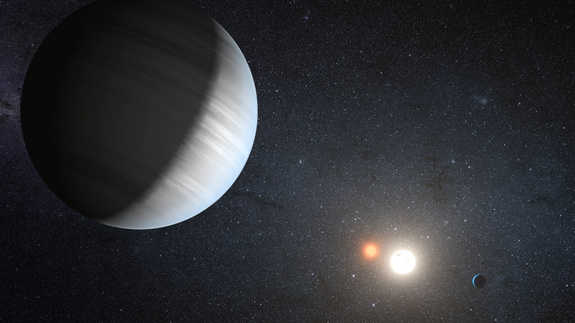
Triple Star System May Challenge Einstein Theory A recently discovered triple-star system could help a team of international researchers test for a potential flaw in Albert Einstein's theory of General Relativity, possibly shedding light on the true nature of gravity. Originally spotted by an American graduate student using a steerable radio telescope, the unique star system features two white dwarf stars and a super-dense pulsar, or neutron star. "This triple system gives us a natural cosmic laboratory far better than anything found before for learning exactly how such three-body systems work and potentially for detecting problems with General Relativity that physicists expect to see under extreme conditions," Scott Ransom, an astronomer with the U.S. National Radio Astronomy Observatory, said in a statement. Related Links Covering an area smaller than the Earth's orbit around the sun, the star system's close orbit will allow researchers to observe a potential violation in Einstein's theory of General Relativity: the strong equivalence principle. What is 'strong equivalence'? The principle states that the effect of gravity on a body doesn't depend on the nature or internal structure of that body. Pulsars emit "lighthouse-like beams of radio waves" so by conducting high-precision timing of the pulses coming from the pulsar, the triple-star system could reveal clues to the true nature of gravity, University of British Columbia astronomer Ingrid Stairs told CTVNews.ca on Monday. "Finding a deviation from the strong equivalence principle would indicate a breakdown of General Relativity and would point us toward a new, revised theory of gravity." The results are published in Nature and will be presented at the 223rd American Astronomical Society meeting.
Showing posts with label Democritus. Show all posts
Showing posts with label Democritus. Show all posts
Friday, January 10, 2014
Democritus Guesses Again 2

Wednesday, August 29, 2012
Democritus Guesses Again!
"He [Democritus] said that the ordered worlds are boundless and differ in size, and that in some there is neither sun nor moon, but that in others, both are greater than with us, and yet with others more in number. And that the intervals between the ordered worlds are unequal, here more and there less, and that some increase, others flourish and others decay, and here they come into being and there they are eclipsed. But that they are destroyed by colliding with one another. And that some ordered worlds are bare of animals and plants and all water." -- Hippolytus, priest, 2nd century
NASA discovers first two-planet system orbiting twin suns.
It's been almost a year ago since we made our first discovery of an exoplanet orbiting two suns, prompting everyone to compare it to the planet Tattooine in the "Star Wars" universe. A handful of other planets orbiting two stars have been found since then, but the Kepler-47 system is special: It's the first twin star system discovered that has not one but two planets in orbit. This unusual system was discovered using data from the Kepler telescope that's responsible for numerous exoplanet finds. According to Kepler mission principal investigator William Borucki, "Unlike our sun, many stars are part of multiple-star systems where two or more stars orbit one another. The question always has been — do they have planets and planetary systems? This Kepler discovery proves that they do." The first star in the system is comparable to our sun in size, although only 84% as bright. The other is a dim star, measuring a third of the sun's size and only 1% as bright. Kepler-47b, one of the two planets that most probably has a blazing hot atmosphere due to its proximity to the stars, completes its orbit within 50 days. With a radius three times larger than Earth's, it's currently the smallest planet known to orbit two stars. The other planet, called Kepler-47c, is located much farther away and completes its orbit around the stars in 303 days. But even though it's located in the system's habitable zone, it's unlikely to support life — the planet is a gas giant that's slightly larger than Neptune. Kepler-47's discovery means exoplanet hunters now have to pay special attention to clusters of stars that may be hiding more than one planet. As Borucki said: "In our search for habitable planets, we have found more opportunities for life to exist."
Friday, September 16, 2011
Democritus Guesses Again

Science in cryptomnesia:
"He [Democritus] said that the ordered worlds are boundless and differ in size, and that in some there is neither sun nor moon, but that in others, both are greater than with us, and yet with others more in number. And that the intervals between the ordered worlds are unequal, here more and there less, and that some increase, others flourish and others decay, and here they come into being and there they are eclipsed. But that they are destroyed by colliding with one another. And that some ordered worlds are bare of animals and plants and all water." -- Hippolytus, priest, 2nd century
Discovery News: WEIRD [sic] EXOPLANET DISCOVERED ORBITING TWO STARS.
If you could stand on the surface of Kepler-16b, you'd have two shadows. At sunset, you would see an orange star about the size of the sun and next to it a much fainter red star. As the stars slipped toward the horizon, they would change places in the sky, like partners in a square dance.
Thursday, February 10, 2011
What Democritus Saw and You Can Too

Democritean pedesis (from Greek: πήδησις "leaping") is the assumably random movement of particles suspended in a fluid (i.e. a liquid such as water or a gas such as air) or the mathematical model used to describe such random movements, often called a particle theory.
"... his [Democritus's] ... atoms are infinite in number ... and [he] compares them to the motes of air which we see in shafts of light coming through windows ...." -- Aristotle, philosopher, On the Soul, Book I, 350 B.C.
Lucretius described Democritean pedesis in his scientific poem On the Nature of Things written in 50 B.C.
"And of this fact (as I record it here)
An image, a type goes on before our eyes
Present each moment; for behold whenever
The sun's light and the rays, let in, pour down
Across dark halls of houses: thou wilt see
The many mites in many a manner mixed
Amid a void in the very light of the rays,
And battling on, as in eternal strife,
And in battalions contending without halt,
In meetings, partings, harried up and down.
From this thou mayest conjecture of what sort
The ceaseless tossing of primordial seeds
Amid the mightier void- at least so far
As small affair can for a vaster serve,
And by example put thee on the spoor
Of knowledge. For this reason too 'tis fit
Thou turn thy mind the more unto these bodies
Which here are witnessed tumbling in the light:
Namely, because such tumblings are a sign
That motions also of the primal stuff
Secret and viewless lurk beneath, behind.
For thou wilt mark here many a speck, impelled
By viewless blows, to change its little course,
And beaten backwards to return again,
Hither and thither in all directions round."
-- T. Lucretius Carus, philosopher poet, On The Nature of Things, Book II, 50 B.C.
In Democritus's lost botanical work titled Causes Affecting Seeds, and Plants, and Fruits, Democritus described pedesis observed under the microscope.
"It would surely be absurd to imagine that the men who could make these observations had not the curiosity or the ability to make many others of which the memory is lost. Indeed, the idea that the Greeks were not observers is ludicrously wrong, as is proved by the anatomical accuracy of their sculpture, which bears witness to trained habits of observation, while the Hippokratean corpus contains models of scientific observation at its best. We know, then, that the Greeks could observe well, and we know that they were curious about the world. Is it conceivable that they did not use their powers of observation to gratify that curiosity? It is true that they had not our instruments of precision; but a great deal can be discovered by the help of very simple apparatus." -- John Burnet, classicist, Early Greek Philosophy, 1892
"Democritus probably deduced the large size of the saline atom from observing that when saline water is filtered the salt is left behind on the surface." -- J.B. McDiarmid, philologist, Theophrastus De Sensibus 66: Democritus' Explanation of Salinity, The American Journal of Philology, Volume 80, Number 1, Pages 56-66, 1959
Ford, B.J., Brownian Movement in Clarkia Pollen: A Reprise of the First [sic] Observations, The Microscope, Volume 40, Number 4, Pages 235-241, 1992
Pearle, P., et al., What Brown Saw and You Can Too, American Journal of Physics, Volume 78, Issue 12, Page 1278, Dec 2010
Wednesday, February 9, 2011
Does Atom Mean Uncut or Uncuttable?

Uncut and uncuttable have different meanings.
I say atom means not cut or uncut.
"At least those atoms whence derives their power
To throw forth fire and send out light from under
To shoot the sparks and scatter embers wide."
-- T. Lucretius Carus, philosopher poet, On the Nature of Things, Book II, 50 B.C.
To Democritus, the polymath, all magnitudes were infinitely divisible.
"... it is highly unscientific to believe that there is an indivisible magnitude. Epicurus would surely never have held that view had he chosen to learn geometry from his friend Polyaenus rather than make Polyaenus himself unlearn it. Democritus thought the sun was of great size, as befits a man of education, well-trained in geometry. Epicurus thought that it was maybe a foot across. He took the view that it was more or less as big as it looked. Thus when he changes Democritus he makes things worse; when he follows Democritus there is nothing original, as is the case with atoms ...." -- Marcus T. Cicero, philosopher, On Moral Ends, Book I, 1st century B.C.
"... divisibility comes about because of the void in compound bodies...." -- Simplicius, philosopher, On the Heavens, 6th century
"The difference between the two men, Democritus and Epicurus, was that Democritus was still modestly aware that he knew nothing, while Epicurus was very sure that he knew very little short of everything." -- Erwin Schrödinger, physicist, Nature and the Greeks, 1954
"Democritus was intensely interested in geometry, not as a mere enthusiast like Plato; he was a geometer of distinction." -- Erwin Schrodinger, physicist, Nature and the Greeks, 1954
"[Thomas] Heath esteems him [Democritus] highly as a mathematician." -- Bertrand Russell, philosopher, A History of Western Philosophy, 1972
"Their [Leucippus and Democritus's] point of view was remarkably like that of modern science, and avoided most of the faults to which Greek speculation was prone. They believed that everything is composed of atoms, which are physically, but not geometrically, indivisible; that between the atoms there is empty space;" -- Bertrand Russell, philosopher, A History of Western Philosophy, 1972
"Democritus invented the word atom...." -- Carl Sagan, professor, Cosmos, 1980
"He [Democritus] was knocking at the door of differential and integral calculus, that fundamental tool for understanding the world that was not, so far as we know from written records, in fact discovered until the time of Isaac Newton. Perhaps if Democritus' work had not been almost completely destroyed, there would have been calculus by the time of Christ." -- Carl Sagan, professor, Cosmos, 1980
"Suppose the following question is put: in what sense did Democritus hold the atom to be indivisible?" -- Stephen Makin, philosopher, How Can We Find Out What Ancient Philosophers Said?, Phronesis, Volume 33, Number 2, Pages 121-132, 1988
"... Democritus seems to have been fully involved in the mathematics of his day and to have been aware of the discussion of infinite divisibility and points with no magnitude, found, for example, in the paradoxes of Zeno. It seems unlikely that such a man would cheerfully hold that his atoms could have shape without having parts and without having magnitude. The different shapes of atoms was a major part of his physical theory, which makes it difficult to see how he could have held that they were partless and thus mathematically indivisible." -- Raymond Godfrey, philosopher, Democritus and the Impossibility of Collision, Philosophy, Volume 65, Number 252, Pages 212-217, 1990
"It is interesting that this contradiction has been exactly predicted by Kant's (1781, 1783) antinomy, namely, Democritus' atom is both indivisible and divisible. Therefore, the atom is a Kantian idea." -- Uri Fidelman, cognitive neuropsychologist, Cognitive and Neuropsychological Basis for Quantum Mechanics: Part II. Quantum-Mechanical Behaviour of Macroscopic Object, Kybernetes, Volume 33, Issue 9/10, Pages 1463-1471, 2004
Sunday, February 6, 2011
Atomism: Ancient & Modern

"Matter is constituted of particles, separated by comparatively large distances; it is embedded in empty space. This notion goes back to Leucippus and Democritus, who lived in Abdera in the fifth century B.C. This conception of particles and empty space is retained today ... and not only that, there is complete historical continuity." -- Erwin Schrödinger, physicist, Science and Humanism, 1951
"Is the ancient atomic theory, which is attached to the names of Leucippus and Democritus (born around 460 B.C.), the true forerunner of the modern one? This question has often been asked and very different opinions about it are on record. Gomperz, Cournot, Bertrand Russell, J. Burnet say: Yes." -- Erwin Schrödinger, physicist, Nature and the Greeks, 1954
"The difference between the two men, Democritus and Epicurus, was that Democritus was still modestly aware that he knew nothing, while Epicurus was very sure that he knew very little short of everything." -- Erwin Schrödinger, physicist, Nature and the Greeks, 1954
"... after Democritus the colours of physics were flown by philosophers who had no real interest in science ...." -- Erwin Schrödinger, physicist, Nature and the Greeks, 1954
"The question as to the origin of ancient atomism and to its connexion with modern theory is of much more than purely historical interest." -- Erwin Schrödinger, physicist, Nature and the Greeks, 1954
"We are facing here one of the most fascinating cases in the history of ideas. The astonishing point is this. From the lives and writings of Gassendi and Descartes, who introduced atomism into modern science, we know as an actual historical fact that, in doing so, they were fully aware of taking up the theory of the ancient philosophers whose scripts they had diligently studied. Furthermore, and more importantly, all the basic features of the ancient theory have survived in the modern one up to this day, greatly enhanced and widely elaborated but unchanged....." -- Erwin Schrödinger, physicist, Nature and the Greeks, 1954
"The connexions between Democritus and Newton are evident; and it would be absurd to deny the link between ancient and modern atomism; conceptually, there are narrow ties; historically, an unbroken (if curiously circuitous) line reaches from Leucippus to Rutherford." -- Jonathan Barnes, philosopher, The Presocratic Philosophers, 1982
"The revival of Democritus was what gave a thinker like Gassendi (who, unlike Galileo or Descartes, was no scientific inventor) such an important place in the theoretical grounding of modern science." -- José G. Merquior, philosopher, Foucault, 1987
"Concerning Schrödinger's question: is Democritus or Planck the founder of quantum theory?" -- Hans-Jürgen Treder, physicist, October 1987
"Democritus' atomism in principle is built only on quantities, namely the number and size of the atoms and their velocities. Here Democritus was far ahead of his time in that he took, preceding Galileo in assuming something like a law of inertia, each atom's velocity to be constant, unless a collision with another atom prevents it's free motion. For Democritus, the cosmos is a world of quantities uniquely given which continue their motion according to their own inertia until they are perturbed by other particles of the same nature." -- Hans-Jürgen Treder, physicist, October 1987
"Democritus's notion is compatible with our present belief." -- Leon M. Lederman, physicist, The God Particle, 2006
"... Democritus, held that matter was inherently grainy and that everything was made up of large numbers of various different kinds of atoms. (The word atom means 'indivisible' in Greek.) We now know that this is true -- at least in our environment, and in the present state of our universe." -- Stephen W. Hawking, mathematician, A Briefer History of Time, 2008
Democritus and the Scientific Method

"Democritus, however, does seem not only to have thought carefully about all the problems, but also to be distinguished from the outset by his method." -- Aristotle, philosopher, On Generation and Corruption, Book I, 350 B.C.
"Of all the more ancient systems, the Democritean is of the greatest consequence. ... Now for the first time do we have a rigorous, scientifically useful hypothesis." -- Friedrich W. Nietzsche, philosopher, The Pre-Platonic Philosophers, 1872-1876
"[Democritus was]... the first of the savants and natural philosophers of his time." -- Eduard Zeller, philosopher, Outlines of the History of Greek Philosophy, 1881
"Aristotle consequently reckons Democritus, in spite of his moral sayings, among the Physicists...." -- Eduard Zeller, philosopher, Outlines of the History of Greek Philosophy, 1881
"It is necessary to insist on the scientific character of the philosophy we are about to study." -- John Burnet, classicist, Early Greek Philosophy, 1892
"It would surely be absurd to imagine that the men who could make these observations had not the curiosity or the ability to make many others of which the memory is lost. Indeed, the idea that the Greeks were not observers is ludicrously wrong, as is proved by the anatomical accuracy of their sculpture, which bears witness to trained habits of observation, while the Hippokratean corpus contains models of scientific observation at its best. We know, then, that the Greeks could observe well, and we know that they were curious about the world. Is it conceivable that they did not use their powers of observation to gratify that curiosity? It is true that they had not our instruments of precision; but a great deal can be discovered by the help of very simple apparatus." -- John Burnet, classicist, Early Greek Philosophy, 1892
"For reasons that will appear soon scientists are very much inclined to regard the Ionians (Thales, Anaximander, etc.), and, above all, the great atomist, Democritus as their spiritual ancestors." -- Erwin Schrödinger, physicist, Nature and the Greeks, 1954
"The speculations of Thales, Anaximander, and Anaximenes are to be regarded as scientific hypotheses...." -- Bertrand Russell, philosopher, A History of Western Philosophy, 1972
"Anaximander of Miletus was a friend and colleague of Thales, one of the first people we know of to do an experiment. By examining the moving shadow cast by a vertical stick he determined accurately the length of the year and the seasons." -- Carl Sagan, professor, Cosmos, 1980
"The first recorded experiment on air was performed by Empedocles, who flourished around 450 B.C. ... Empedocles performed his experiment with a household implement people had used for centuries, the so-called clepsydra or 'water thief,' which was used as a kitchen ladle." -- Carl Sagan, professor, Cosmos, 1980
"Their [Leucippus and Democritus's] theory was indeed a scientific one, in the old Ionian fashion; it was not a myth, nor an abstract philosophy." -- Jonathan Barnes, philosopher, The Presocratic Philosophers, 1982
"Democritus was, indeed, the most successful of the Greek natural philosophers in the uncanny accuracy of his ideas (at least from our present viewpoint)...." -- Isaac Asimov, author, Asimov's Biographical Encyclopedia of Science and Technology, 1982
"...it is for his physics that Democritus is today most famed." -- Paul R. Cartledge, professor, Democritus, 1997
"Democritus (c. 460-370 B.C.E.), considered the father of modern science, was the last of the pre-Socratics and is best known for creating mechanical explanations for all of nature that surrounded him." -- Pamela Gossin, Encyclopedia of Literature and Science, 2002
"[Democritus was] the first particle physicist." -- Leon M. Lederman, physicist, The God Particle, 2006
In response to:
"Democritus went on to interpret the universe in atomic terms and came up with a number of suggestions that sound quite modern. However, it all rested on pure reasoning. He could suggest no evidence for the existence of atoms other than 'this is the way it must be'. ... One of those who came under the influence of Gassendi was the English scientist Robert Boyle (1627-1691), and with him atomism enters a new phase; it is no longer a matter of philosophy and deduction, but rather one of experiment and observation." -- Isaac Asimov, author, Understanding Physics, 1966
"It must not be supposed that their reasons for their theories were wholly empirical. The atomic theory was revived in modern times to explain the facts of chemistry, but these facts were not known to the Greeks." -- Bertrand Russell, philosopher, A History of Western Philosophy, 1972
"By good luck, the atomists hit on a hypothesis for which, more than two thousand years later, some evidence was found, but their belief, in their day, was none the less destitute of any foundation." -- Bertrand Russell, philosopher, A History of Western Philosophy, 1972
"It seemed to Democritus that the atoms of each element were distinct in size and shape and that it was this distinction that made each element different in properties. The actual substances we could see and handle were composed of mixtures of the atoms of the different elements, and one substance could be changed into another by altering the nature of their mixture. All this sounds remarkably modern to us, but Democritus had no way of appealing to experiment for corroboration. (The Greek philosophers did not experiment but came to their conclusions by arguing from 'first principles.')" -- Isaac Asimov, author, A Short History of Chemistry, 1979
"About this time [17th century], however, some scholars were beginning to perform experiments...." -- Isaac Asimov, author, Atom, 1992
"The first to perform experiments that seemed to have a connection with the question of atomism was the British scientist Robert Boyle (1627-1691)...." -- Isaac Asimov, author, Atom, 1992
"D's views - all his views - were purely theoretical and in no way empirically based or tested." -- Paul R. Cartledge, professor, July 14th 2009
I present the following refutations in particular:
"Nor is it true that the Greeks made no use of experiment. The rise of the experimental method dates from the time when the medical schools began to influence the development of philosophy, and accordingly we find that the first recorded experiment of a modern type is that of Empedokles with the klepsydra. We have his own account of this (fr. 100), and we can see how it brought him to the verge of anticipating Harvey and Torricelli. It is inconceivable that an inquisitive people should have applied the experimental method in a single case without extending it to other problems." -- John Burnet, classicist, Early Greek Philosophy, 1892
"There is no justification either for the idea that Greek science was built up by more or less lucky guesswork, instead of by observation and experiment." -- John Burnet, classicist, Early Greek Philosophy, 1892
"Whenever this kind of thing happens one has to envisage two possibilities. The first is that the early thinkers made a lucky guess which later proved to be correct. The second is that the thought pattern in question is not so exclusively based on the recently discovered evidence as the modern thinkers believe...." -- Erwin Schrödinger, physicist, Nature and the Greeks, 1954
"This record is far too good to be chalked up to lucky guesses. Such consistently successful results show that Democritus and his followers had developed a powerful new system for gaining knowledge -- they had begun to explore empirical science, and its methods, thousands of years before it rose up again...." -- Robert L. Oldershaw, cosmologist, Democritus - Scientific Wizard of the 5th Century B.C., Speculations in Science and Technology, Volume 21, Number 1, Pages 37-44, 1998
Nietzsche On Democritus

"The concept of number does not have the same significance [for Democritus] it has for Philolaus, his contemporary; with the latter, it seems, Pythagorean philosophy begins." -- Friedrich W. Nietzsche, philosopher, The Pre-Platonic Philosophers, 1872-1876
"Of all the more ancient systems, the Democritean is of the greatest consequence. ... Now for the first time do we have a rigorous, scientifically useful hypothesis." -- Friedrich W. Nietzsche, philosopher, The Pre-Platonic Philosophers, 1872-1876
Quoted in Nietszche:
"I will therefore not deny that the theory of Lucretius, or his predecessors, Epicurus, Leucippus, and Democritus, has much resemblance with mine." -- Immanuel Kant, natural philosopher, General History of Nature and Theory of the Heavens, 1755
Saturday, February 5, 2011
Lederman On Democritus
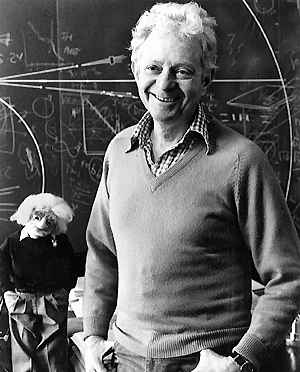
"[Democritus was] the first particle physicist." -- Leon M. Lederman, physicist, The God Particle, 2006
"... even for a genius, Democritus was far ahead of his time." -- Leon M. Lederman, physicist, The God Particle, 2006
"He [Democritus] is probably best known for two of the most scientifically intuitive quotes ever uttered by an ancient: 'Nothing exists except atoms and space, everything else is opinion'....." -- Leon M. Lederman, physicist, The God Particle, 2006
"Democritus's work on the void was revolutionary." -- Leon M. Lederman, physicist, The God Particle, 2006
"Democritus's notion is compatible with our present belief." -- Leon M. Lederman, physicist, The God Particle, 2006
"The British philosopher Bertrand Russell said that philosophy went downhill after Democritus and did not recover until the Renaissance." -- Leon M. Lederman, physicist, The God Particle, 2006
"Where do we stand today compared to Greece circa 400 B.C.? Today's experiment-driven 'standard model' is not all that dissimilar to Democritus's speculative [sic] atomic theory." -- Leon M. Lederman, physicist, The God Particle, 2006
Saturday, September 11, 2010
The Expanding Earth in The Avesta and Democritus

"Then Yima stepped forward, towards the luminous space, southwards, to meet the sun, and (afterwards) he pressed the earth with the golden ring, and bored it with the poniard, speaking thus: 'O Spenta Ârmaiti, kindly open asunder and stretch thyself afar, to bear flocks and herds and men.' And Yima made the earth grow larger by one-third than it was before ...." -- Avesta, Vendidad, Fargard II, 1000 B.C.
"Then Yima stepped forward, towards the luminous space, southwards, to meet the sun, and (afterwards) he pressed the earth with the golden ring, and bored it with the poniard, speaking thus: 'O Spenta Ârmaiti, kindly open asunder and stretch thyself afar, to bear flocks and herds and men.' And Yima made the earth grow larger by two-thirds than it was before ...." -- Avesta, Vendidad, Fargard II, 1000 B.C.
"Then Yima stepped forward, towards the luminous space, southwards, to meet the sun, and (afterwards) he pressed the earth with the golden ring, and bored it with the poniard, speaking thus: 'O Spenta Ârmaiti, kindly open asunder and stretch thyself afar, to bear flocks and herds and men.' And Yima made the earth grow larger by three-thirds than it was before ...." -- Avesta, Vendidad, Fargard II, 1000 B.C.
"There is no doubt that this art [magic] originated in Persia under Zoroaster, this being a point upon which authors are generally agreed; but whether there was only one Zoroaster, or whether in later times there was a second person of that name, is a matter which still remains undecided. Eudoxus, who has endeavored to show that of all branches of philosophy the magic art is the most illustrious and the most beneficial, informs us that this Zoroaster existed six thousand years before the death of Plato, an assertion in which he is supported by Aristotle. Hermippus, again, an author who has written with the greatest exactness on all particulars connected with this art, and has commented upon the two millions of verses left by Zoroaster, besides completing indexes to his several works, has left a statement, that Agonaces was the name of the master from whom Zoroaster derived his doctrines, and that he lived five thousand years before the time of the Trojan War." -- Pliny the Elder, historian, Natural History, XXX, 77
"The first person, so far as I can ascertain, who wrote upon magic, and whose works are still in existence, was Osthanes, who accompanied Xerxes, the Persian king, in his expedition against Greece. It was he who first disseminated, as it were, the germs of this monstrous art, and tainted therewith all parts of the world through which the Persians passed." -- Pliny the Elder, historian, Natural History, XXX, 77
"That it was this same Osthanes, more particularly, that inspired the Greeks, not with a fondness only, but a rage, for the art of magic, is a fact beyond all doubt: though at the same time I would remark, that in the most ancient times, and indeed almost invariably, it was in this branch of science, that was sought the highest point of celebrity and of literary renown. At all events, Pythagoras, we find, Empedocles, Democritus, and Plato, crossed the seas, in order to attain a knowledge thereof, submitting, to speak the truth, more to the evils of exile than to the mere inconveniences of travel. Returning home, it was upon the praises of this art that they expatiated—it was this that they held as one of their grandest mysteries. It was Democritus, too, who first drew attention to Apollobeches of Coptos, to Dardanus, and to Phœnix: the works of Dardanus he sought in the tomb of that personage, and his own were composed in accordance with the doctrines there found. That these doctrines should have been received by any portion of mankind, and transmitted to us by the aid of memory, is to me surprising beyond anything I can conceive. All the particulars there found are so utterly incredible, so utterly revolting, that those even who admire Democritus in other respects, are strong in their denial that these works were really written by him. Their denial, however, is in vain; for it was he, beyond all doubt, who had the greatest share in fascinating men's minds with these attractive chimeras." -- Pliny the Elder, historian, Natural History, XXX, 77
"He [Democritus] said that the ordered worlds are boundless and differ in size, and that in some there is neither sun nor moon, but that in others, both are greater than with us, and yet with others more in number. And that the intervals between the ordered worlds are unequal, here more and there less, and that some increase, others flourish and others decay, and here they come into being and there they are eclipsed. But that they are destroyed by colliding with one another. And that some ordered worlds are bare of animals and plants and all water." -- Hippolytus, priest, Refutation of All Heresies, 2nd century
"He [Democritus] was a pupil of some of the Magi and Chaldaeans, whom Xerxes had left with his father as teachers, when he had been hospitably received by him, as Herodotus [Metrodorus] informs us; and from these men he, while still a boy, learned the principles of astronomy and theology. Afterwards, his father entrusted him to Leucippus, and to Anaxagoras, as some authors assert, who was forty years older than he." -- Diogenes Laertius, historian, Life of Democritus, 3rd century
"The oldest authors quoted by the alchemical manuscripts, Democritus, Ostanes, also appear as magicians and astrologers in Columelle, Pliny and the writers of antiquity." -- Marcellin Berthelot, chemist, Origins of Alchemy, 1885
Thursday, July 15, 2010
Scientists Rediscover Pythagoras/Democritus/Velikovsky

"Some of the Italians called Pythagoreans say that the comet is one of the planets [Venus]." -- Aristotle, philosopher, Meteorology, Book I, 350 B.C.
"Democritus however, insists upon the truth of his view and affirms that certain stars [Venus] have been seen when comets dissolve." -- Aristotle, philosopher, Meteorology, Book I, 350 B.C.
"Venus experienced in quick succession its birth and expulsion under violent conditions; an existence as a comet on an ellipse which approached the sun closely; two encounters with the earth accompanied by discharges of [electric] potentials between these two bodies and with a thermal effect caused by conversion of momentum into heat; a number of contacts with Mars, and probably also with Jupiter. Since all this happened between the third and first millennia before the present era, the core of the planet Venus must still be hot." -- Immanuel Velikovsky, polymath, 1950
Science Daily: Super-Hot Planet With Unique [sic] Comet-Like Tail Discovered [sic].
ScienceDaily (July 15, 2010) — Astronomers using NASA's Hubble Space Telescope have confirmed the existence of a baked object that could be called a "cometary planet." The gas giant planet, named HD 209458b, is orbiting so close to its star that its heated atmosphere is escaping into space.
Wednesday, June 23, 2010
Democritus and the Ancient Telescopes of Babylon

"Anaxagoras, Democritus, and their schools say that the milky way is the light of certain stars." -- Aristotle, philosopher, Meteorology, Book I, 350 B.C.
"Of the Galaxy or the Milky Way: It is a cloudy circle, which continually appears in the air, and by reason of the whiteness of its colors is called the galaxy, or the milky way. Some of the Pythagoreans say that, when Phaeton set the world on fire, a star falling from its own place in its circular passage through the region caused an inflammation. ... Democritus [said], that it is the splendor which ariseth from the coalition of many small bodies, which, being firmly united amongst themselves, do mutually enlighten one another." -- Plutarch, historian, On the Opinions of the Philosophers, Book III, 1st century
"He [Democritus] said that the ordered worlds are boundless and differ in size, and that in some there is neither sun nor moon, but that in others, both are greater than with us, and yet with others more in number. And that the intervals between the ordered worlds are unequal, here more and there less, and that some increase, others flourish and others decay, and here they come into being and there they are eclipsed. But that they are destroyed by colliding with one another. And that some ordered worlds are bare of animals and plants and all water." -- Hippolytus, priest, The Refutation of All Heresies, 2nd century
"He [Democritus] was a pupil of some of the Magi and Chaldaeans, whom Xerxes had left with his father as teachers, when he had been hospitably received by him, as Herodotus [Metrodorus] informs us; and from these men he, while still a boy, learned the principles of astronomy and theology." -- Diogenes Laertius, historian, Life of Democritus, 3rd century
"... sight is made precise by the compass, rule, and telescope." -- Iamblichus, philosopher, Life of Pythagoras, 3rd century
"It is reported that Democritus the Abderite was wise, besides other things, in desiring to live unknown, and that he wholly endeavoured it. In pursuit whereof he travelled to many Countries; he went to the Chaldæans, and to Babylon, and to the Magi, and to the Indian Sophists. When the estate of his Father Damasippus was to be divided into three parts amongst the three Brothers, he took onely so much as might serve for his travel, and left the rest to his Brethren. For this Theophrastus commends him, that by travelling he had gained better things than Menelaus and Ulysses." -- Aelian, historian, Various History, Book IV, Chapter XX, 3rd century
"Greater things than these may be performed by refracted vision. For it is easy to see by the canons above mentioned that the greatest objects may appear exceedingly small, and the contrary, also that the most remote objects may appear just at hand, and the converse; for we can give such figures to transparent bodies, and dispose them in such order with respect to the eye and the objects, that the rays shall be refracted and bent towards any place we please, so that we shall see the object near at hand or at any distance under any angle we please. And thus from an incredible distance we may read the smallest letters, and may number the smallest particles of dust and sand, by reason of the greatness of the angle under which we see them. ... Thus also the sun, moon, and stars may be made to descend hither in appearance, and to be visible over the heads of our enemies, and many things of the like sort, which persons unacquainted with such things would refuse to believe." -- Roger Bacon, natural philosopher, Opus Majus, 1267
"[Roger Bacon] did perfectly understand all kinds of optic glasses, and knew likewise the method of combining them so as to compose some such instrument as our telescope." -- William Molyneux, natural philosopher, Dioptrica Nova, 1692
"If this steel mirror [the Pharos of Alexandria] did really exist we cannot refuse to the ancients the glory of the first invention [of the telescope], for this mirror can be only effected by as much as the light reflected by its surface was collected by another concave mirror placed at its focus, and in this consists the essence of the telescope and the merit of its construction." -- Georges-Louis Leclerc, Comte de Buffon, historian, Natural History, 1749–88
"Some modern writers deny the fact that a great mirror was placed in the light-house of the Alexandrian port for the purpose of discovering vessels at a distance at sea. But the renowned [French historian] Buffon believed in it; for he honestly confesses that 'If the mirror really existed, as I firmly believe it did, to the ancients belong the honor of the invention of the telescope.'" -- Helena P. Blavatsky, theosophist, Isis Unveiled, 1877
"The credit of the discovery of the telescope has been a fruitful subject of discussion. Thus, because Democritus announced that the Milky Way is composed of vast multitudes of stars, it has been maintained that he could only have been led to form such an opinion from actual examination of the heavens with a telescope. Other passages from the Greek and Latin authors have similarly been cited to prove that the telescope was known to the ancients." -- Encyclopaedia Britannica 1888, 1893, & 1911
"The Chaldeans must have understood the manufacture of the telescope, for [Austen H.] Layard reported the discovery of a lens of power in the ruins of Babylon. Nero the emperor of Rome had optical glasses from the east." -- Drusilla D. Houston, historian, Wonderful Ethiopians of the Ancient Cushite Empire, Chapter XIII: The Civilization of Babylonia, 1926
"Thomas Wright marveled in 1750 that Democritus had believed the Milky Way to be composed mainly of unresolved stars: 'long before astronomy reaped any benefit from the improved sciences of optics; [he] saw, as we may say, through the eye of reason, full as far into infinity as the most able astronomers in more advantageous times have done since.'" -- Carl Sagan, professor, Cosmos, 1980
"Galileo always insisted that the ancients had telescopes." -- Ivan Van Sertima, historian, Blacks In Science: Ancient and Modern, The Lost Sciences of Africa: An Overview, 1983
"It is a short and simple step to place one lens in front of another to make a telescope, and the chances are it could have happened and many times." -- Hunter H. Adams III, archaeoastronomer, African Observers of the Universe: The Sirius Question, 1983
"The ancients apparently used the telescope long before Pythagoras's time." -- Larry B. Radka, historian, Telescopes and the Ancients, 2010
George Rawlinson: The Seven Great Monarchies of the Eastern World, Volume 4: Babylon, 1862-67
There is said to be distinct evidence that they [Babylonians] observed the four satellites of Jupiter, and strong reason to believe that they were acquainted likewise with the seven satellites of Saturn.Last year I got into a big argument with Paul Cartledge and one of his stooges James Warren over the issue of Democritus's unbelievably precise cosmology. Professor i.e. Sophist Paul Cartledge wrote to me in a personal email, "D's views- all his views - were purely theoretical and in no way empirically based or tested." To which I gave an Abderite LOL. According to them, Democritus was unable to observe because he lived before 1608 and therefore the greatest lucky guesser who ever walked the face of the Earth. Absurd and absolutely ridiculous. And they fancy themselves scholars. Pity.
... strange as it may seem to us ... the Babylonians possessed optical instruments of the nature of telescopes, since it is impossible, even in the clear and vapor-less sky of Chaldaea, to discern the faint moons of that distant planet [Saturn] without lenses. A lens, it must be remembered, with a fair magnifying power, has been discovered amongst the Mesopotamian ruins.
Saturday, November 14, 2009
Democritus's Steady State Vs. Plato's Big Bang

There is not much new in cosmology as far as I can tell.
"... so far as time is concerned we see that all with one exception are in agreement in saying that it is uncreated: in fact, it is just this that enables Democritus to show that all things cannot have had a becoming: for time, he says, is uncreated. Plato alone asserts the creation of time, saying that it had a becoming together with the universe, the universe according to him having had a becoming." -- Aristotle, Physics, Book VIII, 350 B.C.
Plato's response is customary for Big Bangers:
"And Aristoxenus, in his Historic Commentaries, says that Plato wished to burn all the writings of Democritus that he was able to collect; but that Amyclas and Cleinias, the Pythagoreans, prevented him, as it would do no good; for that copies of his books were already in many hands. And it is plain that that was the case; for Plato, who mentions nearly all the ancient philosophers, nowhere speaks of Democritus; not even in those passages where he has occasion to contradict his theories, evidently, because he said that if he did, he would be showing his disagreement with the best of all philosophers...." -- Diogenes Laertius, historian, 3rd century
Sunday, November 8, 2009
Anaxilaus of Larissa

"The vapor of burning sulphur, and the light of a lamp fed by a particular unctuous substance, were made use of by Anaxilaus of Larissa to work various apparent miracles, which are referable not so much to magic, as to real experiments in physics." -- Eusèbe Salverte, philosopher, 1847
"Anaxilaus had composed a book quoted by Saint Ireneus and Saint Epiphanes, and entitled παίηνια [Tricks]." -- Eusèbe Salverte, philosopher, 1847
"... he [Anaxilaus of Larissa] was banished from Italy, by the order of Augustus, for the crime of magic." -- Joseph Banvard, historian, 1855
"Thus it seems that Anaxilaus believed that Democritus was involved in the imitation of silver...." -- Jackson P. Hershbell, professor, March 1987
"Under the year 28 BC Jerome reports the expulsion from Rome and Italy by Augustus of the Pythagorean and magus, Anaxilaus of Larissa." -- Matthew Dickie, historian, 2003
"What is positively known about the man [Anaxilaus of Larissa] is that he put together a collection of spells of an amusing character such as would entertain those present at a drinking-party. They were like the Tricks of Democritus called by the Greek name of Paignia [Paienia]. Irenaeus, Bishop of Lugdunum (Lyon) in the latter half of the second century AD, accuses the Gnostic heresiarch Marcus of using conjuring-tricks from the Paignia of Anaxilaus to impress his followers." -- Matthew Dickie, historian, 2003
"... by Pliny's time Anaxilaus' collection of what were essentially conjuring-tricks was circulating under the title of Paignia [Tricks]. It is virtually certain that Anaxilaus will have given that title to his work." -- Matthew Dickie, historian, 2003
"He [Anaxilaus of Larissa] will have presented himself as a Pythagorean and will have displayed the outward trappings of membership in the sect, the black cloak and linen garments and shoes. It is frustrating that we know nothing of the philosophy of those Pythagoreans like Anaxilaus with a leaning towards the occult. All that can be said of Anaxilaus is that he represents a version of Pythagoreanism that goes back at least to Bolus of Mendes and almost certainly further. Anaxilaus' expulsion not only from Rome but also from Italy in 28 BC in the year in which the new Augustan dispensation came into place suggests that his activities went rather beyond putting together a collection of conjuring-tricks designed to amuse the guests at a symposium, but what he had been doing is a mystery." -- Matthew Dickie, historian, 2003
Encyclopaedia Britannica (1902): Anaxilaus of Larissa.
Anaxilaus of Larissa, a physician and Pythagorean philosopher, was banished from Rome by Augustus, B.C. 28, on the charge of practicing the magic art. This accusation appears to have originated in his superior skill in natural philosophy, by which he produced effects the ignorant attributed to magic. (Euseb., Chron. ad Olymp. clxxxviii; St Iren. i. 13; Plin. xix. 4, xxviii. 49, xxxii. 52, xxxv. 50.)
Pliny On Democritus's "Magic" Science

I had no idea that atoms are magical.
"Democritus too, composed a similar work [Causes Affecting Seeds, Plants, and Fruits]. Both of these philosophers [Pythagoras and Democritus] had visited the magicians of Persia, Arabia, Ethiopia, and Egypt, and so astounded were the ancients at their recitals, as to learn to make [scientific] assertions which transcend all belief." -- Pliny the Elder, historian, 77
"There is no doubt that this art [magic] originated in Persia under Zoroaster, this being a point upon which authors are generally agreed; but whether there was only one Zoroaster, or whether in later times there was a second person of that name, is a matter which still remains undecided. Eudoxus, who has endeavored to show that of all branches of philosophy the magic art is the most illustrious and the most beneficial, informs us that this Zoroaster existed six thousand years before the death of Plato, an assertion in which he is supported by Aristotle. Hermippus, again, an author who has written with the greatest exactness on all particulars connected with this art, and has commented upon the two millions of verses left by Zoroaster, besides completing indexes to his several works, has left a statement, that Agonaces was the name of the master from whom Zoroaster derived his doctrines, and that he lived five thousand years before the time of the Trojan War." -- Pliny the Elder, historian, 77
"The first person, so far as I can ascertain, who wrote upon magic, and whose works are still in existence, was Osthanes, who accompanied Xerxes, the Persian king, in his expedition against Greece. It was he who first disseminated, as it were, the germs of this monstrous art, and tainted therewith all parts of the world through which the Persians passed." -- Pliny the Elder, historian, 77
"It was Democritus, too, who first drew attention to Apollobeches of Coptos, to Dardanus, and to Phoenix: the works of Dardanus he sought in the tomb of that personage, and his own were composed in accordance with the doctrines there found. That these doctrines should have been received by any portion of mankind, and transmitted to us by the aid of memory, is to me beyond anything I can conceive. All the particulars there found are so utterly incredible, so utterly revolting, that those even who admire Democritus in other respects, are strong in their denial that these works were really written by him. Their denial, however, is in vain; for it was he, beyond all doubt, who had the greatest share in fascinating men's minds with these attractive chimeras." -- Pliny the Elder, historian, 77
"Democritus and the traditions which are attached to him play a key role in the history of the origins of alchemy." -- Marcellin Berthelot, chemist, 1885
"The atomic theory, adopted later by the Epicureans, came to us, and she is still professed today by the majority of chemists. It thus seems that it is by a kind of natural affinity that the alchemists reported their origins to Democritus." -- Marcellin Berthelot, chemist, 1885
"Some regarded the books on magic ascribed to Democritus as spurious, but Pliny insists that they are genuine." -- Lynn Thorndike, historian, 1958
"Any sufficiently advanced technology is indistinguishable from magic." -- Arthur C. Clarke, author, 1973
"Any technology distinguishable from magic is insufficiently advanced." -- Barry Gehm, biochemist, 1973
"What we can say is that magic anticipated modern science and technology." -- Georg Luck, historian, 1985
"If technology is distinguishable from magic, it is insufficiently advanced." -- Gregory Benford, author, 1997
Monday, August 10, 2009
Scientists Confirm Democritus/Velikovsky
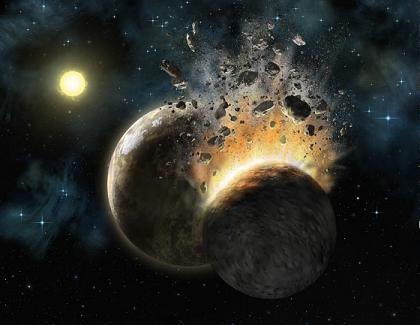
"He [Democritus] said that the ordered worlds are boundless and differ in size, and that in some there is neither sun nor moon, but that in others, both are greater than with us, and yet with others more in number. And that the intervals between the ordered worlds are unequal, here more and there less, and that some increase, others flourish and others decay, and here they come into being and there they are eclipsed. But that they are destroyed by colliding with one another. And that some ordered worlds are bare of animals and plants and all water." -- Hippolytus, priest, 2nd century
2400 years after Democritus, mainstream scientists are finally catching up with 5th century (B.C.) thought.
Clara Moskowitz: Two Worlds Collide in Deep Space. (Hat tip: Jeffery Keown).
Two distant planets orbiting a young star apparently smashed into each other at high speeds thousands of years ago in a cosmic pileup of cataclysmic proportions, astronomers announced Monday.If the universe is over 12 billion years old and there are more than 10 trillion planets, how rare can it be?
Telltale plumes of vaporized rock and lava leftover from the collision revealed its existence to NASA's Spitzer Space Telescope, which picked up signatures from the impact in recent observations.
The two-planet pileup occurred within the last few thousand years or so - a relatively recent cosmic timeframe. The smaller of the two bodies - a planet about the size of Earth's moon, according to computer models - was apparently destroyed by the crash. The other was most likely a Mercury-sized-planet and survived, albeit severely dented.
"This collision had to be huge and incredibly high-speed for rock to have been vaporized and melted," said Carey Lisse of the Johns Hopkins University Applied Physics Laboratory in Maryland, lead author of a paper describing the findings in the Aug. 20 issue of the Astrophysical Journal.
Researchers believe the planets were moving at about 22,400 mph (10 kilometers per second) before the crash. The violent wreck released amorphous silica rock, or melted glass, and hardened chunks of lava called tektites. Spitzer also spotted large clouds of orbiting silicon monoxide gas created when the rock was vaporized.
"This is a really rare and short-lived event, critical in the formation of Earth-like planets and moons," Lisse said. "We're lucky to have witnessed one not long after it happened."
Sunday, June 21, 2009
Democritus and Buddha?

It seems to me likely that Democritus and Buddha met eachother in India in the 5th century B.C.
Hippolytus says Democritus met with the gymnosophists, naked gurus, in India, which in the 5th century B.C. was none other than Gautama Buddha.
Having gone all the way to India, it is unlikely that Democritus wouldn't have sought out the Buddha himself.
"I have roamed over the most ground of any man of my time, investigating the most remote parts. I have seen the most skies and lands, and I have heard of learned men in very great numbers. And in composition no one has surpassed me; in demonstration, not even those among the Egyptians who are called Arpenodaptae, with all of whom I lived in exile up to eighty years." -- Democritus, polymath, 4th century B.C.
"One need hardly mention Pythagoras, Plato, or Democritus. We are told that their desire for knowledge propelled them to the four corners of the earth. Those who cannot understand this have never loved any great and worthy object of knowledge." -- Marcus T. Cicero, philosopher, 1st century B.C.
"This was Democritus of Abdera, son of Damasippus, who met with many gymnosophists [naked gurus] among the Indians and with priests and astrologers in Egypt and with the Magi in Babylon." -- Hippolytus, priest, Refutation of All Heresies, 2nd century
"He [Democritus] said that the ordered worlds are boundless and differ in size, and that in some there is neither sun nor moon, but that in others, both are greater than with us, and yet with others more in number. And that the intervals between the ordered worlds are unequal, here more and there less, and that some increase, others flourish and others decay, and here they come into being and there they are eclipsed. But that they are destroyed by colliding with one another. And that some ordered worlds are bare of animals and plants and all water." -- Hippolytus, priest, Refutation of All Heresies, 2nd century
"Some also say that he [Democritus] made acquaintance with the gymnosophists [naked gurus] in India, and that he went to Aethiopia." -- Diogenes Laertius, historian, 3rd century
"And Aristoxenus, in his Historic Commentaries, says that Plato wished to burn all the writings of Democritus that he was able to collect; but that Amyclas and Cleinias, the Pythagoreans, prevented him, as it would do no good; for that copies of his books were already in many hands. And it is plain that that was the case; for Plato, who mentions nearly all the ancient philosophers, nowhere speaks of Democritus; not even in those passages where he has occasion to contradict his theories, evidently, because he said that if he did, he would be showing his disagreement with the best of all philosophers...." -- Diogenes Laertius, historian, 3rd century
"... a treatise on the Magnet. These are his [Democritus's] miscellaneous works." -- Diogenes Laertius, historian, 3rd century
"Some authors also give a list of some separate treatises which they collect from his [Democritus's] Commentaries. A treatise on the Sacred Letters seen at Babylon; another on the Sacred Letters seen at Meroe; the Voyage round the Ocean; a treatise on History...." -- Diogenes Laertius, historian, 3rd century
"Expressing this in other terms, the Buddha's period of teaching activity was in the second half of the fifth century B.C. perhaps extending into the first quarter of the fourth century." -- L.S. Cousins, historian, 1996
"As for Democritus, Plato notoriously fails altogether to mention either him or his writings, though (especially in the Timaeus) he arguably betrays knowledge of them, if only indirectly." -- Paul Cartledge, philosopher, 1999
Cousins, L.S., The Dating of the Historical Buddha: A Review Article, Journal of the Royal Asiatic Society, Series 3, 6.1, Pages 57-63, 1996
I took that photograph by the way :P
Wednesday, June 10, 2009
Astronomers Admit Defeat, Plagiarize Democritus/Velikovsky
Newtonian astrologers and scientologists are now hedging against the ignorance of their 17th century religion by admitting defeat.
Democritus/Velikovsky 1 - Newton/Lyell 0.
BBC: 'Tiny chance' of planet collision. (Hat tip: Anaconda via Wattsupwiththat)
Astronomers calculate there is a tiny chance that Mars or Venus could collide with Earth - though it would not happen for at least a billion years.LOL @ astrologers.
The finding comes from simulations to show how orbits of planets might evolve billions of years into the future.
But the calculated chances of such events occurring are tiny.
Writing in the journal Nature, a team led by Jacques Laskar shows there is also a chance Mercury could strike Venus and merge into a larger planet.
Professor Laskar of the Paris Observatory and his colleagues also report that Mars might experience a close encounter with Jupiter - whose massive gravity could hurl the Red Planet out of our Solar System.
Astronomers had thought that the orbits of the planets were predictable.
"Let now the astrologers, the stargazers, the monthly prognosticators, stand up, and save thee from these things that shall come upon thee. Behold, they shall be as stubble; the fire shall burn them; they shall not deliver themselves from the power of the flame...." -- Isaiah 37:13-14
But 20 years ago, researchers showed that there were slight fluctuations in their paths.Worlds In Collision was published in 1950 so that would be 59 years ago, not 20 years ago.
Now, the team has shown how in a small proportion of cases these fluctuations can grow until after several million years, the orbits of the inner planets begin to overlap.
The researchers carried out more than 2,500 simulations. They found that in some, Mars and Venus collided with the Earth.
"It will be complete devastation," said Professor Laskar.
"The planet is coming in at 10km per second - 10 times the speed of a bullet - and of course Mars is much more massive than a bullet."
Professor Laskar's calculations also show that there is a possibility of Mercury crashing into Venus. But in that scenario, the Earth would not be significantly affected.
"If there is anyone around billions of years from now, they'd see a burst of light in the sky and the two planets would be merged," he said.
"The new planet would be a little bit bigger than Venus, and the Solar System would be a little more regular after the collision, but the Earth's orbit would not be affected."
Thursday, February 12, 2009
The Wisdom of Democritus

"He said that the ordered worlds are boundless and differ in size, and that in some there is neither sun nor moon, but that in others, both are greater than with us, and yet with others more in number. And that the intervals between the ordered worlds are unequal, here more and there less, and that some increase, others flourish and others decay, and here they come into being and there they are eclipsed. But that they are destroyed by colliding with one another. And that some ordered worlds are bare of animals and plants and all water." -- Hippolytus, Refutation of All Heresies, "On Democritus"
Democritus lived in the 5th and 4th centuries BC so how could he possibly have known all this?
When I read this quote it blew my mind. Here we get a sense of Democritus's cosmology which, with the exception of the void, is almost identical to my own, e.g. Euclidean, growing Earth, abiotic planets, and catastrophic with worlds in collision (I suspect Velikovsky takes his treatise title Worlds In Collision from this Hippolytus quote).
Democritus had gone to Egypt to study. It is no surprise then that he is lightyears ahead of modern and contemporary scientists.
Subscribe to:
Posts (Atom)








-759725.jpg)