Showing posts with label Pythagoras. Show all posts

Tuesday, February 22, 2011

Hebrew Influence on Greek Philosophy


"And Aristobulus, in his first book addressed to Philometor, writes in these words: 'And Plato followed the [Mosaic] laws given to us, and had manifestly studied all that is said in them.' And before Demetrius there had been translated by another, previous to the dominion of Alexander and of the Persians, the account of the departure of our countrymen the Hebrews from Egypt, and the fame of all that happened to them, and their taking possession of the land, and the account of the whole code of laws; so that it is perfectly clear that the above-mentioned philosopher derived a great deal from this source, for he was very learned, as also Pythagoras, who transferred many things from our books to his own system of doctrines. And Numenius, the Pythagorean philosopher, expressly writes: 'For what is Plato, but Moses speaking in Attic Greek?' This Moses was a theologian and prophet, and as some say, an interpreter of sacred laws. His family, his deeds, and life, are related by the Scriptures themselves, which are worthy of all credit...." -- Clement of Alexandria, theologian, Stromata, Book I, Chapter XXII, 2nd century

"Thales was a Phoenician by birth, and was said to have consorted with the prophets of the Egyptians; as also Pythagoras did with the same persons, by whom he was circumcised...." -- Clement of Alexandria, theologian, Stromata, Book I, Chapter XV, 2nd century

"Clearchus the Peripatetic says that he knew a Jew who associated with Aristotle." -- Clement of Alexandria, theologian, Stromata, Book I, Chapter XV, 2nd century

"Of all these, by far the oldest is the Jewish race; and that their philosophy committed to writing has the precedence of philosophy among the Greeks, the Pythagorean Philo shows at large; and, besides him, Aristobulus the Peripatetic, and several others, not to waste time, in going over them by name. Very clearly the author Megasthenes, the contemporary of Seleucus Nicanor, writes as follows in the third of his books, On Indian Affairs: 'All that was said about nature by the ancients is said also by those who philosophise beyond Greece: some things by the Brahmins among the Indians, and others by those called Jews in Syria.'" -- Clement of Alexandria, theologian, Stromata, Book I, Chapter XV, 2nd century

"... he [Pythagoras] sailed to Sidon, which he knew to be his native country, and because it was on his way to Egypt. In Phoenicia he conversed with the prophets who were the descendants of Moschus [Moses] the physiologist [natural philosopher], and with many others, as well as with the local hierephants. He was also initiated into all the mysteries of Byblus and Tyre, and in the sacred functions performed in many parts of Syria. He was led to all this not from any hankering after superstition as might easily be supposed, but rather from a desire of and love for contemplation, and from an anxiety to miss nothing of the mysteries of the divinities which deserved to be learned. After gaining all he could from the Phoenician mysteries, he found that they had originated from the sacred rites of Egypt, forming as it were an Egyptian colony. This led him to hope that in Egypt itself he might find monuments of erudition still more genuine, beautiful, and divine. Therefore following the advice of his teacher Thales, he left, as soon as possible, through the agency of some Egyptian sailors, who very opportunely happened to land on the Phoenician coast under Mount Carmel, in the temple on the peak of which Pythagoras for the most part dwelt in solitude." -- Iamblichus, philosopher, Life of Pythagoras, 3rd century

"Then Pythagoras visited the Egyptians, the Arabians, the Chaldeans and the Hebrews, from whom he acquired expertery in the interpretation of dreams, and he was the first to use frankincense in the worship of divinities." -- Porphyry, philosopher, Life of Pythagoras, 3rd century

Eusebius of Caesaria, theologian, Preparation for the Gospel, Book IX, Chapters V-VIII, 313:
CHAPTER V

[JOSEPHUS] 'BUT Clearchus the Peripatetic philosopher, in his first book Concerning Sleep, attributes to Aristotle the philosopher a statement such as follows concerning the Jews, writing word for word thus:

'But though it would be too long to tell the greater part, it will not be amiss to go through those of his statements which are alike marvellous and philosophical. Now, said he, understand clearly, Hyperochides, I shall seem to you to relate what is as marvellous as dreams. Then Hyperochides modestly replied, Yes, that is the very reason why we all desire to hear it.

'Well then, said Aristotle, according to the rule of the rhetoricians, let us first describe the man's origin, that we may not disobey the teachers of the narrative style.

'Tell it so, if you please, said Hyperochides.

'Well then, the man was by origin a Jew, from Coele-Syria. Now these are descendants of the philosophers of India; and philosophers, it is said, are called among the Indians Calani, but among the Syrians they are called Judaeans, having taken their name from the place. For the place which they inhabit is called Judaea: and the name of their city is very awkward, for they call it Hierusalem.

'This man then, who was hospitably entertained by many on his way down from the inland districts to the sea-coasts, was Greek not only in language but also in spirit. And as at that time we were dwelling in Asia, the man having landed in the same neighbourhood fell into conversation with us and some others of the studious sort, to make trial of their wisdom. And as he had lived in intimacy with many of the learned, he imparted somewhat more than he received.'

Such is the story of Clearchus.

CHAPTER VI

THIS man is mentioned also by our Clement in his first Miscellany, in what he says as follows:

[CLEMENT] 'Clearchus the Peripatetic says that he knew a Jew who associated with Aristotle.'

And afterwards he adds:

'But Numa the king of the Romans, though he was a Pythagorean, received benefit from the teaching of Moses, and forbade the Romans to make an image of God in the shape of man or any animal. So in the first hundred and seventy years, though they built themselves temples, they made no image, neither in sculpture nor yet in painting.

'For Numa used to teach them in secret, that it was not possible for the Perfect Good to be reached by language, but only by the mind.'

Further than this, in what follows below, he speaks thus:

'But most plainly does Megasthenes, the historian who lived with Seleucus Nicator, write as follows in his third book On Indian Affairs.

'All that has been said about nature among the ancients is said also among the philosophers outside Greece, partly among the Indians by the Brachmans, and partly in Syria by those who are called Jews.'

Besides this Clement also mentions Aristobulus the Peripatetic and Numenius the Pythagorean, saying:

'Aristobulus, in his first book addressed to Philometor, writes in these words: Plato too has followed our legislation, and has evidently studied carefully the several precepts contained in it.

'And others before Demetrius, and prior to the supremacy of Alexander and of the Persians, have translated both the narrative of the Exodus of our fellow countrymen the Hebrews from Egypt, and the fame of all that happened to them, and their conquest of the land, and the exposition of the whole Law.

'So it is perfectly clear that the philosopher before-mentioned has borrowed much, for he is very learned; as also was Pythagoras, who transferred many of our precepts into his own system of doctrines.

'And Numenius, the Pythagorean philosopher, writes expressly: "For what is Plato, but Moses speaking in Attic Greek?" '

So far Clement.

CHAPTER VII

ALSO from the Pythagorean philosopher himself, I mean Numenius, I will quote as follows from his first book On the Good:

[NUMENIUS] 8 'But when one has spoken upon this point, and sealed it by the testimonies of Plato, it will be necessary to go back and connect it with the precepts of Pythagoras, and to appeal to the nations of good repute, bringing forward their rites and doctrines, and their institutions which are formed in agreement with those of Plato, all that the Brachmans, and Jews, and Magi, and Egyptians arranged.'

So much then on these points.

CHAPTER VIII

ALSO in his third book the same author makes mention of Moses, speaking as follows:

'And next in order came Jannes and Jambres, Egyptian sacred scribes, men judged to have no superiors in the practice of magic, at the time when the Jews were being driven out of Egypt.

'So then these were the men chosen by the people of Egypt as fit to stand beside Musaeus, who led forth the Jews, a man who was most powerful in prayer to God; and of the plagues which Musaeus brought upon Egypt, these men showed themselves able to disperse the most violent.'

Now by these words Numenius bears witness both to the marvellous wonders performed by Moses, and to Moses himself as having been beloved of God.

Tuesday, August 17, 2010

Sir Isaac Newton On Astrolatry and the Electric Universe


"He [Thales] held the sun and the planets for Gods. And in the same sense Pythagoras, on account of its immense force of attraction, said that the Sun was a prison of Zeus [Jupiter], that is, a body possessed of the greatest circuits. And to the mystical philosophers, Pan was the supreme divinity insipiring this world with harmonic ratio like a musical instrument and handling it with modulation, according to that saying of Orpheus 'striking the harmony of the world in playful song.'" -- Isaac Newton, mathematician, 1690

Thursday, July 15, 2010

Scientists Rediscover Pythagoras/Democritus/Velikovsky


"Some of the Italians called Pythagoreans say that the comet is one of the planets [Venus]." -- Aristotle, philosopher, Meteorology, Book I, 350 B.C.

"Democritus however, insists upon the truth of his view and affirms that certain stars [Venus] have been seen when comets dissolve." -- Aristotle, philosopher, Meteorology, Book I, 350 B.C.

"Venus experienced in quick succession its birth and expulsion under violent conditions; an existence as a comet on an ellipse which approached the sun closely; two encounters with the earth accompanied by discharges of [electric] potentials between these two bodies and with a thermal effect caused by conversion of momentum into heat; a number of contacts with Mars, and probably also with Jupiter. Since all this happened between the third and first millennia before the present era, the core of the planet Venus must still be hot." -- Immanuel Velikovsky, polymath, 1950

Science Daily: Super-Hot Planet With Unique [sic] Comet-Like Tail Discovered [sic].

ScienceDaily (July 15, 2010) — Astronomers using NASA's Hubble Space Telescope have confirmed the existence of a baked object that could be called a "cometary planet." The gas giant planet, named HD 209458b, is orbiting so close to its star that its heated atmosphere is escaping into space.

Monday, February 8, 2010

Mike Tyson: Philosophy of a Spiritual Warrior


"... Eratosthenes says, as Favorinus quotes him, in the eighth book of his Universal History, that this philosopher, of whom we are speaking [Pythagoras], was the first [Greek] man who ever practised boxing in a scientific manner, in the forty-eighth Olympiad...." -- Diogenes Laertius, historian, Lives and Opinions of Eminent Philosophers: Pythagoras, 3rd century

"But you really have to look at the science of the situation." -- Michael J. Tyson, philosopher pugilist, May 1st 2002

"Everybody says they believe in God but they don't do God's work. Everybody counteracts what God is really about." -- Michael J. Tyson, philosopher pugilist, May 1st 2002

"Cus D'Amato was a physical person like I am. He was impulsive and impetuous like me. If somebody upset him, he would just go after them — even at 75. God, the psychologists would've had a field day with him." -- Michael J. Tyson, philosopher pugilist, June 13th 2005

"You can disarm (people) with words. I probably have a 20,000 word vocabulary. I'll match my wits with anyone on literature, science, and the arts." -- Michael J. Tyson, philosopher pugilist, June 13th 2005

"Listen, I got a imam, I got a rabbi, I got a priest, I got a reverend — I got 'em all. But I don't want to be holier-than-thou." -- Michael J. Tyson, philosopher pugilist, June 13th 2005

"The past is a glorious moment. Isn't it? The past." -- Michael J. Tyson, philosopher pugilist, 2007

"Cus was different with me than he was with his other fighters. Cus trained me to be totally ferocious in the ring and out." -- Michael J. Tyson, philosopher pugilist, 2008

"Cus D'Amato would watch me for like, he didn't let me box he would just talk to me for like two or three weeks about fighting and the psychology of fighting and what fighting was truely about. Fighting was nothing physical it was all spiritual and he would say if you don't have the spiritual, spiritual warrior in you, you'll never be a good fighter, I don't care how big and strong you are. He explained that to me." -- Michael J. Tyson, philosopher pugilist, 2008

"You know when I used to fight I used to look at myself as being some guy that faught some barbarian tribe or something. Some imperial leader. It was just really crazy stuff my mindset back then." -- Michael J. Tyson, philosopher pugilist, 2008

"Well listen, I know it's gonna sound crazy but the guys that I most admired are guys like Sonny Liston and Jack Dempsey. Because out of all the fighters I watched them, not necessarily as a fighter, but I watched them when they came to the ring. I watched them. I read about their clippings before they fought. And what they had, and George Foreman did as well, but not like these two guys for some reason and that's why they're tied ... they had the ability to have a guy frozen in fear. Where a guy who was a great fighter could no longer perform at the height of his ability because he was so frozen in fear. And as I got older and I read around and I read these books ... and that's the art of war. Intimidation is the art of war. It's an art: intimidation. In intimidation ... you don't have to be a big guy to be intimidating. It's just a persona. It's a conduct in your character. Persona. How you conduct yourself." -- Michael J. Tyson, philosopher pugilist, April 20th 2009

"He [Cus D'Amato] would be very disappointed if I felt some kind of emotion, compassion for somebody, especially if they were somebody with wealth. He said, 'They don't deserve any feelings. They deserve what they get.' ... He was really strange. That household was all about controlling your feelings." -- Michael J. Tyson, philosopher pugilist, October 2009

Thursday, November 12, 2009

The Music of the Spheres


+ Play sound of Saturn's radio emissions, which have changing frequencies.

NASA: Bizarre Sounds of Saturn's Radio Emissions.

Saturn is a source of intense radio emissions, which have been monitored by the Cassini spacecraft. The radio waves are closely related to the auroras near the poles of the planet. These auroras are similar to Earth's northern and southern lights. This is an audio file of Saturn's radio emissions.

The Cassini spacecraft began detecting these radio emissions in April 2002, when Cassini was 374 million kilometers (234 million miles) from the planet, using the Cassini radio and plasma wave science instrument.
"In the same city [Cyzicus] also, there is a stone, known as the 'Fugitive Stone;' the Argonautæ, who used it for the purposes of an anchor, having left it there. This stone having repeatedly taken flight from the Prytanæum, the place so called where it is kept, it has been fastened down with lead." -- Pliny the Elder, historian, 77

"Democritus [said], that there is but one sort of motion, and it is that which is vibratory." -- Plutarch, historian, 1st century

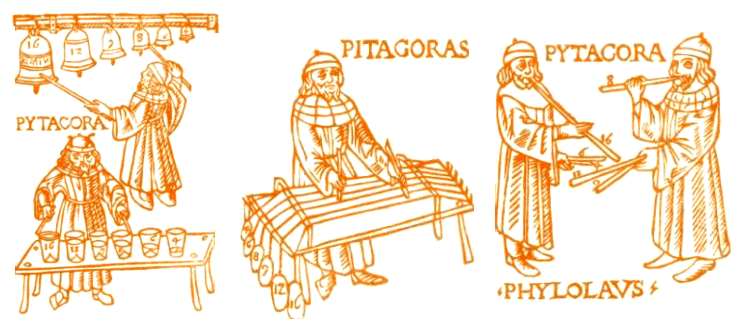
"And he [Pythagoras], after having enquired into physics, combined with it astronomy, geometry, and music." -- Hippolytus, priest, 2nd century

"He [Pythagoras] declared ... that the nature of the cosmos is according to musical harmony, wherefore the sun makes his journey rhythmically." -- Hippolytus, priest, 2nd century

"He [Pythagoras] also discovered the numerical relation of sounds on a single string...." -- Diogenes Laertius, historian, 3rd century

"He himself [Pythagoras] could hear the harmony of the Universe, and understood the universal music of the spheres, and of the stars which move in concert with them, and which we cannot hear because of the limitations of our weak nature. This is testified to by ... Empedocles." -- Porphyry, philosopher, 3rd century

"... to what Agent did the Ancients attribute the gravity of their atoms and what did they mean by calling God an harmony and comparing him & matter (the corporeal part of the Universe) to the God Pan and his Pipe?" -- Isaac Newton, mathematician, 169-

"In 1960, already in 1955, radio noises from Jupiter were detected and this was one of the crucial tests that I offered for the truth of my theory." -- Immanuel Velikovsky, cosmologist, 1966

"Francois Lenormont writes in his Chaldean Magic that by means of sounds the priests of ancient Babylon were able to raise into the air heavy rocks which a thousand men could not have lifted." -- Andrew Tomas, author, 1971

"Babylonian tablets affirm that sound could lift stones. The Bible speaks of Jericho and what sound waves did to it's walls. Coptic writings relate the process by which blocks for the pyramids were elevated by the sound of chanting. However, at the present state of our knowledge we can establish no connection between sound and weightlessness." -- Andrew Tomas, author, 1971

"Our debate ended on Friday, April 8, 1955, only nine days before Einstein’s death. I think I was the last person with whom he discussed a scientific problem. On that day I brought him the published news that Jupiter sends out radio noises; ten months earlier, in a letter to him, I had offered to stake our dispute on this my claim of an as yet undiscovered phenomenon...." -- Immanuel Velikovsky, cosmologist, 1976

"Subsequent experiments conducted by Tom Danley in the King's Chamber of the Great Pyramid and in chambers above the King's Chamber suggest that the pyramid was constructed for a sonic purpose. Danley identifies four resident frequencies, or notes, that are enhanced by the structure of the pyramid, and by the materials used in it's construction. The notes from an F Sharp chord, which according to ancient Egyptian texts were the harmonic of our planet." -- Boris Said, egyptologist, 1996

"Included in the program is a meeting with a Native American maker of sacred flutes from Oregon. His flutes, which are made to serenade Mother Earth, are tuned to the key of F Sharp!" -- Boris Said, egyptologist, 1996

"If I were to try to replicate [Edward] Leedskalnin's feat, I would begin with the premise that he was using his flywheel to generate a single-frequency tunable radio signal. The box at the top of the tripod would contain the radio receiver (there are several tuners in Leedskalnin's workshop), and the cable coming from the box would be attached to a speaker that emitted sound to vibrate the coral rock at it's resonant frequency. With the atoms in the coral vibrating (like those in an iron bar), I would then attempt to flip their magnetic poles -- which are naturally in an attraction orientation with the Earth -- using an electromagnetic field." -- Christopher Dunn, author, 1998

"Recently, granite cores dated to Egypt's pyramid age and examined by American technologist Christopher Dunn have revealed clear signs of being drilled using a form of ultrasonics -- the same technique that powers pneumatic drills today. According to his calculations, the drills employed must have penetrated the granite 500 times faster than the modern diamond-tipped drills. All this is interesting, for there is also evidence that ultrasonic devices were used to disintegrate rock in Tibetan monasteries, while in the nineteenth century a maverick American scientist named John Ernest Worrell Keely developed a sympathetic vibratory apparatus that could raise heavy objects into the air and disintegrate granite. Like the stone cores from Egypt, Keely found that ultrasonics could penetrate quartz much faster than other types of mineral because it so closely matched the ultrasonic frequency range used in this process. This knowledge of ultrasonic drilling in ancient Egypt is a startling revelation, and is yet further evidence that the Pyramid builders were in possession of an advanced technology that came out of nowhere. " -- Andrew Collins, author, 1998

"Was it possible therefore that the world once possessed an understanding of sound that was lost and never recovered?" -- Andrew Collins, author, 1998

"Saturn is a source of intense radio emissions. The radio waves are closely related to the auroras near the poles of the planet. These auroras are similar to Earth's northern and southern lights." -- Bill Kurth, astrophysicist, July 2005

"[Andrew] Collins is also alive to the possibility that the 'Sound Eye' may represent some lost science and technology of sound." -- Joseph P. Farrell, author, 2007

Tuesday, November 10, 2009

Pythagorean Heliocentrism


"... then yonder sun strings these worlds to himself on a thread. Now that thread is the same as the [solar] wind; and that wind is the same as this Vikarnî: thus when he lays down the latter, then yonder sun strings to himself these worlds on a thread." -- Yajnavalkya, gymnosophist, Satapatha Brahmana, 1st millenium B.C.

"Most people -- all, in fact, who regard the whole heaven as finite -- say it [the Earth] lies at the centre. But the Italian philosophers known as Pythagoreans take the contrary view. At the centre, they say, is fire, and the earth is one of the [wandering] stars, creating night and day by its circular motion about the centre." -- Aristotle, philosopher, On The Heavens, 350 B.C.

"And some people, (of whom Satyrus is one,) say that he [Plato] sent a commission to Sicily to Dion, to buy him three books of Pythagoras from Philolaus for a hundred minae; for they say that he was in very easy circumstances, having received from Dionysius more than eighty talents [$1.6 million in 2004], as Onetor also asserts in his treatise which is entitled, Whether a Wise Man Ought to Acquire Gains." -- Diogenes Laertius, historian, 3rd century

"And as he [Pythagoras] was a young man, and devoted to learning, he quitted his country, and got initiated into all the Grecian and barbarian sacred mysteries. Accordingly, he went to Egypt, on which occasion Polycrates gave him a letter of introduction to Amasis; and he learnt the Egyptian language, as Antipho tells us, in his treatise on those men who have been conspicuous for virtue, and he associated with the Chaldeans and with the Magi [i.e. scientists]." -- Diogenes Laertius, historian, 3rd century

"Now, some people say that Pythagoras did not leave behind him a single book; but they talk foolishly; for Heraclitus, the natural philosopher, speaks plainly enough of him, saying, 'Pythagoras, the Son of Mnesarchus, was the most learned of all men in history; and having selected from these writings, he thus formed his own wisdom and extensive learning, and mischievous art.' And he speaks thus, because Pythagoras, in the beginning of his treatise on Natural Philosophy, writes in the following manner: 'By the air which I breathe, and by the water which I drink, I will not endure to be blamed on account of this discourse.'" -- Diogenes Laertius, historian, 3rd century

"... until the time of Philolaus, there were no doctrines of Pythagoras ever divulged; and he [Philolaus] was the first [Greek] person who published the three celebrated books which Plato wrote to have purchased for him for a hundred minae." -- Diogenes Laertius, historian, 3rd century

"Philolaus was a native of Crotona, and a pupil of Pythagoras, it was from him that Plato wrote to Dion to take care and purchase the books of Pythagoras." -- Diogenes Laertius, historian, 3rd century

"He [Philolaus] wrote one book, which Hermippus reports, on the authority of some unknown writer, that Plato the philosopher purchased when he was in Sicily (having come thither to the court of Dionysius), of the relations of Philolaus, for forty Alexandrian minae of silver; and that from this book he copied his Timaeus." -- Diogenes Laertius, historian, 3rd century

"Demetrius, in his treatise on people of the same name, says that he [Philolaus] was the first of the Pythagoreans who wrote a treatise on Natural Philosophy...." -- Diogenes Laertius, historian, 3rd century

"Monsieur Newton croit avoir decouvert assez clairement que les Anciens comme Pythagore, Platon, &c, avoient toutes les demonstrations qu'il donne du veritable Systeme du Monde...." -- Nicolas Fatio de Duiller, mathematician, February 5th 1691/2

"This [heliocentrism] was the philosophy taught of old by Philolaus, Aristarchus of Samos, Plato in his riper years, the whole sect of Pythagoreans, and that wisest king of the Romans, Numa Pompilius." -- Isaac Newton, mathematician, 1694

"This question of measurement is only one example of Newton's faith in the prisca sapientia of Ancient Egypt. He was also convinced that atomic theory, heliocentricity and gravitation had been known there [See McGuire and Rattansi (1966, p. 110)]." -- Martin Bernal, historian, 1987

"There's a tradition of scholarship that was very popular in the Renaissance called the prisca sapientia, the primal wisdom. It claimed that there was a secret wisdom that was first trasmitted by an archetypal figure--say, for example, Moses--and then passed down through the line of successors, usually including Pythagoras, Plato, and so forth, and that this wisdom was really the ultimate tool for understanding the universe. Newton clearly believed that." -- Bill Newman, historian, November 15th 2005

Sunday, November 8, 2009

Anaxilaus of Larissa


"The vapor of burning sulphur, and the light of a lamp fed by a particular unctuous substance, were made use of by Anaxilaus of Larissa to work various apparent miracles, which are referable not so much to magic, as to real experiments in physics." -- Eusèbe Salverte, philosopher, 1847

"Anaxilaus had composed a book quoted by Saint Ireneus and Saint Epiphanes, and entitled παίηνια [Tricks]." -- Eusèbe Salverte, philosopher, 1847

"... he [Anaxilaus of Larissa] was banished from Italy, by the order of Augustus, for the crime of magic." -- Joseph Banvard, historian, 1855

"Thus it seems that Anaxilaus believed that Democritus was involved in the imitation of silver...." -- Jackson P. Hershbell, professor, March 1987

"Under the year 28 BC Jerome reports the expulsion from Rome and Italy by Augustus of the Pythagorean and magus, Anaxilaus of Larissa." -- Matthew Dickie, historian, 2003

"What is positively known about the man [Anaxilaus of Larissa] is that he put together a collection of spells of an amusing character such as would entertain those present at a drinking-party. They were like the Tricks of Democritus called by the Greek name of Paignia [Paienia]. Irenaeus, Bishop of Lugdunum (Lyon) in the latter half of the second century AD, accuses the Gnostic heresiarch Marcus of using conjuring-tricks from the Paignia of Anaxilaus to impress his followers." -- Matthew Dickie, historian, 2003

"... by Pliny's time Anaxilaus' collection of what were essentially conjuring-tricks was circulating under the title of Paignia [Tricks]. It is virtually certain that Anaxilaus will have given that title to his work." -- Matthew Dickie, historian, 2003

"He [Anaxilaus of Larissa] will have presented himself as a Pythagorean and will have displayed the outward trappings of membership in the sect, the black cloak and linen garments and shoes. It is frustrating that we know nothing of the philosophy of those Pythagoreans like Anaxilaus with a leaning towards the occult. All that can be said of Anaxilaus is that he represents a version of Pythagoreanism that goes back at least to Bolus of Mendes and almost certainly further. Anaxilaus' expulsion not only from Rome but also from Italy in 28 BC in the year in which the new Augustan dispensation came into place suggests that his activities went rather beyond putting together a collection of conjuring-tricks designed to amuse the guests at a symposium, but what he had been doing is a mystery." -- Matthew Dickie, historian, 2003

Encyclopaedia Britannica (1902): Anaxilaus of Larissa.

Anaxilaus of Larissa, a physician and Pythagorean philosopher, was banished from Rome by Augustus, B.C. 28, on the charge of practicing the magic art. This accusation appears to have originated in his superior skill in natural philosophy, by which he produced effects the ignorant attributed to magic. (Euseb., Chron. ad Olymp. clxxxviii; St Iren. i. 13; Plin. xix. 4, xxviii. 49, xxxii. 52, xxxv. 50.)

Friday, November 6, 2009

Did Pythagoras Fly?


"Abaris was called Aethrobates, the walker in air; for he was carried in the air on an arrow of the Hyperborean Apollo, over rivers, seas and inaccessible places. It is believed that this was the method employed by Pythagoras when on the same day he discoursed with his friends at Metapontum and Tauromenium." -- Porphyry, philosopher, 3rd century

"Flying machines as these were of old, and are made even in our day." -- Roger Bacon, natural philospher, 1260

"... flying through the air by magic has has now become reality...." -- Georg Luck, historian, 1985

"Iamblichus presents Pythagoras as a soul sent from the gods to enlighten mankind (O'Meara 1989, 35-40)." -- Carl Huffman, historian, 2005

"Porphyry also emphasizes Pythagoras' divine aspects and may be setting him up as a rival to Jesus (Iamblichus 1991, 14)." -- Carl Huffman, historian , 2005

Thursday, November 5, 2009

Prisca Sapientia: Primal Wisdom


"Monsieur Newton croit avoir decouvert assez clairement que les Anciens comme Pythagore, Platon, &c, avoient toutes les demonstrations qu'il donne du veritable Systeme du Monde...." -- Nicolas Fatio de Duiller, mathematician, February 5th 1691/2

"This [heliocentrism] was the philosophy taught of old by Philolaus, Aristarchus of Samos, Plato in his riper years, the whole sect of Pythagoreans, and that wisest king of the Romans, Numa Pompilius." -- Isaac Newton, mathematician, 1694

"...the Egyptians...concealed mysteries that were above the common herd under the veil of religious rites and hieroglyphic symbols." -- Isaac Newton, mathematician, 1694

"...the Corpus Hermeticum -- Greek and Latin translations of supposedly ancient Egyptian concepts -- Newton regarded the stream of such writings as an expression of the prisca sapientia, as it was called in Renaissance times, i.e., the wisdom of the ancients." -- I.M. Oderberg, writer, 1986

"This question of measurement is only one example of Newton's faith in the prisca sapientia of Ancient Egypt. He was also convinced that atomic theory, heliocentricity and gravitation had been known there [See McGuire and Rattansi (1966, p. 110)]." -- Martin Bernal, historian, 1987

"There's a tradition of scholarship that was very popular in the Renaissance called the prisca sapientia, the primal wisdom. It claimed that there was a secret wisdom that was first transmitted by an archetypical figure—say, for example, Moses—and then passed down through a line of successors, usually including Pythagoras, Plato, and so forth, and that this wisdom was really the ultimate tool for understanding the universe. Newton clearly believed that." -- Bill Newman, historian, November 15th 2005

MathPages.Com: Prisca Sapientia.

It's ironic that most of the men who participated in the "scientific revolution", whose contributions seem (to us) so original and innovative, were themselves convinced that they were merely re-discovering the vast body of pristine knowledge (prisca sapientia) that had been possessed by the ancients, but somehow lost and forgotten during the centuries that came to be called the "dark ages" of western civilization. This was not an entirely unreasonable belief, because the great works, both material and intellectual, of the classical civilizations were (and to some extent still are) very imposing. The intellectual culture of Western Europe really did decline during the fall of Rome, and the institutions for preserving and passing along knowledge, as well as the inclination to do so, were severely diminished. Then, after so long an absence, when the ancient texts were re-discovered, the scholars of the Renasiance and later periods were acutely aware of their intellectual inferiority vis-a-vis "the ancients". Also, the fact that many of the ancient texts were now available only in fragmentary form, often in third-hand translations, and many of the references were to works totally unknown and presumably lost, contributed to the impression that the ancients had known far MORE, if we could only find it out.

This attitude toward the past is, in some ways, the exact opposite of our usual view today, which is of a totally ordered sequence of eras progressing from less knowledge in the past to more knowledge in the future. It's hard for us to imagine, today, the intellectual climate among people who believed (knew) they were scientifically and mathematically inferior to their ancestors in the distant past.
Well, it's not hard for me anyway. I recognize the ancients were centuries (if not millenia) more scientifically and technologically advanced than we are today.