Showing posts with label Earth Expansion. Show all posts

Thursday, March 19, 2009

The Myth of Rising Sea Levels


Via Watts Up With That?: Despite popular opinion and calls to action, the Maldives are not being overrun by sea level rise.

No spot in the Maldives is more than six feet above sea level. ...

The Maldives, a strand of coral atolls south of India, is just about the most tenuous country on Earth. No patch of land in the island chain, where the population has risen from 200,000 to 400,000 in the last 25 years, is more than six feet or so above sea level. Even modest projections for a rise in sea level from global warming would increase flooding from storm surges. A higher rise could render hundreds of islands uninhabitable. ...

So it boils down to this: Who would you rather believe? People doing studies on-site and gathering photographic evidence that shows clear geologic actions of lowered sea levels on the islands, or somebody sitting in an office analyzing and doing regressions on tide gauge data
The Maldives are not submerged nor are they submerging.

As a matter of fact, the sea level is receding as the Earth expands.

Ostia, aka Portus Romanus, the main seaport of Ancient Rome, is now 2 miles inland with no access to the sea.

In New Jersey, new land exposed by the receding sea is sold to the highest bidder.

And the only thing submerged in the Maldives is Ithaa at the Conrad.


Amazing what a little intelligent design can do.

Thursday, December 11, 2008

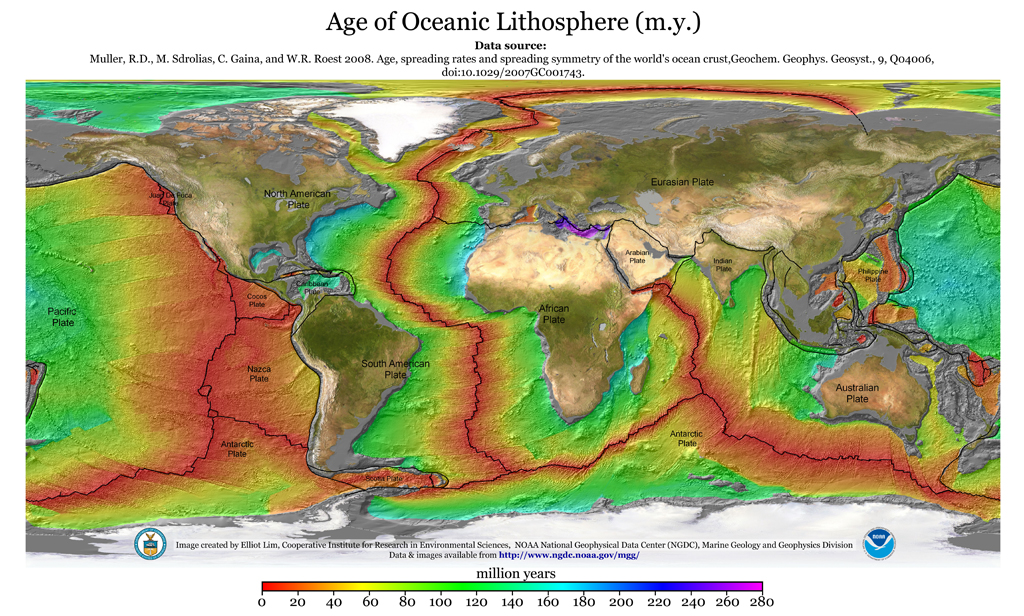
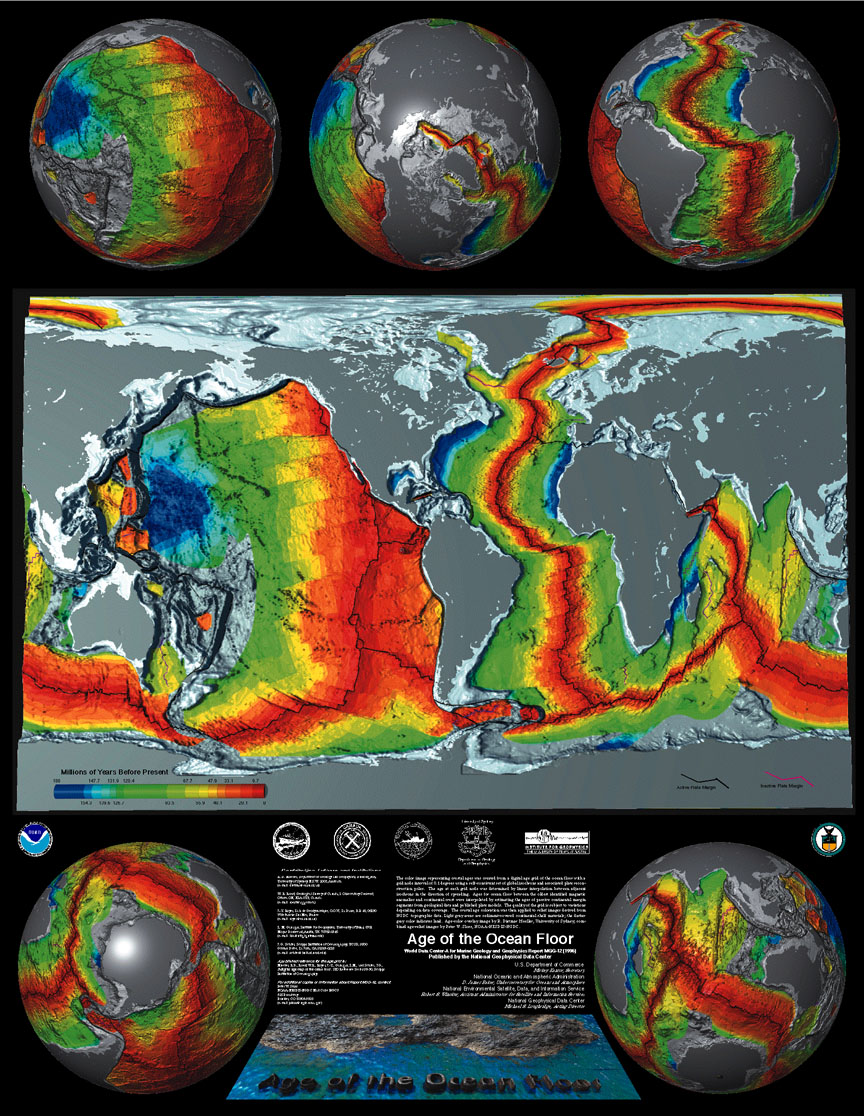
Earth Expansion Observed At Continental Rift


Calais, et al.: Strain accommodation by slow slip and dyking in a youthful continental rift, East Africa.

Continental rifts begin and develop through repeated episodes of faulting and magmatism, but strain partitioning between faulting and magmatism during discrete rifting episodes remains poorly documented. In highly evolved rifts, tensile stresses from far-field plate motions accumulate over decades before being released during relatively short time intervals by faulting and magmatic intrusions1, 2, 3. These rifting crises are rarely observed in thick lithosphere during the initial stages of rifting. Here we show that most of the strain during the July–August 2007 seismic crisis in the weakly extended Natron rift, Tanzania, was released aseismically. Deformation was achieved by slow slip on a normal fault that promoted subsequent dyke intrusion by stress unclamping. This event provides compelling evidence for strain accommodation by magma intrusion, in addition to slip along normal faults, during the initial stages of continental rifting and before significant crustal thinning.

Tuesday, November 11, 2008

Secular Acceleration of the Moon as Evidence for Earth Expansion


In 1683, Sir Edmond Halley (discoverer of Halley's Comet) commenced a long series of lunar studies, discovering the Moon's secular acceleration in 1693. This was based upon Ptolemy's recordings of eclipses in Babylon in the 8th Century BC in the Almagest.

Direct measurements of the acceleration have been only been possible since 1969 using the Apollo retro-reflectors left on the Moon. The results from Lunar Laser Ranging show that the Moon's mean distance from Earth is increasing by 3.8 cm per year (Dickey, et al., 1994).

"Currently, the moon is moving away from the Earth at such a great rate, that if you extrapolate back in time -- the moon would have been so close to the Earth 1.4 billion years ago that it would have been torn apart by tidal forces (Slichter, 1963)" (McCarthy 2003).

"The implications of employing the present rate of tidal energy dissipation on a geological timescale are catastrophic. Around 1500 Ma the Moon would have been close to the Earth, with the consequence that the much larger tidal forces would have disrupted the Moon or caused the total melting of Earth's mantle and of the moon." (Williams 2000)

"This was a mystery for decades that surprised mainstream planetary scientists. It is now explained away by assuming that tidal forces were not as great during the Mesozoic as they are today." (McCarthy 2003)

However, there is no reason to believe tidal forces have changed since the Mesozoic unless Earth expansion is taking place.

Slichter, L. B., Secular Effects of Tidal friction upon the Earth's Rotation, Journal of Geophysical Research, Volume 68, Number 14, Jul 1963

Lambeck, K., The Earth's Variable Rotation: Geophysical Causes and Consequences, Page 449, 1980

Dickey, et al., Lunar Laser Ranging: A Continuing Legacy of the Apollo Program, Science, Volume 265, Number 5171, Pages 482-490, Jul 1994

Williams, G.E., Geological Constraints on the Precambrian History of the Earth's Rotation and the Moon's Orbits, Reviews of Geophysics, Volume 38, Number 1, Pages 37-59, 2000

Saturday, November 8, 2008

What the Fascists Don't Want You To See


Egyed: Some remarks on continental drift

L. Egyed1

(1) Geophysical Institute, Eötvös University, Budapest, Hungary

Received: 5 April 1960

Summary: The continental drift may be explained by an expanding Earth only.
Cox and Doell: Palæomagnetic Evidence Relevant to a Change in the Earth's Radius.

INTEREST in the hypothesis that the Earth's radius has increased during geological history has been renewed in recent years because of several sets of independent observations and interpretations. From studies of the deformation of mountain ranges and the distribution of faults and oceans, Carey1 proposes an increase in the Earth's area of 45 per cent since the Palæozoic era. Heezen2 similarly interprets submarine topography as indicating that the oceans may be immense rift valleys formed by a pulling apart of the continents as the Earth expanded. Using a different approach, Egyed3,4 infers a rate of increase of the Earth's radius of 0.4–0.8 mm. per year. This calculation is based on a decrease in the total amount of continental area covered by oceans during the past 400 million years, as determined palæographically. Egyed4 has also pointed out the desirability of using palæomagnetic data to test this hypothesis.
Carey: Palæomagnetic Evidence relevant to a Change in the Earth's Radius.

Cox and Doell1, applying a suggestion of Egyed2 to test the reality of the expansion of the Earth through geological time, have calculated the radius of the Earth implied by comparison of Permian palseomagnetic measurements in the Maymecha–Kotuy region of Siberia and localities in western Europe, and find that although the standard deviation of the individual results is very wide indeed, the average of the computed radii of the Earth is close to the present radius. From this they conclude that the substantial post-Palæozoic expansion of the globe deduced by me on tectonic grounds is unlikely.

Tuesday, October 14, 2008

The Mysterious Receding Seas


A new book on Earth expansion: ANCIENT CIVILIZATIONS IN HIGH MOUNTAINS.

NEW YORK, NEW YORK, Oct. 8 -/E-Wire/-- Richard Guy in his latest book shows how all ancient civilizations worldwide evolved in high mountains. The fact that they did originate in high mountains has never been subject to historical scrutiny or research. Guy does an in-depth expose of this anomaly in his new book "The Mysterious Receding Seas." He takes his readers on an interesting journey back into ancient history to show how sea levels have influenced the development and dispersion of civilizations from pre-history up to the present.

Did you ever stop to seriously consider why the oldest civilizations known to mankind all resided at extremely high altitudes? Did you ever wonder whatever became of important port cities like Pithom and Ramses in Egypt or Ostia, the harbor city of ancient Rome? Did it ever strike you as odd that the legendary Sinbad the Sailor sailed from Baghdad harbor which was on the Persian Gulf? Today, Baghdad is some 350 miles from the sea and one hundred and twenty five feet above sea level. Author Richard Guy is a structural engineer. His work has taken him all over the world. And Richard Guy has a theory. Guy believes that the earth is constantly expanding as a result of seismic activity and volcanic eruptions. Furthermore, the consequences of our expanding earth are a slow but steady decline in sea levels worldwide.

"The Mysterious Receding Seas" presents Guy's incredible hypothesis for your consideration. As it says on the back cover of this book "This book will not only convince you but will forever change your perspective on the way our civilization developed."

As a structural engineer with forty years of experience in this field, He has built roads, harbors, docks, oil refineries and airports on lands that were once under the sea. Richard Guy developed a relationship and respect for the seas and oceans. His vast experience, direct observations, as well as acquired knowledge from a keen interest in the subject, is clear and evident throughout the book. His enthusiasm for the subject is contagious. His book is dedicated to showing how sea levels have changed over the millennia and how new land develops, that mankind is oblivious to this fact, and that the creation of new topography is a natural phenomenon.

Given that the volume of water in the oceans is relatively constant, the changes in land development are shown from ancient times into the present. It is a continuing process where estuaries and wetlands are by nature temporary. They will dry up as seas recede and new land claims their space and displaces the life forms dependent on this habitat. The author provides a fascinating look at the earth and environment, as it used to be in the past and how it is developing for the future. This book opens up new vistas of understanding nature and the vastness of earth changes. The reader comes to realizes how brief and temporary our existence is on planet earth and how large and infinite the possibilities for these change really are ... This book is about earth expansion theory and how this relates to receding sea levels. A fascinating read. "The Mysterious Receding Seas" is published by Xlibris www.widemargin2000.com