Showing posts with label Earth's Increasing Diameter. Show all posts

Saturday, November 8, 2008

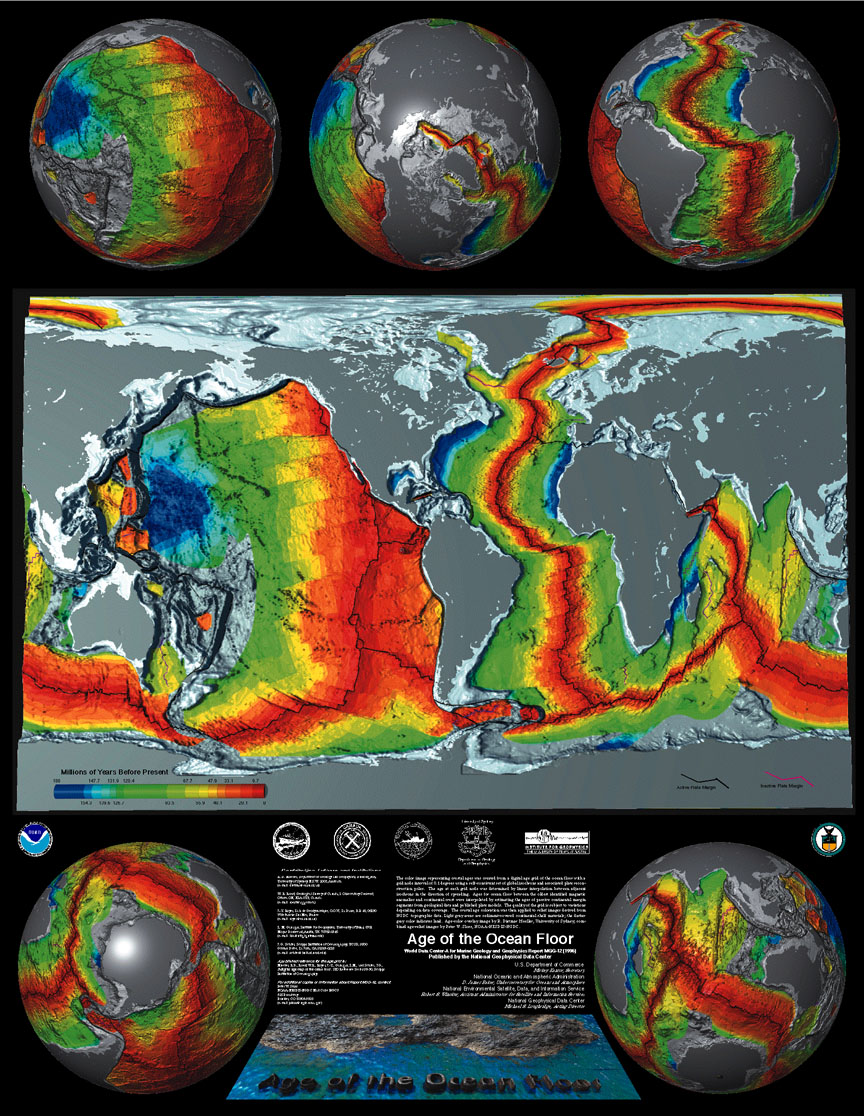
What the Fascists Don't Want You To See


Egyed: Some remarks on continental drift

L. Egyed1

(1) Geophysical Institute, Eötvös University, Budapest, Hungary

Received: 5 April 1960

Summary: The continental drift may be explained by an expanding Earth only.
Cox and Doell: Palæomagnetic Evidence Relevant to a Change in the Earth's Radius.

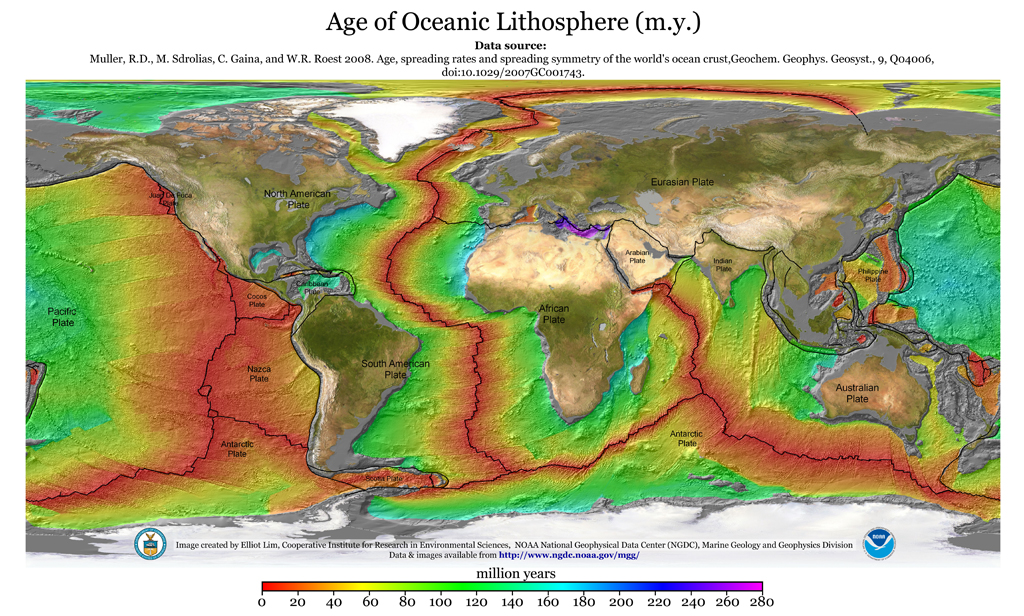
INTEREST in the hypothesis that the Earth's radius has increased during geological history has been renewed in recent years because of several sets of independent observations and interpretations. From studies of the deformation of mountain ranges and the distribution of faults and oceans, Carey1 proposes an increase in the Earth's area of 45 per cent since the Palæozoic era. Heezen2 similarly interprets submarine topography as indicating that the oceans may be immense rift valleys formed by a pulling apart of the continents as the Earth expanded. Using a different approach, Egyed3,4 infers a rate of increase of the Earth's radius of 0.4–0.8 mm. per year. This calculation is based on a decrease in the total amount of continental area covered by oceans during the past 400 million years, as determined palæographically. Egyed4 has also pointed out the desirability of using palæomagnetic data to test this hypothesis.
Carey: Palæomagnetic Evidence relevant to a Change in the Earth's Radius.

Cox and Doell1, applying a suggestion of Egyed2 to test the reality of the expansion of the Earth through geological time, have calculated the radius of the Earth implied by comparison of Permian palseomagnetic measurements in the Maymecha–Kotuy region of Siberia and localities in western Europe, and find that although the standard deviation of the individual results is very wide indeed, the average of the computed radii of the Earth is close to the present radius. From this they conclude that the substantial post-Palæozoic expansion of the globe deduced by me on tectonic grounds is unlikely.

Tuesday, October 28, 2008

Earth's Increasing Diameter


What is the diameter of the Earth and does it increase over time?

Eratosthenes

"Now the distance from S [Syrene] to A [Alexandria] was known by measurement to be 5,000 stades; it followed that the circumference of the earth was 250,000 stades. This is the figure given by Cleomedes, but Theon of Smyrna and Strabo both give it as 252,000 stades. The reason for the discrepancy is not known; it is possible that Eratosthenes corrected 250,000 to 252,000 for some reason, perhaps in order to get a figure divisible by 60 and, incidentally, a round number (700) of stades for one degree. If Pliny is right in saying that Eratosthenes made 40 stades equal to the Egyptian skoinos, then, taking the skoinos at 12,000 Royal cubits of 0.525 metres, we get 300 such cubits, or 157.5 metres, i.e. 516.73 feet, as the length of the stade. On this basis 252,000 stades works out to 24,662 miles, and the diameter of the earth to about 7,850 miles.
Source: A History of Greek Mathematics (Heath 1921).


Theon of Smyrna


"Thus the whole diameter of the Earth would be approximately 80,182 stades. For three times this number plus a seventh of it was the perimeter of 252,000 stades."

Quoted from On Mathematics Useful for Understanding of Plato.

Also 7,850 miles.

Claudius Ptolemy


Ptolemy in the Geographia improved on the work of Eratosthenes. He calculated 1 degree as 500 stades, which using Heath's math works out to an Earth diameter of 5,607 miles.

Plus, according to one author, "he tended to overestimate the breadth of the whole known world." (Evans 1998)

Modern Measurements

Modern measurements are all over the place (as usual there is no scientific consensus). See here.

However, The North American Datum of 1983 (NAD83) [Schwarz, Ed., NOAA, 1989] was determined by the NGS to be 12,756.274 km (7926.75 miles) on the major axis (equatorial), and 12,713.504 km (7900.17 miles) on the minor axis (polar), with an average diameter of 12,734.889 km (7913.46 miles).

At least 76.75 miles growth in 2223 years.