Showing posts with label Extreme Human Antiquity. Show all posts

Thursday, July 8, 2010

Britain: 800,000 B.C.


Science Daily: Dig Discovers Ancient Britons Were Earliest North Europeans.

ScienceDaily (July 8, 2010) — A University College London archaeologist is part of a team who have unearthed the earliest evidence of human occupation in Britain.

Simon Parfitt was part of a team of archaeologists, palaeontologists and earth scientists from the British Museum, the Natural History Museum, UCL, and Queen Mary, University of London, who unearthed the new evidence at an archaeological dig in East Anglia.

Their findings demonstrate that ancient humans occupied Britain over 800,000 years ago, marking the first known settlement in northern Europe -- far earlier than previously thought.

Monday, March 8, 2010

Cormac McCarthy On Forgotten Worlds


"He [Judge Holden] gathered up the other artifacts and cast them also into the fire and he shook out the wagonsheet and folded it away among his possibles together with the notebook. Then he sat with his hands cupped in his lap and he seemed much satisfied with the world, as if his counsel had been sought at it's creation. A Tennessean named [Marcus] Webster had been watching him and he asked the judge what he aimed to do with those notes and sketches and the judge smiled and said that it was his intention to expunge them from the memory of man. Webster smiled and the judge laughed." -- Cormac McCarthy, author, Blood Meridian or The Evening Redness in the West, 1985

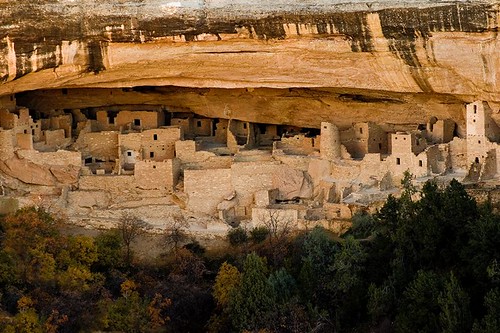
"What is true of one man, said the judge, is true of many. The people who once lived here are called the Anasazi. The old ones. ... The tools, the art, the building -- these things stand in judgement on the latter races. Yet there is nothing for them to grapple with. The old ones are gone like phantoms and the savages wander these canyons to the sound of an ancient laughter." -- Cormac McCarthy, author, Blood Meridian or The Evening Redness in the West, 1985

"All progressions from a higher to a lower order are marked by ruins and mystery...." -- Cormac McCarthy, author, Blood Meridian or The Evening Redness in the West, 1985

"This you see here, these ruins wondered at by tribes of savages, do you not think that this will be again? Aye. And again. With other people, with other sons." -- Cormac McCarthy, author, Blood Meridian or The Evening Redness in the West, 1985

"The rocks about in every sheltered place were covered with ancient paintings and the judge was soon among them copying out certain ones into his book to take away with him. ... Then he rose and with a piece of broken chert he scappled away one of the designs, leaving no trace of it only a raw place on the stone where it had been." -- Cormac McCarthy, author, Blood Meridian or The Evening Redness in the West, 1985

"The desert wind would salt their ruins and there would be nothing, nor host nor scribe, to tell any pilgrim in his passing how it was that people had lived in this place and in this place died." -- Cormac McCarthy, author, Blood Meridian or The Evening Redness in the West, 1985

"They're gone. Ever one of them that God ever made is gone as if they'd never been at all. The ragged sparks blew down the wind. The prairie about them lay silent. Beyond the fire it was cold and the night was clear and the stars were falling. The old hunter pulled his blanket about him. I wonder if there's other worlds like this, he said. Or if this is the only one." -- Cormac McCarthy, author, Blood Meridian or The Evening Redness in the West, 1985

"Men's memories are uncertain and the past that was differs little from the past that was not." -- Cormac McCarthy, author, Blood Meridian or The Evening Redness in the West, 1985

Wednesday, February 24, 2010

Seafaring Cavemen Contradict Evolution


"Today’s obsession with ‘progress’ – a straight line from one accomplishment to another – blinds us to the lost realities of our past. Our research reveals a legacy closer to the ideas of the ancients." -- Rand and Rose Flem-Ath, scholars, 2010

Pringle, H., Primitive Humans Conquered Sea Surprising Finds Suggest, National Geographic, Feb 2010

Prehistoric axes found on a Greek island suggest that seafaring existed in the Mediterranean more than a hundred thousand years earlier than thought. ...

Crete has been surrounded by vast stretches of sea for some five million years. The discovery of the hand ax suggests that people besides technologically modern humans—possibly Homo heidelbergensis—island-hopped across the Mediterranean tens of thousands of millennia earlier than expected.

Many researchers have hypothesized that the early humans of this time period were not capable of devising boats or navigating across open water. But the new discoveries hint that these human ancestors were capable of much more sophisticated behavior than their relatively simple stone tools would suggest.

"I was flabbergasted," said Boston University archaeologist and stone-tool expert Curtis Runnels. "The idea of finding tools from this very early time period on Crete was about as believable as finding an iPod in King Tut's tomb."
UPDATE: Until now, scientists honestly believed boats evolved in 5000 B.C.

Duce, J., 'Oldest Boat' Found In Egypt, BBC, Nov 2000

Lawler, A., Report of Oldest Boat Hints at Early Trade Routes, Science, Volume 296, Number 5574, Pages 1791-1792, Jun 2002

Oldest Boat Unearthed, China.Org, Dec 2002

8,000 Year Old Dug Out Canoe On Show In Italy, Archaeo News, Sep 2005

Thursday, November 12, 2009

Domesticated Wheat In 23,000 B.C.?


Wheat has been cultivated domestically at least since 9,000 B.C. and probably earlier.

Domesticated Einkorn wheat at Nevali Cori 40 miles northwest of Gobekli Tepe in Turkey has been dated to 9,000 B.C.

Which Came First, Monumental Building Projects or Farming?, Archaeo News, Dec 2008.

At Nevali Cori, a Neolithic village 40 miles northwest of Schmidt's site, archaeologists found seeds of domesticated einkorn wheat dating from 9000 BCE.
However domesticated barley has been dated to 23,000 B.C. and some say this is also true of wheat.

Eureka Alert (Aug 2004): Oldest Evidence for Processing of Wild Cereals: Starch Grains from Barley, Wheat, on Grinding Stone.

When the water level in the Sea of Galilee dropped in 1989, archaeologists rushed to excavate Ohalo II, an ancient human settlement. On the floor of one hut they found a large, flat, basaltic stone. The stone's uneven surface yielded starch grains of grass seeds, mostly from wild barley and possibly also from wheat. This evidence presented in the journal Nature (August 5, 2004), pushes back the date for the processing of close wild relatives of domesticated wheat and barley, a key step in cultural development, to 23,000 years before the present era. "Ten thousand years before people were cultivating cereals, they were processing wild barley: starch grain analysis establishes a clear link between an intensive exploitation of wild cereals and the subsequent development of plant cultivation and domestication in the region " explains Dolores Piperno, lead author.
Piperno, D.R., et al., Processing of Wild Cereal Grains in the Upper Palaeolithic Revealed by Starch Grain Analysis, Nature, 430, Pages 670-673, Aug 2004

Barley (Hordeum vulgare L.) and wheat (Triticum monococcum L. and Triticum turgidum L.) were among the principal 'founder crops' of southwest Asian agriculture. Two issues that were central to the cultural transition from foraging to food production are poorly understood. They are the dates at which human groups began to routinely exploit wild varieties of wheat and barley, and when foragers first utilized technologies to pound and grind the hard, fibrous seeds of these and other plants to turn them into easily digestible foodstuffs. Here we report the earliest direct evidence for human processing of grass seeds, including barley and possibly wheat, in the form of starch grains recovered from a ground stone artefact from the Upper Palaeolithic site of Ohalo II in Israel. Associated evidence for an oven-like hearth was also found at this site, suggesting that dough made from grain flour was baked. Our data indicate that routine processing of a selected group of wild cereals, combined with effective methods of cooking ground seeds, were practiced at least 12,000 years before their domestication in southwest Asia.
It is obvious that corn is over 80,000 years old.

Thursday, October 22, 2009

2 Million Year Old Tool Making Humans


"At the very least, human culture reaches much further back in time than conventional history admits." -- Stephen Wagner, author, February 2004

Only an evolutionist would be gullible enough to believe that Homo sapiens magically and miraculously appeared for no reason 200,000 years ago in Ethiopia: Tool-making Human Ancestors Inhabited Grassland Environments Two Million Years Ago.

ScienceDaily (Oct. 21, 2009) — In an article published in the open-access, peer-reviewed journal PLoS ONE on October 21, 2009, Dr Thomas Plummer of Queens College at the City University of New York, Dr Richard Potts of the Smithsonian Institution National Museum of Natural History and colleagues report the oldest archeological evidence of early human activities in a grassland environment, dating to 2 million years ago.