Than, K., Lost City Revealed Under Centuries of Jungle Growth, National Geographic News, Apr 26th 2011
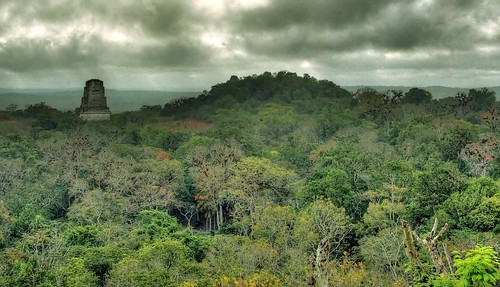
Hidden for centuries, the ancient Maya city of Holtun, or Head of Stone, is finally coming into focus.
Three-dimensional mapping has "erased" centuries of jungle growth, revealing the rough contours of nearly a hundred buildings, according to research presented earlier this month.
Though it's long been known to locals that something—something big—is buried in this patch of Guatemalan rain forest, it's only now that archaeologists are able to begin teasing out what exactly Head of Stone was.
Using GPS and electronic distance-measurement technology last year, the researchers plotted the locations and elevations of a seven-story-tall pyramid, an astronomical observatory, a ritual ball court, several stone residences, and other structures.
The Maya Denver?
Some of the stone houses, said study leader Brigitte Kovacevich, may have doubled as burial chambers for the city's early kings.
"Oftentimes archaeologists are looking at the biggest pyramids or temples to find the tombs of early kings, but during this Late-Middle Preclassic period"—roughly 600 B.C. to 300 B.C.—"the king is not the center of the universe yet, so he's probably still being buried in the household," said Kovacevich, an archaeologist at Southern Methodist University in Dallas.
"That may be why so many Preclassic kings have been missed" by archaeologists, who expected to find the rulers' burials at grand temples, she added.
The findings at Head of Stone—named for giant masks found at the site—could shed light on how "secondary" Maya centers were organized and what daily life was like for Maya living outside of the larger metropolitan areas such as Tikal, about 22 miles (35 kilometers) to the north, according to Kathryn Reese-Taylor, a Preclassic Maya specialist at Canada's University of Calgary.
Head of Stone, which has never been excavated, "was not a New York or Los Angeles, but it was definitely a Denver or Atlanta," said Reese-Taylor, who called the new mapping study "incredibly significant." ...
King of Stars
During special events at Head of Stone, such as the crowning of a king or the naming of a royal heir, "there would have been a lot of people—not only the 2,000 people living at the site itself but all the people from surrounding areas as well. So, several thousand people," Reese-Taylor said.
Thick gray smoke and the smell of burning incense would have filled the air. Gazing up at the temple top through this haze, a visitor might have seen "ritual practitioners" performing dances and sacred rituals while adorned with elaborate feathered costumes and jade jewelry.
During the solstices or equinoxes, the crowds would have moved farther south and higher up in the city, surrounding the buildings that made up the astronomical observatory.
"During the solstices, you would've been able to see the sun rising in line with the eastern structure, and the common people would have thought that the king was commanding the heavens," study leader Kovacevich said.
The researchers, though, are directing their gaze downward. This summer they hope to begin excavating residential structures and the observatory, as well as to possibly remove the undergrowth from the main temple.
And, by using ground-penetrating radar, they hope to bring Head of Stone into even sharper relief.
By seeing through soil the way the previous mapping project saw through trees and brush, radar should reveal not just the rounded shapes of the city but the hard outlines of the buildings themselves.








-759725.jpg)