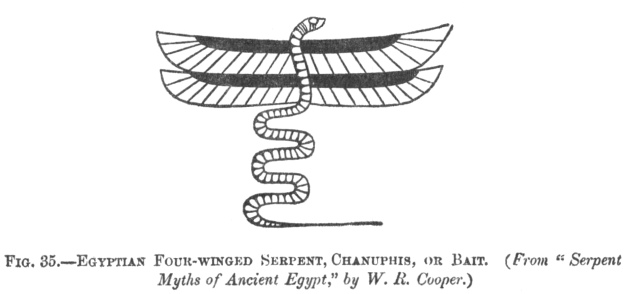
"And the LORD sent fiery serpents among the people, and they bit the people; and much people of Israel died." -- Numbers 21:6
"Who led thee through that great and terrible wilderness, wherein were fiery serpents, and scorpions, and drought, where there was no water; who brought thee forth water out of the rock of flint;" -- Deuteronomy 8:15
"The burden of the beasts of the south: into the land of trouble and anguish, from whence come the young and old lion, the viper and fiery flying serpent, they will carry their riches upon the shoulders of young asses, and their treasures upon the bunches of camels, to a people that shall not profit them." -- Isaiah 30:6
"Out of his [Leviathan's] mouth go burning lamps, and sparks of fire leap out. Out of his nostrils goeth smoke, as out of a seething pot or caldron. His breath kindleth coals, and a flame goeth out of his mouth." -- Job 41:19-21
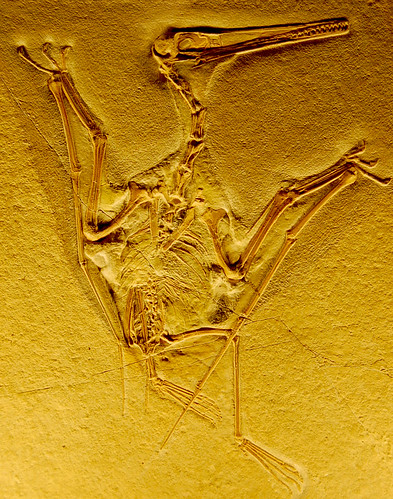
"There is evidence that pterosaurs may have flown the skies a couple thousand years ago. There are numerous depictions precise enough to identify the pterosaur species,
Scaphognathus crassirostris, from several cultures of antiquity. Since that species is the only long-tailed species with a head crest, it is readily identified." -- John Goertzen, zoologist, 1998
"The notion of a 'fire-breathing dragon' is regularly held up to ridicule any relationship between dinosaurs and dragons. Actually, scientists would find it very easy to explain an animal that could literally breathe out flames. Many animals generate methane in their digestive tracts. Methane, or natural gas, is quite flammable, and there's a college prank (which I will not describe) based on setting human methane on fire! Some scientists think that dinosaurs belched so much methane that a 'greenhouse gas' may have helped keep the polar regions of the earth warm! Scientists also know of dinosaurs that had cavities in their skulls with tubular passages leading to the fronts of their mouths. Imagine such chambers contained an enzyme that would accelerate the chemical reaction between methane and oxygen. If the enzyme were injected just as the belching dinosaur opened its mouth, the methane blast would burst into a fiery stream of flame as the methane hit the oxygen in the air." -- Gary Parker, scientist, 2007
"The Parasaurolophus, the 'Crested Lizard,' had a single bony crest rising from it's nostrils and going back over it's head, looking something like a very large horn. The males had a larger crest than the females. Inside the crests were very large nasal cavities, much larger than needed for smell." -- Grady S. McMurtry, theologian, 2009
"Dinosaurs had a lot of vegetable materials in their stomachs and it would have produced a lot of methane gas. Sea dwelling reptiles could have easily had it too, especially if they ate kelp and similar aquatic plants. So, here we would have a source of fuel for a fire breathing dragon." -- Grady S. McMurtry, theologian, 2009









-759725.jpg)