Showing posts with label Venus. Show all posts

Sunday, January 12, 2014

Ficino On Timaeus

All Things Natural: Ficino On Plato's Timaeus
"Near the beginning of this dialogue [Timaeus] Plato relates an account of the war that was once faught between the Athenians and the men of Atlantis. It is clear that Crantor, the principal expounder of Plato at the time, takes the account to be devoid of any allegory. Some, on the other hand, take it as pure allegory, but they are refuted by Platonists of the highest standing, who declare that it is an historical account because Plato has uttered it. The tale that follows is indeed amazing, but totally true." -- Marsilio Ficino, polymath, On Plato's Timaeus, Chapter 4, 15th century
"Here I ask you once more to remember that nine thousand years are calculated by Eudoxus as a thousand months; and that Phaethon, offspring of the Sun, consumed the Earth with thunderbolts, which, according to some, means that a huge comet [Venus], solar by nature and eventually disintegrating, provoked unbearable periods of heat and perhaps the fires which Moses says were sent by divine intervention." -- Marsilio Ficino, polymath, On Plato's Timaeus, Chapter 5, 15th century

Friday, August 17, 2012

Augustine of Hippo: On Changes of Venus


Augustine, City of God, Book XXI: THAT IT IS POSSIBLE FOR A THING TO BECOME DIFFERENT FROM WHAT IT WAS FORMERLY KNOWN CHARACTARISTICALLY TO BE
From the book of Marcus Varro, entitled, Of the Race of the Roman People, I cite word for word the following instance: "There occurred a remarkable celestial portent; for Castor records that, in the brilliant star Venus, called Vesperugo by Plautus, and the lovely Hesperus by Homer, there occurred so strange a prodigy, that it changed its color, size, form, course, which never happened before nor since. Adrastus of Cyzicus, and Dion of Naples, famous mathematicians, said that this occurred in the reign of Ogyges." So great an author as Varro would certainly not have called this a portent had it not seemed to be contrary to nature. For we say that all portents are contrary to nature; but they are not so. For how is that contrary to nature which happens by the will of God, since the will of so mighty a Creator is certainly the nature of each created thing? A portent, therefore, happens not contrary to nature, but contrary to what we know as nature. But who can number the multitude of portents recorded in profane histories? Let us then at present fix our attention on this one only which concerns the matter in hand. What is there so arranged by the Author of nature of heaven and earth as the exactly ordered course of the stars? What is there established by laws so sure and inflexible? And yet, when it pleased Him who with sovereignty and supreme power regulates all He has created, a star conspicuous among the rest by its size and splendor changed its color, size, form, and, most wonderful of all, the order and law of its course! Certainly that phenomenon disturbed the canons of the astronomers, if there were any then, by which they tabulate, as by unerring computation, the past and future movements of the stars, so as to take upon them to affirm that this which happened to the morning star (Venus) never happened before nor since. ... But possibly, though Varro is a heathen historian, and a very learned one, they may disbelieve that what I have cited from him truly occurred; or they may say the example is invalid, because the star did not for any length of time continue to follow its new course, but returned to its ordinary orbit.

Friday, April 9, 2010

Goddess Venus Is Geologically Alive


Science Daily: Venus Is Geologically Alive, Signs of Recent Lava Flows Suggest.

ScienceDaily (Apr. 9, 2010) — For the first time, scientists have detected clear signs of recent lava flows on the surface of Venus.

The observations reveal that volcanoes on Venus appeared to erupt between a few hundred years to 2.5 million years ago. This suggests the planet may still be geologically active, making Venus one of the few worlds in our solar system that has been volcanically active within the last 3 million years.

Thursday, April 1, 2010

Phaethon


"Now this has the form of a myth, but really signifies a declination of the bodies moving in the heavens around the earth, and a great conflagration of things upon the earth, which recurs after long intervals...." -- Plato, philosopher, Timaeus, 360 B.C.

"... the stars ... fell from heaven at the time of Phaethon's downfall." -- Aristotle, Meteorology, Book I, 350 B.C.

Science Daily: Was a Giant Comet Responsible for a North American Catastrophe in 11,000 BC? Let me guess: the correct answer is yes.

ScienceDaily (Apr. 1, 2010) — Some 13,000 years ago the Earth was struck by thousands of Tunguska-sized cometary fragments over the course of an hour, leading to a dramatic cooling of the planet, according to astronomer Professor Bill Napier of the Cardiff University Astrobiology Centre.

He presents his new model in the journal Monthly Notices of the Royal Astronomical Society.

The cooling, by as much as 8°C, interrupted the warming which was occurring at the end of the last ice age and caused glaciers to readvance. Evidence has been found that this catastrophic change was associated with some extraordinary extraterrestrial event. The boundary is marked by the occurrence of a "black mat" layer a few centimetres thick found at many sites throughout the United States containing high levels of soot indicative of continental-scale wildfires, as well as microscopic hexagonal diamonds (nanodiamonds) which are produced by shocks and are only found in meteorites or impact craters. These findings led to the suggestion that the catastrophic changes of that time were caused by the impact of an asteroid or comet 4 km across on the Laurentide ice sheet, which at that time covered what would become Canada and the northern part of the United States.

The cooling lasted over a thousand years, and its onset coincides with the rapid extinction of 35 genera of North American mammals, as well as the disruption of the Palaeoindian culture. The chief objection to the idea of a big impact is that the odds against the Earth being struck by an asteroid this large only 13,000 years ago are a thousand to one against. And the heat generated by the rising fireball would be limited by the curvature of the horizon and could not explain the continent-wide occurrence of wildfires.

Professor Napier has now come up with an astronomical model which accounts for the major features of the catastrophe without involving such an improbable event. According to his model, the Earth ran into a dense trail of material from a large disintegrating comet. He points out that there is compelling evidence that such a comet entered the inner planetary system between 20 000 and 30 000 years ago and has been fragmenting ever since, giving rise to a number of closely related meteor streams and comoving asteroids known as the Taurid Complex.

In the course of the giant comet's disintegration, the environment of the interplanetary system would have been hazardous and the Earth would probably have run through at least one dense swarm of cometary material. The new model indicates that such an encounter would last for about an hour during which thousands of impacts would take place over continental dimensions, each releasing the energy of a megaton-class nuclear bomb, generating the extensive wildfires which took place at that time. The nanodiamonds at the extinction boundary would then be explained as having come in with the comet swarm.

One recent meteorite is known which may have come from this giant comet progenitor: the Tagish Lake meteorite, which fell over Yukon Territory in January 2000. It has the highest abundance of nanodiamonds of any meteorite so far analysed.

Professor Napier sums up his model: "A large comet has been disintegrating in the near-Earth environment for the past 20,000 to 30,000 years, and running into thousands of fragments from this comet is a much more likely event than a single large collision. It gives a convincing match to the major geophysical features at this boundary."

Sunday, November 29, 2009

How Old Is Venus?


"... the solar system may have changed so much since it was created that a study of the present state would tell us very little about it's origin." -- Hannes O.G. Alfvén, physicist, 1954

"... looking at the map of craters of Venus, all of them seem relatively pristine, and there are no older ones." -- David Grinspoon, planetary scientist, August 2004

"Assuming Venus was exposed to the same rain of asteroids and comets that the other planets experienced, they expected Magellan would spot about 5000 craters on the planet's surface. But they found only about 1000, suggesting that the planet's surface is actually very young ...." -- David Shiga, journalist, November 2006

Scientists assume based upon only their religion and no evidence, that Venus is billions of years old.

However, the reality is that no Venusian rock has ever been dated.

What data can scientists use to estimate the age of a planet whose rocks have never been dated?

Impact crater counts.

Venus has so few impact craters that they have literally been quantified -- less than 900.

And almost all of them (84%) are in pristine condition and have never even been affected by lava flows (97.5%).

Therefore Venus cannot possibly be billions of years old.

And the historical record demonstrates that Venus is a new planet that is only thousands of years old.

"As when the son [Jupiter] of devious-devising Kronos [Saturn] casts down a star [Venus], portent to sailors or to widespread armies of peoples gliterring, and thickly the sparks of fire break from it, in such likeness Pallas Athene swept flashing earthward and plunged between the two hosts; and amazement seized the beholders, Trojans, breakers of horses, and strong-greaved Achaians." -- Homeros, poet, Iliad, Book IV: 75-80

"There is a story, which even you have preserved, that once upon a time Paethon [Venus], the son of Helios, having yoked the steeds in his father's chariot, because he was not able to drive them in the path of his father, burnt up all that was upon the earth, and was himself destroyed by a thunderbolt. Now this has the form of a myth, but really signifies a declination of the bodies moving in the heavens around the earth, and a great conflagration of things upon the earth, which recurs after long intervals." -- Sonchis of Sais, priest, 6th century B.C.

"As Zeus's daughter [Venus] she'll be immortal and live in heaven with her brothers, Pollux and Castor, the heavenly twins, an extra star for ships to steer their courses by." -- Euripides, playwright, Orestes, 408 B.C.

"...the stars...fell from heaven at the time of Phaethon's [Venus's] downfall." -- Aristotle, philosopher, Meteorology, 350 B.C.

"Democritus however, insists upon the truth of his view and affirms that certain stars [Venus] have been seen when comets dissolve." -- Aristotle, philosopher, Meteorology, 350 B.C.

"Some of the Italians called Pythagoreans say that the comet is one of the planets [Venus]." -- Aristotle, philosopher, Meteorology, 350 B.C.

"The stars were fled, for Lucifer [Venus] had chased
The stars away, and fled himself at last."--Ovid, Metamorphoses Book II: Phaeton, 8

"Below the Sun revolves the great star called Venus, wandering with an alternate motion, and, even in its surnames, rivalling the Sun and the Moon. For when it precedes the day and rises in the morning, it receives the name of Lucifer, as if it were another sun, hastening on the day. On the contrary, when it shines in the west, it is named Vesper, as prolonging the light, and performing the office of the moon. Pythagoras the Samian, was the first who discovered its nature, about the 62nd olympiad, in the 222nd year of the City." -- Pliny the Elder, historian, 77

"On leaving the market-place along the road to Lechaeum you come to a gateway, on which are two gilded chariots, one carrying Phaethon [Venus] the son of Helius (Sun), the other Helius himself." -- Pausanius, geographer, Description of Greece: Argolis, 2nd century

"And in the time of Crotopus occurred the burning of Phaethon [Venus], and the deluges of Deucalion." -- Clement of Alexandria, priest, Stromata, 2nd century

"But this reign [The Reign of Quetzalcoatl], like that of Saturn, and the happiness of the world, were not of long duration...." -- Alexander Von Humboldt, naturalist, 1814

"Some Indian tribes of North-western America tell a story which bears a close resemblance to the story of Phaethon [Venus] and the chariot of the Sun, his father. The tale of Phaethon is related most fully in Ovid." -- James G. Frazer, translator, 1920

"Here you see the Morning Star [Venus]. Who sees the Morning Star shall see more, for he shall be wise." -- Black Elk, medicine man, August 1930

"... the morning star [Venus] lives to give men wisdom ...." -- Black Elk, medicine man, August 1930

"These four-planet systems and the inability of the ancient Hindus and Babylonians to see Venus in the sky, even though it is more conspicuous than the other planets, are puzzling unless Venus was not among the planets." -- Immanuel Velikovsky, cosmologist, 1950

"In an ancient Hindu tablet of planets, attributed to the year -3012 Venus among the visible planets is absent [Delambre, J.B.J., Histoire de l'astronomie ancienne I, Page 407, 1817: 'Venus alone is not found there.']." -- Immanuel Velikovsky, cosmologist, 1950

"Venus experienced in quick succession its birth and expulsion under violent conditions; an existence as a comet on an ellipse which approached the sun closely; two encounters with the earth accompanied by discharges of [electric] potentials between these two bodies and with a thermal effect caused by conversion of momentum into heat; a number of contacts with Mars, and probably also with Jupiter. Since all this happened between the third and first millennia before the present era, the core of the planet Venus must still be hot." -- Immanuel Velikovsky, cosmologist, 1950

Tuesday, June 2, 2009

Remembering Comet Venus


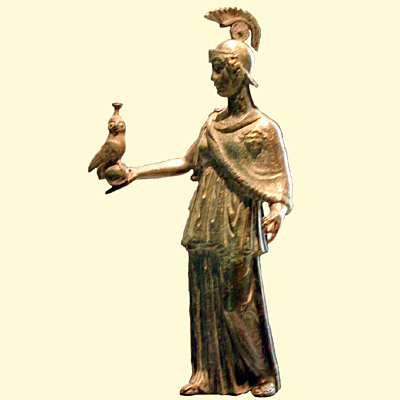
Minerva (Athena) the Roman goddess of wisdom.

I wondered why Min, the founder of Egypt, and Minerva have similar names.

Where does the Latin word Minerva come from?

From the Greek μνῆστις meaning memory, remembrance, or recollection.

"There is no teaching, but only recollection." -- Plato, philosopher, 380 B.C.

And where did Athena come from?

From the city of Sais, the sacred site built upon the "Great Pit" meteorite impact crater in Sa el Hagar, Egypt.

"Furthermore, the Egyptians (they said) first used the names of twelve gods (which the Greeks afterwards borrowed from them); and it was they who first assigned to the several gods their altars and images and temples, and first carved figures on stone. Most of this they showed me in fact to be the case. The first human king of Egypt, they said, was Min." -- Herodotos, historian, Book II, ~440-420 B.C.

"She [Minerva] founded your city a thousand years before ours, receiving from the Earth and Hephaestus the seed of your race, and afterwards she founded ours, of which the constitution is recorded in our sacred registers to be eight thousand years old." -- Sonchis of Sais, priest, ~594 B.C.

"Afterwards, when most of the inhabitants of Greece were destroyed by flood, and all records and ancient monuments perished with them, the Egyptians took this occasion to appropriate the study of astrology solely to themselves; and whereas the Grecians (through ignorance) as yet valued not learning, it became a general opinion that the Egyptians were the first that found out the knowledge of the stars." -- Diodoros, historian, ~1st century B.C.

"And so even to the Athenians themselves, though they built the city of Sais in Egypt, yet by reason of the flood, were led into the same error of forgetting what was before." -- Diodoros, historian, ~1st century B.C.

Sunday, May 31, 2009

Venus Craters of Baigong Correlated To Chinese Pyramids


Baigong China archaeological site correlates meteorite impacts and pyramids. (Hat tip: Suzannah)

Chinese Scientists to Head for Suspected ET Relics, Xinhua News Agency, Jun 2002

On the north of the mountain are twin lakes dubbed as the "lover Lakes", one with fresh water and the other with salty water.
Lover Lakes should be called Venus Craters.

Thursday, May 28, 2009

The Venus Pyramid


"Of all the planets, Venus [Kukulkan/Gukumatz] is clearly the most important in Maya art, cosmology, and calendrics." -- Susan Milbrath, archaeologist, 1999

Milbrath, S., Star Gods of the Maya, 1999


So who were the Blood Lords ripping and tearing hearts out for, if not Lucifer who tried to yoke the steeds of his father Aten's chariot?

"Are you so impressed also by the planet Jupiter that you would regard it as a chief deity above Sun and Moon? And they worshipped those planets, those gods, in the planets themselves. They were lifting their hands, the Babylonians and the Indians, Hindu, and the Chinese, all, they were lifting their hands to those planets in worshipping them. And human sacrifice were brought to them. Even into recent times, among the American Indians, in the last century still, human sacrifice were brought to the planet Venus." -- Immanuel Velikovsky, cosmologist, 1966

Thurman, M.D., The Timing of the Skidi-Pawnee Morning Star Sacrifice, Ethnohistory, Volume 30, Issue 3, Pages 155-163, 1983

Friday, March 27, 2009

Venus and Velikovsky


Rens Van Der Sluijs: Velikovskian Chaff and Wheat: Venus

Science progresses in a variety of ways.

One way that science progresses is through a careful evaluation of arguments advanced by earlier scholars in the field. For the sake of academic honesty, this has to be done in a completely dispassionate manner. The work of pioneers, Nobel-prize winners and other prestigious people cannot be judged by different standards than that of the least noticed postgraduate student.

The maverick Russian-American polymath, Immanuel Velikovsky (1895-1979), deserves recognition for his pioneering statements about the role of electromagnetic activity in space and the importance of catastrophic events even in historically recent periods. Yet science has no place for worship and it is incumbent on modern researchers to scrupulously evaluate each of Velikovsky’s many claims in the light of current knowledge.

One of Velikovsky’s boldest ideas was that the planet Venus is a relative newcomer in the solar system: during the mid-2nd millennium BCE, it would have been erupted from the interior of the planet Jupiter and have inflicted damage to the earth’s atmosphere and biosphere with its conspicuous cometary tail before settling in its present orbit and shedding its appendage. How does this analysis fare when approached today with an open but a sternly critical mind? ...

First, Velikovsky’s citation of the Roman intellectual, Varro, to the effect that Venus “changed its color, size, form, course, which never happened before nor since,” presents a genuine puzzle to modern historians of the solar system. The citation itself is unambiguous and not suspicious, but it needs to be resolved exactly how and when Venus’ colour, appearance and movement were modified.

In addition, the so-called Venus Tablet of Ammiṣaduqa (7th century BCE?), which presents the oldest known set of Venus observations, remains a mystery. Specialists are urged to investigate whether the data given in the tablet could consistently describe not the present orbit of Venus, but any other course the planet might have followed.

Second, Velikovsky’s argument that Venus once sported a cometary tail stands up to close scrutiny and can be buttressed with a mass of additional evidence. In modern terms, a plausible explanation for the ancient testimony would be the assumption that Venus’ large magnetosphere had acquired a visible glow in historical times, at a time when the inner solar system was brimming with electrical activity.

Third, Velikovsky rightly drew attention to the voluminous body of mythical traditions concerning the birth of the morning star. The spectacular ascent to heaven of the feathered serpent, Quetzalcoatl, in Aztec mythology, is a textbook example for this motif.

Friday, January 30, 2009

Al Gore and Venus Envy


Great post on Velikovsky and Venus via Louis Hissink's Crazy World: Al Gore and Venus Envy.

Steven Milloy of the Junkscience site has just posted an interesting development - Al Gore has publicly stated what drive's his, and therefore Jim Hansen's, belief that CO2 is a dangerous greenhouse gas - Venus.

Jim Hansen's PhD was on the atmosphere of Venus and it is from this work that his belief in CO2 being a significant greenhouse gas is based.

The theory is wrong as was Carl Sagan who postulated that Venus was hot because of a runaway greenhouse mechanism.

This raises the ghost of Velikovsky for it was Velikovsky who initially proposed that Venus would be hot because of it's youthfulness based on historical evidence from many sources.

Mainstream science believed Venus was an earth-like arcadia, our sister planet! As Sagan could not admit that Venus was a young planet, he therefore had to come up with an ad hoc explanation to make this new discovery fit the "standard model", hence the runaway greenhouse effect.

Tuesday, December 9, 2008

Mystery Chemical On Venus


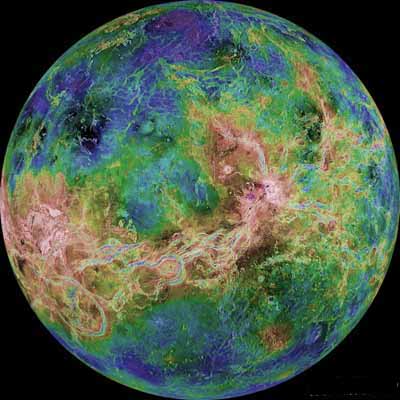
(Please note: the numbers and coordinate lines have been mathematically superimposed by human imagination and do not exist in physical material actuality.)

Venus is a very strange place. It is the only planet in the inner solar system with retrograde rotation.

Now scientists say there is an unidentified mystery chemical in it's atmosphere that absorbs ultraviolet light: Venus Comes To Life At Wavelengths Invisible To Human Eyes.

Using Venus Express, it is possible to compare what the planet looks like in different wavelengths, giving scientists a powerful tool to study the physical conditions and dynamics of the planet’s atmosphere.

Observed in the ultraviolet, Venus shows numerous high-contrast features. The cause is the inhomogeneous distribution of a mysterious chemical in the atmosphere that absorbs ultraviolet light, creating the bright and dark zones.
All cultures on Earth worshipped Venus. The Chinese (Tai'Pei), the Sumerians (Innana), the Babylonians (Ishtar), the Greeks (Aphrodite), the Romans, the Arabs (Al-'Uzza), the Aztecs (Tlahuizcalpantecuhtli), the Yucatec Maya (Kukulkan), the K'iche' Maya (Gukumatz), the Toltecs (Quetzalcoatl), and the Olmecs. Even into recent times among the American Indians, in the last century still, human sacrifices were brought to the planet Venus.

Thurman, M.D., The Timing of the Skidi-Pawnee Morning Star Sacrifice, Ethnohistory, Volume 30, Issue 3, Pages 155-163, 1983