Friday, July 11, 2008

Drilling Deep And Flying High


Last week's Barron's article: Drilling Deep and Flying High

Brazil's Petrobras could become one of the world's top oil companies if its three new deepwater wells are as plentiful as some expect.

THERE ARE GUSHERS and then there are gushers.

At a time when the oil industry is struggling mightily to find new wells, Brazil's Petrobras is sitting atop what appears to be the Western Hemisphere's biggest find in 30 years. The Tupi oil field, discovered off Rio de Janeiro two years ago and 65% owned by Petrobras, may contain as much as eight billion barrels of oil, an amount that would boost Brazil's reserves by more than 50%.

As if that weren't enough, the company has since found three other potentially lucrative, deepwater wells in the same area. And, with sophisticated operations in the Gulf of Mexico, it could be a big winner in President Bush's new drive to lift U.S. moratoriums on offshore drilling.

All this and high oil prices, too. Can it get any better?

In fact, Petrobras is a singularly tantalizing investment. "Buying Petrobras today is like having the opportunity to invest in Saudi Aramco 40 years ago," says Shawn Reynolds, portfolio manager of Van Eck Global's $1.03 billion Hard Assets Fund. Saudi Aramco, Saudi Arabia's state-owned oil company, today is the world's largest oil corporation in terms of proven reserves and production.

Investors already have struck it rich with Petrobras' stock (ticker: PBR for the American depositary receipts). Recently trading around $70, it has more than doubled over the past 12 months, far outpacing such rivals as ConocoPhillips (COP), Chevron (CVX) and ExxonMobil (XOM). Yet, bulls say the stock could climb another 25% or so within a year, perhaps hitting $90.

"If you're in oil, you have to own this stock," says Robert Levitt, asset manager of $500 million Levitt Capital Management, in Boca Raton, Fla. "They are sitting on the biggest oil find in years, that's why. You don't look at resource companies based on earnings; you look at their oil reserves. Exxon and Conoco aren't making any new discoveries. Petrobras just made the biggest one in years."


Wednesday, July 9, 2008

JP Morgan Upgrades Transocean


JP Morgan upgrades Transocean

July 9 (Reuters) - J.P. Morgan Securities upgraded Transocean Inc (RIG) to "overweight" from "neutral" on Wednesday, a day after the world's biggest offshore drilling contractor said it received a lucrative five-year contract.

Transocean said on Tuesday one of its deepwater drill ships was given a contract worth a record $650,000 per day. The contract is expected to start in March 2010 and generate revenue of $1.19 billion over the five years.

JP Morgan said recent contracts including the Transocean one indicated the deepwater market is strong.

"(Transocean's) valuation does not reflect visibility and strength of deepwater market," the brokerage said in a note to clients.

Tuesday, July 8, 2008

Transocean Signs Record $650,000 Day Rate


Transocean rig gets record $650,000 dayrate

HOUSTON, July 8 (Reuters) - Transocean Inc (RIG), the world's largest offshore drilling contractor, said on Tuesday one of its deepwater drill ships has been awarded a five-year contract worth a record $650,000 per day.

Shares of Transocean, whose operations are based in Houston, climbed as much as 2.5 percent on the news before retreating to trade slightly lower along with other energy stocks.

Record crude oil prices have stirred booming demand for offshore drilling rigs, which are currently in tight supply worldwide.

The contract for the Deepwater Pathfinder is set to start in March 2010. The agreement with a subsidiary of Eni (ENI) is for drilling primarily in the U.S. Gulf of Mexico.

"The new Eni contract represents a new record day rate for the industry and a meaningfully positive datapoint for Transocean and deepwater peers ... ," Bill Herbert, oilfield services analyst with Simmons & Co Int'l, wrote to clients.

Saturday, July 5, 2008

Volcanism Confirmed On Mercury


Volcanoes on Mercury Solve 30-year Mystery (Via Volcano World)

A NASA spacecraft's first flyby of Mercury has yielded a wealth of information about the inner-most planet, some of which confirms volcanism occurred there, settling a longstanding debate.

Information about such planetary mysteries as Mercury's magnetic field and geological history also has flooded in.

"We're really pleased," said Sean C. Solomon of the Carnegie Institution of Washington, principal investigator for the MESSENGER probe. "[The data] gives us a lot to chew on."

MESSENGER (short for MErcury Surface, Space ENvironment, GEochemistry, and Ranging) made its debut flyby of Mercury on Jan. 14, passing about 124 miles (200 kilometers) over the planet's surface. The spacecraft's instruments took a closer look at the areas seen by the Mariner 10 mission in 1974 and 1975, which imaged about 45 percent of the planet's surface, as well as an additional 21 percent of the surface never before seen by a spacecraft.

In a collection of 11 papers detailed in the July 4 issue of the journal Science, mission scientists presented the preliminary findings of the initial flyby.

Drilling Begins Off Florida Coast


Happy Independence Day. Now Americans can compete with Cuba and China: Companies begin quest for oil, gas off Fla. coast

As petroleum prices soar, 4 companies begin costly quest for oil and gas off Florida's coast

PENSACOLA, Fla. (AP) -- Oil companies once viewed drilling in the deep waters off Florida as cost prohibitive. Politicians feared even the slightest sign of support would be career suicide.

No more. Record crude oil prices are fueling support for oil and natural gas exploration off the nation's shores. In Florida, movement was underway even before President Bush called on Congress last month to lift a federal moratorium that's barred new offshore drilling since 1981.

The early activity here stems from a 2006 Congressional compromise that allows drilling on 8.3 million acres more than 125 miles off the Panhandle -- an area that had been covered by the moratorium, which was enacted out of environmental concerns. In exchange, the state got a no-drilling buffer along the rest of its beaches.

Florida may turn out to be a prelude for other coastal states. If oil or natural gas deposits are found in the newly opened region, experts say it could further the push to explore other once-protected areas everywhere. It also could be a rallying point for critics, who say the new exploration isn't a license to expand exploration.

With gas topping $4 a gallon, recent polls show Americans, Floridians included, more supportive of drilling in protected areas. Some politicians -- including Gov. Charlie Crist -- have switched sides.

"We think the public is way out ahead of the politicians on these issues. People are more open to (offshore drilling) now," said Tom Moskitis, spokesman for the American Gas Association, a trade group.

At the same time, oil companies, driven by the record energy price, are more willing to risk $100 million or more to begin exploring new regions. The Interior Department estimates there could be 18 billion barrels of oil and 77 trillion cubic feet of natural gas beneath the 574 million acres of federal coastal waters that are now off-limits.

Drilling activity off the Florida Panhandle has started and sputtered for decades. Some companies had leases to drill off the Panhandle before the 1981 moratorium. They were grandfathered in when the moratorium passed because they were already actively exploring in their lease areas. They continued their activity off and on into the early 1990s.

In March, four companies -- Australia-based BHP Billiton Petroleum Deepwater Inc., Houston-based Anadarko E&P Co., Shell Offshore Inc. and Italian oil and natural gas company Eni SpA -- purchased leases on 36 Gulf of Mexico tracts under the 2006 compromise.

Jeb Bachmann, an analyst with New Orleans energy consultant Howard Weil, said the four understand the shifting political and financial realities.

"It gives you an indication that some of these companies believe there is some light at the end of the tunnel," Bachmann said. "There is higher pricing and a belief that higher prices are going to ultimately drive some changes."

Thursday, July 3, 2008

Everything You Know About Oil Is Wrong


Myth Vs. Reality:

Myth: Oil Comes From Biological Organisms

Reality: No biological organism has ever been observed miraculously transforming into hydrocarbons. The Second Law of Thermodynamics prevents that from ever happening.

Myth: Oil Is Formed In The Earth's Crust

Reality: In 2002, the National Academy of Sciences published a paper which proves that the complex polycyclic aromatic hydrocarbons found in outer space and on Earth can only be formed at pressures above 30 kilobar, which corresponds to a depth of about 100 kilometers deep in the Earth's mantle. (No biological molecule can survive at such a depth because it is hotter than the critical point of water).

Myth: Oil Is Only Found In Sediments

Reality: Oil is found in volcanic igneous rocks. See here, here, here, and here.

Myth: Biomarkers Are Found In Oil

Reality: In 2007 ICP-MS analysis proved that all oil has inorganic geochemistry. Also see here.

Wednesday, July 2, 2008

Death From Below?


What happens when molten magma or lava hits a natural gas deposit?

Huge Tunguska Explosion Remains Mysterious 100 Years Later (Hat tip: Bill)

Death from below?

Instead of a cause from above, in the last decade some researchers have suggested the Tunguska explosion actually came from below. Astrophysicist Wolfgang Kundt at the University of Bonn in Germany and others have suggested that an eruption of natural gas from kimberlite, a kind of volcanic rock best known for sometimes holding diamonds, could be to blame.

"It would have come from the molten earth, some 3,000 kilometers deep (1,864 miles)," Kundt said. "The natural gas would be stored as a fluid that deep, and when it reaches the surface it would become a gas and expand by a factor of thousand in volume, for a huge explosion."

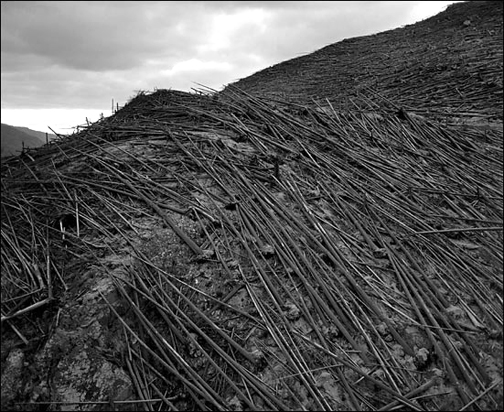
For support, he cited the pattern the trees fell in, as well as chemical anomalies.
Tunguska trees look exactly like the trees after the Mount St. Helens eruption.