Showing posts with label Cyberpunk. Show all posts

Saturday, October 23, 2010

Scientists Open Electrical Link to Living Cells


"And now we might add something concerning a certain most subtle spirit which pervades and lies hid in all gross bodies; by the force and action of which spirit the particles of bodies attract one another at near distances, and cohere, if contiguous; and electric bodies operate to greater distances, as well repelling as attracting the neighboring corpuscles; and light is emitted, reflected, refracted, inflected, and heats bodies; and all sensation is excited, and the members of animal bodies move at the command of the will, namely, by the vibrations of this spirit, mutually propagated along the solid filaments of the nerves, from the outward organs of sense to the brain, and from the brain into the muscles. But these are things that cannot be explained in few words, nor are we furnished with that sufficiency of experiments which is required to an accurate determination and demonstration of the laws by which this electric and elastic spirit operates." -- Isaac Newton, alchemist/mathematician, Principia, 1687

Science Daily: Scientists Open Electrical Link to Living Cells.
ScienceDaily (Oct. 23, 2010) — The Terminator. The Borg. The Six Million Dollar Man. Science fiction is ripe with biological beings armed with artificial capabilities. In reality, however, the clunky connections between living and non-living worlds often lack a clear channel for communication. Now, scientists with the Lawrence Berkeley National Laboratory (Berkeley Lab) have designed an electrical link to living cells engineered to shuttle electrons across a cell's membrane to an external acceptor along a well-defined path. This direct channel could yield cells that can read and respond to electronic signals, electronics capable of self-replication and repair, or efficiently transfer sunlight into electricity.

"Melding the living and non-living worlds is a canonical image in science fiction," said Caroline Ajo-Franklin, a staff scientist in the Biological Nanostructures Facility at the Molecular Foundry. "However, in most attempts to interface living and non-living systems, you poke cells with a sharp hard object, and the cells respond in a predictable way -- they die. Yet, in Nature many organisms have evolved to interact with the rocks and minerals that are part of their environment. Here, we took inspiration from Nature's approach and actually grew the connections out of the cell."

Coaxing electrons across a cellular membrane is not trivial: attempts to pull an electron from a cell may disrupt its function, or kill the entire cell in the process. What's more, current techniques to transfer cellular electrons to an external source lack a molecular roadmap, which means even if electrons do turn up outside a cell, there is no way to direct their behavior, see where they stopped along the way, or send a signal back to the cell's interior.

"We were interested in finding a pathway that wouldn't kill the living systems we were studying," said Heather Jensen, a graduate student at University of California, Berkeley whose thesis work is part of this publication. "By using a living system in electronics, we can one day create biotechnologies that can repair and self-replicate."

Sunday, September 12, 2010

Modern Scientists Rediscover Mind-Activated Weapons Systems


"Bhava replied, 'O powerful one [Arjuna]. I will give to thee that favourite weapon of mine called the Pasuputa. O son of Pandu, thou art capable of holding, hurling, and withdrawing it. Neither the chief himself of the gods, nor Yama, nor the king of the Yakshas, nor Varuna, nor Vayu, knoweth it. How could men know anything of it? But, O son of Pritha, this weapon should not be hurled without adequate cause; for if hurled at any foe of little might it may destroy the whole universe. In the three worlds with all their mobile and immobile creatures, there is none who is incapable of being slain by this weapon. And it may be hurled by the mind, by the eye, by words, and by the bow.'" -- Vaisampayana, Mahabharata, Book III: Vana Parva, Section XL, 8th century B.C.

Science Daily: The Brain Speaks: Scientists Decode Words from Brain Signals.

ScienceDaily (Sep. 7, 2010) — In an early step toward letting severely paralyzed people speak with their thoughts, University of Utah researchers translated brain signals into words using two grids of 16 microelectrodes implanted beneath the skull but atop the brain.

"We have been able to decode spoken words using only signals from the brain with a device that has promise for long-term use in paralyzed patients who cannot now speak," says Bradley Greger, an assistant professor of bioengineering.

Wednesday, December 2, 2009

Cyberpunk December 2009


"Things that a physicist would snicker at today could become possible in the coming decades. As we get a better grasp on quantum theory, we think that it may be possible to make objects invisible. It may be possible to teleport them like you see on 'Star Trek.' So some of the things that we see in science fiction could very well become science fact in the coming years." -- Michio Kaku, physicist, February 2008

AP via AOL News: Man Moved Robotic Hand With Mind.

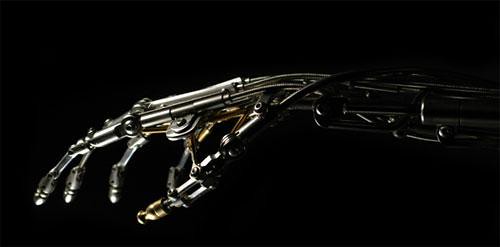
ROME (Dec. 2) - An Italian who lost his left forearm in a car crash was successfully linked to a robotic hand, allowing him to feel sensations in the artificial limb and control it with his thoughts, scientists said Wednesday.

During a one-month experiment conducted last year, 26-year-old Pierpaolo Petruzziello felt like his lost arm had grown back again, although he was only controlling a robotic hand that was not even attached to his body.

"It's a matter of mind, of concentration," Petruzziello said. "When you think of it as your hand and forearm, it all becomes easier."

Wednesday, October 28, 2009

Cyberpunk 2009


"At what point do 'replacements' become enhancements?" -- Peter W. Singer, author, February 2009

Adelson, E., Bionic Athletes: Let 'em play, ESPN, Apr 2008

Prosthetic advances let athletes like Jerrod Fields and Anthony Burruto dream of keeping up with (or passing) the pros. If this sounds impossible - or unfair - you might want to keep reading.
Fermoso, J., Prosthetic Limb Research Could Lead To Bionic Athletes, Gadgets Controlled by the Brain, Wired, Jul 2008

Oscar Pistorius, a double amputee, uses carbon fiber-composite legs and doesn’t define himself as disabled — he’s already considered one of the fastest men in the world. The International Association of Athletics Federations (IAAF) agrees: When Pistorius requested to participate in the trials for the Beijing Olympics, he was flatly rejected.

Why? According to Time, ‘more energy is returned to [his] upper legs from his blades than from ankles and calf muscles and . . . uses less oxygen.’ He was too physically advanced to compete against ‘non-disabled’ men.
Mahoney, J., Paralympics: The Games Where Bionic Athletes Reign, Gizmodo, Sep 2008

Before double-amputee sprinter Oscar Pistorius was finally approved to compete in the Olympics (he failed to qualify, barely), naysayers claimed his carbon-fiber Cheetah blade prostheses gave him an advantage over non-cyborg competitors.

Tuesday, June 30, 2009

Transhumanism Has Arrived


Science Daily: Real-time Control Of Wheelchair With Brain Waves.

ScienceDaily (June 29, 2009) — Japan's BSI-TOYOTA Collaboration Center has successfully developed a system that controls a wheelchair using brain waves in as little as 125 milliseconds.

BTCC was established in 2007 by RIKEN, an independent Japanese research institution, as a collaborative project with Toyota Motor Corporation, Toyota Central R&D Labs, Inc., and Genesis Research Institute, Inc. Also collaborating in the research were Andrzej Cichocki, Unit Leader, and Kyuwan Choi, Research Scientist, of BTCC's Noninvasive BMI Unit.

Recently technological developments in the area of brain machine interface (BMI) have received much attention. Such systems allow elderly or handicapped people to interact with the world through signals from their brains, without having to give voice commands.