Showing posts with label Cyberpunk 2009. Show all posts

Wednesday, December 2, 2009

Cyberpunk December 2009


"Things that a physicist would snicker at today could become possible in the coming decades. As we get a better grasp on quantum theory, we think that it may be possible to make objects invisible. It may be possible to teleport them like you see on 'Star Trek.' So some of the things that we see in science fiction could very well become science fact in the coming years." -- Michio Kaku, physicist, February 2008

AP via AOL News: Man Moved Robotic Hand With Mind.

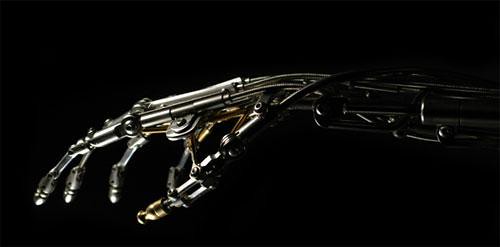
ROME (Dec. 2) - An Italian who lost his left forearm in a car crash was successfully linked to a robotic hand, allowing him to feel sensations in the artificial limb and control it with his thoughts, scientists said Wednesday.

During a one-month experiment conducted last year, 26-year-old Pierpaolo Petruzziello felt like his lost arm had grown back again, although he was only controlling a robotic hand that was not even attached to his body.

"It's a matter of mind, of concentration," Petruzziello said. "When you think of it as your hand and forearm, it all becomes easier."

Wednesday, October 28, 2009

Cyberpunk 2009


"At what point do 'replacements' become enhancements?" -- Peter W. Singer, author, February 2009

Adelson, E., Bionic Athletes: Let 'em play, ESPN, Apr 2008

Prosthetic advances let athletes like Jerrod Fields and Anthony Burruto dream of keeping up with (or passing) the pros. If this sounds impossible - or unfair - you might want to keep reading.
Fermoso, J., Prosthetic Limb Research Could Lead To Bionic Athletes, Gadgets Controlled by the Brain, Wired, Jul 2008

Oscar Pistorius, a double amputee, uses carbon fiber-composite legs and doesn’t define himself as disabled — he’s already considered one of the fastest men in the world. The International Association of Athletics Federations (IAAF) agrees: When Pistorius requested to participate in the trials for the Beijing Olympics, he was flatly rejected.

Why? According to Time, ‘more energy is returned to [his] upper legs from his blades than from ankles and calf muscles and . . . uses less oxygen.’ He was too physically advanced to compete against ‘non-disabled’ men.
Mahoney, J., Paralympics: The Games Where Bionic Athletes Reign, Gizmodo, Sep 2008

Before double-amputee sprinter Oscar Pistorius was finally approved to compete in the Olympics (he failed to qualify, barely), naysayers claimed his carbon-fiber Cheetah blade prostheses gave him an advantage over non-cyborg competitors.

Tuesday, June 30, 2009

Transhumanism Has Arrived


Science Daily: Real-time Control Of Wheelchair With Brain Waves.

ScienceDaily (June 29, 2009) — Japan's BSI-TOYOTA Collaboration Center has successfully developed a system that controls a wheelchair using brain waves in as little as 125 milliseconds.

BTCC was established in 2007 by RIKEN, an independent Japanese research institution, as a collaborative project with Toyota Motor Corporation, Toyota Central R&D Labs, Inc., and Genesis Research Institute, Inc. Also collaborating in the research were Andrzej Cichocki, Unit Leader, and Kyuwan Choi, Research Scientist, of BTCC's Noninvasive BMI Unit.

Recently technological developments in the area of brain machine interface (BMI) have received much attention. Such systems allow elderly or handicapped people to interact with the world through signals from their brains, without having to give voice commands.