"They are looking through the wrong end of the telescope and telling us what they imagine they see." -- Mel Acheson
According to relativity, photons have zero mass. Since they have zero mass, it is impossible for gravity to have any effect on them. However this is all denied by the fanatic relativists: Supermassive Black Hole Dissected With Natural Magnifying Glasses: 1,000 Times Clearer Than Best Telescopes Can Do.
The team of astronomers from Europe and the US studied the "Einstein Cross", a famous cosmic mirage. This cross-shaped configuration consists of four images of a single very distant source. The multiple images are a result of gravitational lensing by a foreground galaxy, an effect that was predicted by Albert Einstein as a consequence of his theory of general relativity. The light source in the Einstein Cross is a quasar approximately ten billion light-years away, whereas the foreground lensing galaxy is ten times closer. The light from the quasar is bent in its path and magnified by the gravitational field of the lensing galaxy.So let me get this straight. Prior to Einstein's hypothesis of General Relativity, magnetic fields couldn't bend light? Ever heard of magneto-optic effects? And how can something that has zero mass be affected by gravity? If gravity bends light, why don't astronauts and cosmonauts observe this effect when they look at the Earth? Why don't we see the Earth as blurry? And why don't we observe this effect around Sagittarius A*?
Dowdye, Jr., E.H., Astrophysical observations at the galactic center appear to counter General Relativity, suggesting that the conventional understanding of gravitational lensing is seriously flawed, 2007
Intense astrophysical observations at the galactic center of the Milky Way appear to counter General Relativity, suggesting that the conventional understanding of gravitational lensing is seriously flawed. The lack of evidence for any gravitational light bending effects on the emissions from the orbiting stellar objects about the galactic core clearly shows that fundamental principles of Mathematical Physics may have been seriously misapplied to the problem at the galactic core. This has apparently resulted in flawed concepts on the interaction of gravity and light, also resulting in the conventional understanding of gravitational lensing.Scott, D., Gravitational Lensing or Death of a Theory?, Jul 2006
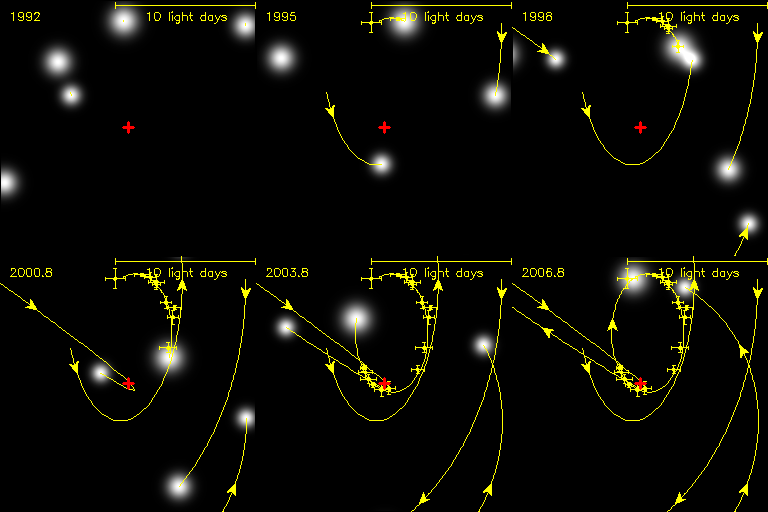
Observed emissions from the rapidly moving stars, especially the star known as S2, observed to move on an well defined eliptical path about the galactic center known as Sagittarius A*, appear to contradict General Relativity. Time resolved images of the Keplerian motion of these stars have exhibited to date no evidence of gravitational distortions in the images due to gravitational
light bending effects, as predicted by General Relativity. Moreover, the findings clearly show that fundamental principles of Mathematical Physics may have been seriously misapplied to the conventional understanding of gravitational lensing.
Details have been published in the highly esteemed and renowned refereed journal, the Astronomische Nachrichten (English title: Astronomical Notes). The title of the article is: "Time resolved images from the center of the Galaxy appear to counter General Relativity", Dowdye, Jr., E.H., Astronomische Nachrichten, Volume 328, Issue 2, Date: February 2007, Pages 186-191.
Dowdye, Jr., E.H., Profound Fundamentals of Mathematical Physics Seriously Misapplied to Gravitational Lensing, Dec 2008