Showing posts with label Antarctica. Show all posts

Monday, March 25, 2013

18 KG Meteorite Found In Antarctica

SCIENTISTS AT PRINCESS ELISABETH ANTARCTICA DISCOVER 18KG ANTARCTIC METEORITE.
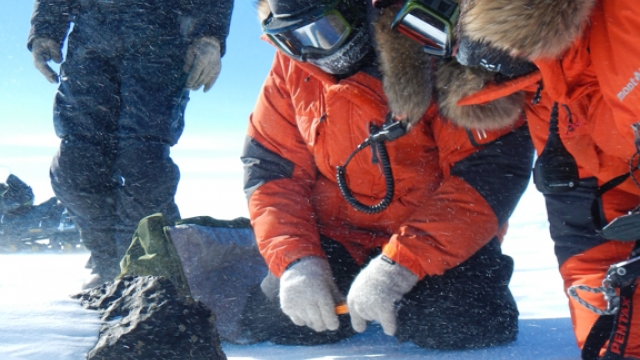
A team of scientists working at Princess Elisabeth Antarctica has recently discovered a meteorite weighing 18kg embedded in the East Antarctic ice sheet, the largest such meteorite found in the region since 1988. The eight members of the SAMBA project, from Université Libre de Bruxelles (ULB) and Vrije Universiteit Brussel (VUB), Japan’s National Institute of Polar Research (NIPR) and Tokyo University were searching for meteorites scattered across the Nansen Ice Field on January 28, when they found the 18kg ordinary chondrite. The team discovered a total of 425 meteorites, with a total weight of 75kg during the 40 day expedition, at an altitude of 2,900m, 140km south of Belgium’s Princess Elisabeth Antarctica research base. “This meteorite was a very unexpected find for us, not only due to its weight, but because we don’t normally find such large meteorites in Antarctica”, said Vinciane Debaille, a geologist from Université Libre de Bruxelles, who led the Belgian team during the expedition. “This is the biggest meteorite found in East Antarctica for 25 years, so it’s a very special discovery for us, only made possible by the existence and location of Princess Elisabeth Antarctica.” The SAMBA project contributesto the US and Japan-led global collection of Antarctic meteorites, and is an initiative of VUB and ULB, in collaboration with the Japanese Institute of Polar Research. SAMBA is supported by the Belgian Science Policy (BELSPO) and the International Polar Foundation. Initial field analysis by the scientists suggests that the 18kg meteorite is an ordinary chondrite, the most abundant kind of meteorite. The fusion crust – the meteorite’s outer casing - was eroded, allowing the scientists to inspect the rock underneath. The meteorite is currently undergoing a special thawing process in Japan – to ensure water doesn’t get inside the rock - but will be brought to Belgium in the future. “We study meteorites in order to better understand how the solar system formed, how it evolved, how the Earth became such a unique planet in our solar system”, said Debaille. “This season’s SAMBA mission was a success both in terms of the number and weight of the meteorites we found. Two years ago, we found less than 10kg. This year, we found so much that we had to call the travel agency – because we had 75kg of meteorites to take home”. Princess Elisabeth Antarctica is the world’s first zero emission polar research station, and is operated by the International Polar Foundation, in partnership with the Belgian Polar Secretariat. Princess Elisabeth Antarctica’s design and construction seamlessly integrates passive building technologies, renewable wind and solar energy, water treatment facilities, continuously monitored power demand and a smart grid for maximising energy efficiency. Located in East Antarctica’s Sør Rondane Mountains, Princess Elisabeth Antarctica welcomes scientists from around the world to conduct research in this little-studied and pristine environment. “Both Princess Elisabeth Antarctica and the International Polar Foundation are proud to support the research work of the Belgian and Japanese meteorite team”, said expedition leader Alain Hubert. “By providing solid logistics and field accomodation solutions to scientists working on the ice, we can ensure they can concentrate on what they have come to Antarctica to achieve: unlocking of Nature’s mysteries and broadening understanding of our planet”. To find out more about science at Princess Elisabeth Antarctica and life in the frozen south, visit Inside the Station – an interactive exhibition that takes visitors on a journey inside Belgium’s zero emission polar research centre - currently taking place at Tour & Taxis, Brussels.

Thursday, April 5, 2012

Lewis Spence: The History of Atlantis


"When was the human race destroyed by a flood? Was it not before us? When was the world set on fire, and reduced to coals and ashes? Was it not before us? When were the greatest cities engulfed in the billows of the sea? Was it not before us? When were wars waged with wild beasts, and battles fought with lions? Was it not before us? When was ruin brought upon whole communities by poisonous serpents? Was it not before us?" -- Arnobius, author, 4th century

"... let it be remembered, that the very site of Nineveh was forgotten, that until a century ago only the barest outlines of Babylonian and Egyptian history were known to us, that their written hieroglyphs were undecipherable." -- Lewis Spence, author, The History of Atlantis, 1927

"... it is merely childish to refuse to believe the main details of Plato's story." -- Lewis Spence, author, The History of Atlantis, 1927

"Nine thousand years before Solon's day, or about 9600 B.C., war broke out between the the nations within the Pillars of Hercules and those beyond them." -- Lewis Spence, author, The History of Atlantis, 1927

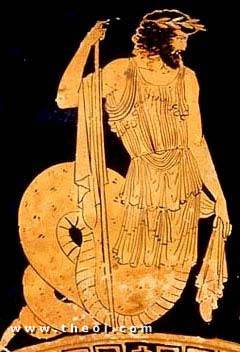
"The name of the eldest son [of Uranus/Poseidon] was Atlas, who was king of the entire island [Antarctica/Atlantis/Ogygia], and from him the Atlantic Ocean takes its name. His twin brother was called, in the Atlantean language, Gadir, and in the Greek Eumolus." -- Lewis Spence, author, The History of Atlantis, 1927

"Uranus had forty-five children by various wives, and eighteen by Titea or Terra, who thus came to be known as Titans, or the Terrene people." -- Lewis Spence, author, The History of Atlantis, 1927

"Diodorus, in his Fifth Book, also states that a certain Atlantic island was discovered [sic] by some Phoenician navigators, who, while sailing along the west coast of Africa, were driven by violent winds across the Ocean [like Odysseus]. They brought back such an account of the beauty and resources of the island, that the Tyrrhenians, having obtained the mastery of the sea, planned an expedition to colonise the new land, but were hindered by the opposition of the Carthaginians. Diodorus does not mention the name of the island; and he differs from Plato by referring to it [Antarctica] as still existing." -- Lewis Spence, author, The History of Atlantis, 1927

"Pomponius Mela (b. A.D. 80) expressly affirmed in his First Book the existence of such an island as Atlantis, but places it in the Southern temperate zone [Antarctica/Terra Australis]." -- Lewis Spence, author, The History of Atlantis, 1927

Sunday, September 26, 2010

Orpheus In Antarctica


"First then let us name Orpheus whom once Calliope bare, it is said, wedded to Thracian Oeagrus, near the Pimpleian height. Men say that he by the music of his songs charmed the stubborn rocks upon the mountains and the course of rivers. And the wild oak-trees to this day, tokens of that magic strain, that grow at Zone on the Thracian shore, stand in ordered ranks close together, the same which under the charm of his lyre he led down from Pieria. Such then was Orpheus whom Aeson's son [Jason] welcomed to share his toils, in obedience to the behest of Cheiron, Orpheus ruler of Bistonian Pieria." -- Apollonius Rhodius, Argonautica, 3rd century B.C.

"He [Jason] spake, and mounted the ship first of all; and so the rest of the chiefs followed, and, sitting in order, seized the oars; and Argus loosed for them the hawsers from under the sea-beaten rock. Whereupon they mightily smote the water with their long oars, and in the evening by the injunctions of Orpheus they touched at the island of Electra, daughter of Atlas, in order that by gentle initiation they might learn the rites that may not be uttered, and so with greater safety sail over the chilling sea. Of these I will make no further mention; but I bid farewell to the island itself and the indwelling deities, to whom belong those mysteries, which it is not lawful for me to sing." -- Apollonius Rhodius, Argonautica, 3rd century B.C.

Friday, September 10, 2010

Atlantis In The Avesta


"Upon the material world the fatal winters are going to fall, that shall bring the fierce, foul frost; upon the material world the fatal winters are going to fall, that shall make snow-flakes fall thick ...." -- Avesta, Vendidad, Fargard II, 1000 B.C.

"After the third time, Ahura Mazda warns Yima in an assembly of 'celestial gods and excellent mortals' that upon the material world the fatal winters are going to fall, and all life will perish. This is the old Mazdean symbolism for the 'flood,' and the coming cataclysm to Atlantis, which sweeps away every race in its turn. Like Vaivasvata Manu and Noah, Yima makes a vara (an enclosure, an ark) under the God's direction, and brings thither the seed of every living creature, animals, and 'fire.'" -- Helena P. Blavatsky, theosopher, The Secret Doctrine, 1888

"Ahura Mazda then warns Yima of a series of terrible winters that are about to come to the earth, in which the tops of the highest mountains will be covered by snow." -- Elwood Worcester, author, The Book of Genesis in the Light of Modern Knowledge, 1901

"Ahura Mazda warns Yima, the first king of men, of the approach of a dire winter, which is to destroy every living creature by covering the land with a thick sheet of ice, and advises Yima to build a Vara, or an enclosure, to preserve the seeds of every kind of animal and plant." -- Bal G. Tilak, author, The Arctic Home in the Vedas, 1903

Thursday, September 9, 2010

Abrupt Cooling of Antarctica 3,000 B.C.


"[The] Antarctic may hold the future of archaeology." -- Norman Hammond, archaeologist, February 2008

Stager, J.C., Mayeswski, P.A., Abrupt Early to Mid-Holocene Climatic Transition Registered at the Equator and the Poles, Science, Volume 276, Number 5320, Pages 1834-1836, Jun 1997
Paleoclimatic records from equatorial East Africa, Antarctica, and Greenland reveal that atmospheric circulation changed abruptly at the early to mid-Holocene transition to full postglacial conditions. A climatic reorganization occurred at all three sites between 8200 and 7800 years ago that lasted 200 years or less and appears to have been related to abrupt transitions in both marine and terrestrial records around the world.
Masson, V., et al., Holocene Climate Variability in Antarctica Based on 11 Ice-Core Isotopic Records, Quaternary Research, Volume 54, Issue 3, Pages 348-358, Nov 2000
All the records confirm the widespread Antarctic early Holocene optimum between 11,500 and 9000 yr; in the Ross Sea sector, a secondary optimum is identified between 7000 and 5000 yr, whereas all eastern Antarctic sites show a late optimum between 6000 and 3000 yr.
Hodell, E.A., et. al, Abrupt Cooling of Antarctic Surface Waters and Sea Ice Expansion in the South Atlantic Sector of the Southern Ocean at 5000 cal yr B.P., Quaternary Research, Volume 56, Issue 2, Pages 191-198, Sep 2001
Antarctic surface waters were warm and ice free between 10,000 and 5000 cal yr B.P., as judged from ice-rafted debris and microfossils in a piston core at 53°S in the South Atlantic. This evidence shows that about 5000 cal yr B.P., sea surface temperatures cooled, sea ice advanced, and the delivery of ice-rafted detritus (IRD) to the subantarctic South Atlantic increased abruptly. These changes mark the end of the Hypsithermal and onset of Neoglacial conditions. They coincide with an early Neoglacial advance of mountain glaciers in South America and New Zealand between 5400 and 4900 cal yr B.P., rapid middle Holocene climate changes inferred from the Taylor Dome Ice Core (Antarctica), cooling and increased IRD in the North Atlantic, and the end of the African humid period. The near synchrony and abruptness of all these climate changes suggest links among the tropics and both poles that involved nonlinear response to gradual changes in Northern Hemisphere insolation. Sea ice expansion in the Southern Ocean may have provided positive feedback that hastened the end of the Hypsithermal and African humid periods in the middle Holocene.
Hjort, C., et al., Holocene and Pre-Holocene Temporary Disappearance of the George VI Ice Shelf, Antarctic Penninsula, Antarctic Science, Volume 13, Number 3, Pages 296-301, 2001
Barnacle Bathylasma corolliforme shells sampled from ice shelf moraines at Two Step Cliffs on Alexander Island have been dated to c. 5750-6000 14C yr BP (c. 6550-6850 cal yr BP)
Pudsey C.J., and Evans, J., First Survey of Antarctic Sub–Ice Shelf Sediments Reveals Mid-Holocene Ice Shelf Retreat, Geology, Volume 29, Number 9, Pages 787-790, Sep 2001
The retreat of five small Antarctic Peninsula ice shelves in the late 20th century has been related to regional (possibly anthropogenic) climate warming. We use the record of ice- rafted debris (IRD) in cores to show that the Prince Gustav Channel ice shelf also retreated in mid-Holocene time. Early and late Holocene-age sediments contain IRD derived entirely from local ice drainage basins, which fed the section of ice shelf covering each site. Core- top and mid-Holocene (5–2 ka) sediments include a wider variety of rock types, recording the drift of far-traveled icebergs, which implies seasonally open water at the sites. The period when the Prince Gustav ice shelf was absent corresponds to regional climate warming deduced from other paleoenvironmental records. We infer that the recent decay cannot be viewed as an unequivocal indicator of anthropogenic climate perturbation.
Perkins, S., Antarctic Sediments Muddy Climate Debate, Science News, Sep 8th 2001
Ocean-floor sediments drilled from Antarctic regions recently covered by ice shelves suggest that those shelves were only 2,000 years old.
Gore, D.B. et al., Bunger Hills, East Antarctica: Ice free at the Last Glacial Maximum, Geology, Volume 29, Number 12, Pages 1103-1106, Dec 2001
Optically stimulated luminescence dating of glaciofluvial and glacial-lake shoreline sediments indicates that the Bunger Hills area, in coastal East Antarctica, was largely ice free by the Last Glacial Maximum (LGM). Deglaciation commenced as early as 30 ka, and the southern hills were completely exposed by 20 ka. The sediments do not record evidence of an LGM readvance. Previous reconstructions of LGM ice limits for the area are incompatible with this new evidence.
Bentley, M.J., et al., Early Holocene Retreat of the George VI Ice Shelf, Antarctic Peninsula, Geology, Volume 33, Number 3, Pages 173-176, Mar 2005
The recent collapse of several Antarctic Peninsula ice shelves has been linked to rapid regional atmospheric warming during the twentieth century. New high-resolution lake sediment records of Holocene ice-shelf behavior show that the George VI Ice Shelf was absent beginning ca. 9595 calibrated (cal.) yr B.P., but reformed by ca. 7945 cal. yr B.P. This retreat immediately followed a period of maximum Holocene warmth that is recorded in some ice cores and occurred at the same time as an influx of warmer ocean water onto the Antarctic Peninsula shelf. The absence of the ice shelf suggests that early Holocene ocean-atmosphere variability in the Antarctic Peninsula was greater than that measured in recent decades.
Bentley, M.J., and Hodgson, D.A., Antarctic Ice Sheet and Climate History Since the Last Glacial Maximum, Pages, Volume 17, Number 1, Jan 2009
Results showed that there are two warm periods recorded in most of the proxy records - a period of early Holocene warmth, and a Mid-Holocene Hypsithermal (Fig. 3)
Bentley, M.J., et al., Mechanisms of Holocene Palaeoenvironmental Change in the Antarctic Peninsula Region, The Holocene, Volume 19, Number 1, Pages 51-69, 2009
Two warm events are well recorded in the Holocene palaeoclimate record, namely the early Holocene warm period, and the `Mid Holocene Hypsithermal' (MHH)
Sime, L.C., et al., Evidence For Warmer Interglacials in East Antarctic Ice Cores, Nature, Number 462, Pages 342-345, Nov 19th 2009
We conclude that previous temperature estimates from interglacial climates are likely to be too low.
Schiermeier, Q., Antarctic Temperature Spike Surprises Researchers, NatureNews, Nov 18 2009
Sime adds that scientists still know too little about what happened in Antarctica during warm climates similar to ours. "We'd be better off if we did."

Wednesday, September 8, 2010

Warm Antarctica 11,000 B.C.


Science Daily: New Clue to How Last Ice Age Ended.

ScienceDaily (Sep. 8, 2010) — As the last ice age was ending, about 13,000 years ago, a final blast of cold hit Europe, and for a thousand years or more, it felt like the ice age had returned. But oddly, despite bitter cold winters in the north, Antarctica was heating up. For the two decades since ice core records revealed that Europe was cooling at the same time Antarctica was warming over this thousand-year period, scientists have looked for an explanation.

A new study in Nature brings them a step closer by establishing that New Zealand was also warming, indicating that the deep freeze up north, called the Younger Dryas for the white flower that grows near glaciers, bypassed much of the southern hemisphere.

"Glaciers in New Zealand receded dramatically at this time, suggesting that much of the southern hemisphere was warming with Antarctica," said study lead author, Michael Kaplan, a geochemist at Columbia University's Lamont-Doherty Earth Observatory. "Knowing that the Younger Dryas cooling in the northern hemisphere was not a global event brings us closer to understanding how Earth finally came out of the ice age."
The biting question I have is: who needs Lamont-Doherty Observatory when we have Homer, Herodotus, Plato, Plutarch, and Newton?

Tuesday, September 7, 2010

Revisiting Atlantis/Antarctica In Homer


"... on a sea-girt island, where the sea's navel is.
The island is forested, and on it a goddess makes her home,
the daughter of malign Atlas, he who knows the depths
of every sea
and by himself holds the tall pillars
that hold apart heaven and earth
." -- Homer, poet, Odyssey, Book I, 50-54, 8th century B.C.

"... to the island of Ogygia ...." -- Homer, Odyssey, Book I, 85, 8th century

"Instead, he'll [Odysseus] suffer miseries on a well-bound raft
and reach fertile Scheria on the twentieth day,
the land of the Phaeacians, who are close to the gods...." -- Homer, Odyssey, Book V, 33-35, 8th century B.C.

"Even an immortal, after coming there,
would gaze in admiration at what he saw and be delighted in his mind.
Runner Argeiphontes stood there and gazed in admiration." -- Homer, Odyssey, Book V, 73-74, 8th century B.C.

"Who'd run across so much briny water?
It's immense! Nor is there nearby any mortals' city...." -- Homer, Odyssey, Book V, 100-101, 8th century B.C.

"An island, Ogygia, lies far off on the sea.
Atlas' daughter lives there, crafty fair-haired Calypso,
a dread goddess. No one mixes with her,
neither gods nor mortal men.
But a divine one led this wretched one, me, to her hearth
alone, after Zeus impeded and split my swift ship
with white lightning in the midst of the wine-dark sea.
All the rest of my good comrades perished there,
but in my arms I grabbed the double-curved ship's keel
and for nine days I was carried. On the tenth dark night
the gods brought me to the island of Ogygia
." -- Homer, Odyssey, Book VII, 244-254, 8th century B.C.

"'Nine days I was carried from there, and on the tenth night
the gods brought me to the island of Ogygia
.'" -- Homer, Odyssey, Book XII, 447-448, 8th century B.C.

"After this at a distance of ten days' journey there is another hill of salt and spring of water, and men dwell round it. Near this salt hill is a mountain named Atlas, which is small in circuit and rounded on every side; and so exceedingly lofty is it said to be, that it is not possible to see its summits, for clouds never leave them either in the summer or in the winter. This the natives say is the pillar of the heaven. After this mountain these men got their name, for they are called Atlantians; and it is said that they neither eat anything that has life nor have any dreams." -- Herodotus, historian, History, Book IV, 440 B.C.

"For at one moment he [Polybius] quotes the words of the poet, 'Thence for nine whole days was I borne by baneful winds'; and at another moment he suppresses statements. For Homer says also: 'Now after the ship had left the river-stream of Oceanus'; and 'In the island of Ogygia, where is the navel of the sea,' going on to say that the daughter of Atlas lives there; and again, regarding the Phaeacians, 'Far apart we live in the wash of the waves, the farthermost men, and no other mortals are conversant with us.' Now all these incidents are clearly indicated as being placed in fancy in the Atlantic Ocean; but Polybius by suppressing them destroys what the poet states in expressing them. In so doing he is wrong ...." -- Strabo, geographer, The Geography, 7


"The great mainland, by which the great ocean is encircled, while not so far from the other islands, is about five thousand stades from Ogygia, the voyage being made by oar, for the main is slow to traverse and muddy as a result of the multitude of streams. The streams are discharged by the great land-mass and produce alluvial deposits, thus giving density and earthiness to the sea, which has been thought actually to be congealed. On the coast of the mainland Greeks dwell about a gulf which is not smaller than the Maeotis and the mouth of the Caspian sea. These people consider and call themselves continentals and the inhabitants of this land islanders because the sea flows around it on all sides; and they believe that with the peoples of Cronus there mingled at a later time those who arrived in the train of Heracles and were left behind by him and that these latter so to speak rekindled again to a strong, high flame the Hellenic spark there which was already being quenched and overcome by the tongue, the laws, and the manners of the barbarians. Therefore Heracles has the highest honours and Cronos the second. Now when at intervals of thirty years the star of Cronus, which we call 'Splendent' but they, our author said, call 'Night-watchman,' enters the sign of the Bull, they, having spent a long time in preparation for the sacrifice and the expedition, choose by lot and send forth a sufficient number of envoys in a correspondingly sufficient number of ships, putting aboard a large retinue and the provisions necessary for men who are going to cross so much sea by oar and live such a long time in a foreign land. Now when they have put to sea the several voyagers meet with various fortunes as one might expect; but those who survive the voyage first put in at the outlying islands, which are inhabited by Greeks, and see the sun pass out of sight for less than an hour over a period of thirty days, — and this is night, though it has a darkness that is slight and twilight glimmering from the west. There they spend ninety days regarded with honour and friendliness as holy men and so addressed, and then winds carry them across to their appointed goal. Nor do any others inhabit it but themselves and those who have been dispatched before them, for, while those who have served the god together for the stint of thirty years are allowed to sail off home, most of them usually choose to settle in the spot, some out of habit and others because without toil or trouble they have all things in abundance while they constantly employ their time in sacrifices and celebrations or with various discourse and philosophy, for the nature of the island is marvellous as is the softness of the circumambient air. Some when they intend to sail away are even hindered by the divinity which presents itself to them as to intimates and friends not in dreams only or by means of omens, but many also come upon the visions and the voices of spirits manifest. For Cronus himself sleeps confined in a deep cave of rock that shines like gold — the sleep that Zeus has contrived like a bond for him —, and birds flying in over the summit of the rock bring ambrosia to him, and all the island is suffused with fragrance scattered from the rock as from a fountain; and those spirits mentioned before tend and serve Cronus, having been his comrades what time he ruled as king over gods and men. Many things they do foretell of themselves, for they are oracular; but the prophecies that are greatest and of the greatest matters they come down and report as dreams of Cronus, for all that Zeus premeditates Cronus sees in his dreams and the titanic affections and motions of his soul make him rigidly tense until sleep restores his repose once more and the royal and divine element is all by itself, pure and unalloyed. Here then the stranger was conveyed, as he said, and while he served the god became at his leisure acquainted with astronomy, in which he made as much progress as one can by practising geometry, and with the rest of philosophy by dealing with so much of it as is possible for the natural philosopher. Since he had a strange desire and longing to observe the Great Island (for so, it seems, they call our part of the world...." -- Plutarch, historian, Concerning the Face Which Appears In The Orb of the Moon, Chapter 26, 1st century

"896 B.C. Ulysses found Calypso on the island of Ogygia [Antarctica] .... She was the daughter of Atlas, according to Homer. The ancients at length imagined that this island (which they called Atlantis after the name of Atlas) had been as large as all Europe, Africa and Asia, and sank into the sea." -- Isaac Newton, mathematician, Revised History of Ancient Kingdoms, 1727
Sunday, September 5, 2010

The Atlantis Sea In Herodotus


Herodotus, History, Book I, 203, 440 B.C.
Now the Caspian Sea is apart by itself, not having connection with the other Sea: for all that Sea which the Hellenes navigate, and the Sea beyond the Pillars, which is called Atlantis, and the Erythraian Sea are in fact all one ....
Plato, Critias, 360 B.C.
I have before remarked in speaking of the allotments of the gods, that they distributed the whole earth into portions differing in extent, and made for themselves temples and instituted sacrifices. And Poseidon, receiving for his lot the island of Atlantis, begat children by a mortal woman, and settled them in a part of the island, which I will describe. Looking towards the sea, but in the centre of the whole island, there was a plain which is said to have been the fairest of all plains and very fertile. Near the plain again, and also in the centre of the island at a distance of about fifty stadia, there was a mountain not very high on any side.

In this mountain there dwelt one of the earth born primeval men of that country, whose name was Evenor, and he had a wife named Leucippe, and they had an only daughter who was called Cleito. The maiden had already reached womanhood, when her father and mother died; Poseidon fell in love with her and had intercourse with her, and breaking the ground, inclosed the hill in which she dwelt all round, making alternate zones of sea and land larger and smaller, encircling one another; there were two of land and three of water, which he turned as with a lathe, each having its circumference equidistant every way from the centre, so that no man could get to the island, for ships and voyages were not as yet. He himself, being a god, found no difficulty in making special arrangements for the centre island, bringing up two springs of water from beneath the earth, one of warm water and the other of cold, and making every variety of food to spring up abundantly from the soil. He also begat and brought up five pairs of twin male children; and dividing the island of Atlantis into ten portions, he gave to the first-born of the eldest pair his mother's dwelling and the surrounding allotment, which was the largest and best, and made him king over the rest; the others he made princes, and gave them rule over many men, and a large territory. And he named them all; the eldest, who was the first king, he named Atlas, and after him the whole island and the ocean were called Atlantic.
Plato, Timaeus, 360 B.C.
This power came forth out of the Atlantic Ocean, for in those days the Atlantic was navigable; and there was an island situated in front of the straits which are by you called the Pillars of Heracles; the island was larger than Libya and Asia put together, and was the way to other islands, and from these you might pass to the whole of the opposite continent which surrounded the true ocean; for this sea which is within the Straits of Heracles is only a harbour, having a narrow entrance, but that other is a real sea, and the surrounding land may be most truly called a boundless continent.
Atlantic Ocean, Encyclopaedia Britannica, 1929, 1956, 1963, 1970
ATLANTIC OCEAN, the name given to the vast stretch of sea dividing the continents of Europe and Africa from the new world. The term is supposedly derived from Atlantis, presumed to be a submerged continent below the present ocean.

The Naga of Antarctica In The Vishnu Purana


Vishnu Purana, Book II, Chapter V:

PARÁŚARA.--The extent of the surface of the earth has been thus described to you, Maitreya. Its depth below the surface is said to be seventy thousand Yojanas, each of the seven regions of Pátála extending downwards ten thousand. These seven, worthy Muni, are called Atala [Antarctica], Vitala, Nitala, Gabhastimat, Mahátala, Sutala, and Pátála. Their soil is severally white, black, purple, yellow, sandy, stony, and of gold. They are embellished with magnificent palaces, in which dwell numerous Dánavas, Daityas, Yakshas, and great snake-gods. The Muni Nárada, after his return from those regions to the skies, declared amongst the celestials that Pátála was much more delightful than Indra's heaven. "What," exclaimed the sage, "can be compared to Pátála, where the Nágas are decorated with brilliant and beautiful and pleasure-shedding jewels? who will not delight in Pátála, where the lovely daughters of the Daityas and Dánavas wander about, fascinating even the most austere; where the rays of the sun diffuse light, and not heat, by day; and where the moon shines by night for illumination, not for cold; where the sons of Danu, happy in the enjoyment of delicious viands and strong wines, know not how time passes? There are beautiful groves and streams and lakes where the lotus blows; and the skies are resonant with the Koïl's song. Splendid ornaments, fragrant perfumes, rich unguents, the blended music of the lute and pipe and tabor; these and many other enjoyments are the common portion of the Dánavas, Daityas, and snake-gods, who inhabit the regions of Pátála."

Thursday, September 2, 2010

Atala: The White Island


"Ahura Mazda warns Yima, the first king of men, of the approach of a dire winter, which is to destroy every living creature by covering the land with a thick sheet of ice, and advises Yima to build a Vara, or an enclosure, to preserve the seeds of every kind of animal and plant." -- Zend-Avesta, Fargard II, 1000 B.C.

"On the northern shores of the Ocean of Milk there is an island of great splendour called by the name of White Island [Atala]. The men that inhabit that island have complexions as white as the rays of the Moon and that are devoted to Narayana. Worshippers of that foremost of all Beings, they are devoted to Him with their whole souls. They all enter that eternal and illustrious deity of a thousand rays. They are divested of senses. They do not subsist on any kind of food. Their eyes are winkless." -- Mahabharata, Book 12 (Santi Parva), SECTION CCCXXXVII, 8th century B.C.

"Now the Caspian Sea is apart by itself, not having connection with the other Sea: for all that Sea which the Hellenes navigate, and the Sea beyond the Pillars, which is called Atlantis, and the Erythraian Sea are in fact all one...." -- Herodotus, historian, History, Book I, 440 B.C.

"After this at a distance of ten days' journey there is another hill of salt and spring of water, and men dwell round it. Near this salt hill is a mountain named Atlas, which is small in circuit and rounded on every side; and so exceedingly lofty is it said to be, that it is not possible to see its summits, for clouds never leave them either in the summer or in the winter. This the natives say is the pillar of the heaven. After this mountain these men got their name, for they are called Atlantians; and it is said that they neither eat anything that has life nor have any dreams." -- Herodotus, historian, History, Book IV, 440 B.C.

"In the year 1193 after the birth of our Redeemer, Jesus Christ, the Aztec nation reached this land. These people, like the others who populated the country, departed from seven caves in a land called Aztlán. This name could mean 'Whiteness' or 'Place of the Herons.' Because of this the people were called Aztec which means 'People of Whiteness.'" -- Diego Duran, historian, 1581

"The account of this delightful country [Aztlan] given by Cueuhcoatl to the elder Montezuma, is as follows: 'Our fathers dwelt in that happy and prosperous place which they called Aztlan, which means 'whiteness.' In this place there is a great mountain in the middle of the water, which is called Culhuacan which means 'crooked mountain.'" -- John T. Short, historian, The North Americans of Antiquity, 1880

"The elder Montezuma said to Cortez, 'Our fathers dwelt in that happy and prosperous place which they called Aztlan, which means whiteness. ... In this place there is a great mountain in the middle of the water which is called Culhuacan, because it has the point somewhat turned over towards the bottom; and for this reason it is called Culhuacan, which means 'crooked mountain.' ... Here we have the same mountain in the midst of the water that Plato describes -- the same mountain to which all the legends of the most ancient races of Europe refer." -- Ignatius L. Donnelly, author, Atlantis: The Antediluvian World, 1882

"Do the Greeks, accused of borrowing a Hindu fiction (Atala) and inventing from it another (Atlantis), stand also accused of getting their geographical notions and the number seven from them?" -- Helena P. Blavatsky, theosophist, The Secret Doctrine, 1888

"... the four well-known native documents which have been preserved and which depict the wanderings of Montezuma's people, the Aztecs, from their original home to the valley of Mexico, agree in representing their point of departure as an island named Aztlan. Friar Duran translates this name as 'Place of Whiteness' which can be rendered as 'White land.'" -- Zelia Nuttall, anthropologist, The Island of Sacrificios, American Anthropologist, Volume 102, Issues 1-2, 1910

"The Vishnu Purana, the oldest of the Hindu puranas, speaks of Atala, the White Island, which is one of the seven islands (dwipas) belonging to Patala (the home of the Naga serpent deities)." -- Philip Gardiner, author, Gnosis, 2006

Monday, August 16, 2010

Atlantean Ice


"Ahura Mazda warns Yima, the first king of men, of the approach of a dire winter, which is to destroy every living creature by covering the land with a thick sheet of ice, and advises Yima to build a Vara, or an enclosure, to preserve the seeds of every kind of animal and plant." -- Zend-Avesta, Fargard II, 1000 B.C.

"Some say the world will end in fire,
Some say in ice.
From what I've tasted of desire
I hold with those who favor fire.
But if it had to perish twice,
I think I know enough of hate
To say that for destruction ice
Is also great
And would suffice."
-- Robert Frost, poet, December 1920

Science Daily: Resolving the Paradox of the Antarctic Sea Ice.

ScienceDaily (Aug. 16, 2010) — While Arctic sea ice has been diminishing in recent decades, the Antarctic sea ice extent has been increasing slightly.

Friday, July 2, 2010

Odysseus In Antarctica


"But Odysseus led the high-hearted men of Kephallenia,
those who held Ithaka and leaf-trembling Neriton,
those who dwelt about Krokyleia and rigged Aigilips,
those who held Zakynthos and those who dwelt about Samos,
those who held the mainland and the places next to the crossing.
All these men were led by Odysseus, like Zeus in counsel.
Following with him were twelve ships with bows red painted." -- Homer, poet, The Iliad, Book II: 631-637, ~ 8th century B.C.

"Next again the old man [Priam] asked her [Helen], seeing Odysseus:
'Tell me of this one also, dear child; what man can he be,
shorter in truth by a head than Atreus' son Agamemnon,
but broader, it would seem, in the chest and across the shoulders.
Now as his armour lies piled on the prospering earth, still he
ranges, like some ram, through the marshalled ranks of the fighters.
Truly, to some deep-fleeced ram would I liken him
who makes his way through the great mass of the shining sheep-flocks.'
Helen, the daughter descended of Zeus, spoke then in answer:
'This one is Laertes' son, resourceful Odysseus,
who grew up in the country, rough though it be, of Ithaka,
to know every manner of shiftiness and crafty counsels.'
In his turn Antenor of the good counsel answered her:
'Surely this word you have spoken, my lady, can be no falsehood.
Once in the days before now brilliant Odysseus came here
with warlike Menelaos, and their embassy was for your sake.
To both of these I gave in my halls kind entertainment
and I learned the natural way of both, and their close counsels.
Now when these were set before the Trojans assembled
and stood up, Menelaos was bigger by his broad shoulders
but Odysseus was the more lordly when both were seated.
Now before all when both of them spun their speech and their counsels,
Menelaos indeed spoke rapidly, in few words
but exceedingly lucid, since he was no long speaker
one who wasted his words though he was only a young man.
But when that other drove to his feet, resourceful Odysseus,
he would just stand and stare down, eyes fixed on the ground beneath him,
nor would he gesture with the staff backward and forward, but hold it
clutched hard in front of him, like any man who knows nothing.
Yes, you would call him a sullen man, and a fool likewise.
But when he let the great voice go from his chest, and the words came
drifting down like the winter snows, then no other mortal
man beside could stand up against Odysseus. Then we
wondered less beholding Odysseus' outward appearance.'"-- Homer, poet, The Iliad, Book III: 191-224, ~ 8th century B.C.


Newton, I., Revised History of Ancient Kingdoms: A Complete Chronology, 1727

896 B.C. Ulysses found Calypso on the island of Ogygia [Antarctica] .... She was the daughter of Atlas, according to Homer. The ancients at length imagined that this island (which they called Atlantis after the name of Atlas) had been as large as all Europe, Africa and Asia, and sank into the sea.
"Odysseus' island is no longer a fantasy." -- Robert Bittlestone, consultant, Odysseus Unbound, 2005

Saturday, June 5, 2010

Drilling Into Atlantis


"For these histories tell of a mighty power which unprovoked made an expedition against the whole of Europe and Asia, and to which your city put an end. This power came forth out of the Atlantic Ocean, for in those days the Atlantic was navigable; and there was an island situated in front of the straits which are by you called the Pillars of Heracles; the island was larger than Libya and Asia put together, and was the way to other islands, and from these you might pass to the whole of the opposite continent which surrounded the true ocean; for this sea which is within the Straits of Heracles is only a harbour, having a narrow entrance, but that other is a real sea, and the surrounding land may be most truly called a boundless continent. Now in this island of Atlantis there was a great and wonderful empire which had rule over the whole island and several others, and over parts of the continent, and, furthermore, the men of Atlantis had subjected the parts of Libya within the columns of Heracles as far as Egypt, and of Europe as far as Tyrrhenia." -- Plato, philosopher, Timaeus, 360 B.C.

Science Daily: Drilling Into the Unknown: First Exploration of a Sub-Glacial Antarctic Lake Is a Major Step Closer.

In a paper published in Geophysical Research Letters this week, scientists from Northumbria University, the University of Edinburgh and the British Antarctic Survey have revealed the optimal drill site for exploring Lake Ellsworth -- a sub-glacial lake, comparable in size to England's Lake Windermere, that is covered by three kilometers of ice.

No one has yet drilled into an Antarctic sub-glacial lake.

Monday, May 10, 2010

Cometary Dust Found In Atlantis


Science Daily: Cometary Dust in Antarctica?

ScienceDaily (May 10, 2010) — A new family of extraterrestrial particles, probably of cometary origin, has been identified for the first time in snow in Central Antarctica.

Discovered by researchers from the Center for Nuclear Spectrometry and Mass Spectrometry (CSNSM) (CNRS/Université Paris-Sud 11), attached to IN2P3 (Institut national de physique nucléaire et de physique des particules), the micrometeorites, which are remarkably well preserved, are made up of organic matter containing small assemblages of minerals from the coldest and most remote regions of the Solar System. This work is published in the journal Science.

The French-Italian scientific base Concordia is located at Dome C in the central region of the Antarctic continent. This is one of the most remote places in the world, where the amount of dust of terrestrial origin is extremely small.

Monday, November 16, 2009

Everything Is Older Than We Have Assumed


Science Daily: Ancient Penguin DNA Raises Doubts About Accuracy of Genetic Dating Techniques.

ScienceDaily (Nov. 15, 2009) — Penguins that died 44,000 years ago in Antarctica [Atlantis] have provided extraordinary frozen DNA samples that challenge the accuracy of traditional genetic aging measurements, and suggest those approaches have been routinely underestimating the age of many specimens by 200 to 600 percent.

In other words, a biological specimen determined by traditional DNA testing to be 100,000 years old may actually be 200,000 to 600,000 years old, researchers suggest in a new report in Trends in Genetics, a professional journal.

The findings raise doubts about the accuracy of many evolutionary rates based on conventional types of genetic analysis.

"Some earlier work based on small amounts of DNA indicated this same problem, but now we have more conclusive evidence based on the study of almost an entire mitochondrial genome," said Dee Denver, an evolutionary biologist with the Center for Genome Research and Biocomputing at Oregon State University.

Sunday, October 11, 2009

China's 26th Atlantean Expedition


China Daily: Snow Dragon leaves for 26th Antarctica expedition.

SHANGHAI: With hundreds of people waving hands and saying goodbye, Chinese scientists left Shanghai Sunday morning for the country's 26th scientific expedition to the Antarctica.

Chen Lianzeng, deputy director of the National Bureau of Oceanography (NBO), declared at 10:10 am the start of China's 26th expedition to the Antarctica.

A group of 251 scientists, workers and logistics staff from China, Australia and Russia began the half-year-long research expedition in the icebreaker Xuelong, or "Snow Dragon."

During the trip, two exploration teams would be sent to the inner land of Antarctica.

One would head to China's Kunlun Station located at Dome A, the highest point on the continent at 4,093 meters above sea level, where more research equipment would be installed for astronomical observation.

The other to the Grove Mountains some 400 kilometers away from the Zhongshan Station to collect meteorites and conduct other scientific research. From 1998 to 2006, China has made four trips of scientific research to the mountains and collected 9,834 meteorites, making the country boast the third largest collection of meteorites in the world.

Saturday, September 12, 2009

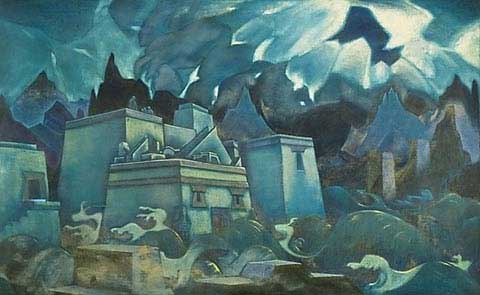
Atlantis Art of Nicholas Roerich


Star of the Hero, 1936


The Last of Atlantis, 1928


And We Do Not Fear, 1922

"I admire sincerely your art so much that I can say without exaggeration that never have landscapes made such a great impression on me." -– Albert Einstein, mathematician, 1931

Tuesday, September 8, 2009

Encounters at the End of the World


"Those few who have experienced the world under the frozen sky often speak of it as going down into the cathedral." -- Werner Herzog, film maker, 2007

"There are creatures that are down there that are like science fiction creatures. They range in the way that they would gobble you up from slime type blobs. But creepier than classical science fiction blobs. These would have long tendrils that ensnare you and as you tried to get away from them you would just become more and more ensnared by your own actions. And then after you would be frustrated and exhausted, then this creature would start to move in and take you apart. So that's one example of one of the types of creatures and then there are other worm type things with horrible mandibles and jaws and just bits to rend your flesh. It really is a violent, horribly violent, world. That is obscure to us because we are encased in neoprene and we're much larger than that world. So it doesn't really affect us. But if you were to shrink down and to miniaturize into that world, it would be a horrible place to be. Just horrible." -- Samuel A. Bowser, biologist, 2007

"The end of human life on this Earth is assured. Human life on Earth is part of an endless chain of catastrophes. The demise of the dinosaurs being just one of these events." -- Werner Herzog, film maker, 2007

Wednesday, August 19, 2009

Atlantean Sloths Set Carribean Civ Back To 8,000 B.C.


Science Daily: Stone Tools, Rare Animal Bones: Clues To Caribbean's Earliest Inhabitants Discovered.

ScienceDaily (Aug. 19, 2009) — A prehistoric water-filled cave in the Dominican Republic has become a "treasure trove" with the announcement by Indiana University archaeologists of the discovery of stone tools, a small primate skull in remarkable condition, and the claws, jawbone and other bones of several species of sloths.

The discoveries extend by thousands of years the scope of investigations led Charles Beeker, director of Academic Diving and Underwater Science Programs at IU Bloomington's School of Health, Physical Education and Recreation, and his interdisciplinary team of collaborators. The researchers' focus has been on the era a mere 500 years ago when the Old World and New World first met after Christopher Columbus stepped ashore in the Caribbean -- and on scintillating pirate lore. This rare find is expected to give insights into the earliest inhabitants of the Greater Antilles and the animals they encountered.

"To be honest, I couldn't believe my eyes as I viewed each of these astonishing discoveries underwater," Beeker said. "The virtually intact extinct faunal skeletons really amazed me, but what may prove to be a fire pit from the first human occupation of the island just seems too good to be true. But now that the lithics (stone tools) are authenticated, I can't wait to direct another underwater expedition into what may prove to become one of the most important prehistoric sites in all the Caribbean."

Beeker and researchers Jessica Keller and Harley McDonald found the tools and bones in fresh water 28- to 34-feet deep in a cave called Padre Nuestro. Nearby, and also underwater in the same cave, were found more recent Taino artifacts. The Taino were the first Native American peoples to encounter Europeans. Beeker and his colleagues have been diving in this particular cave, which sits beneath a limestone bluff and is only accessible after submerging into a small pool, since 1996 as they studied its use as a Taino water-gathering site.

Geoffrey Conrad, director of the Mathers Museum of World Culture at IU Bloomington and professor of anthropology, said the tools are estimated to be 4,000 to 6,500 years old. The bones might range in age from 4,000 and 10,000 years old. While sloth bones are not uncommon, he knows of only a handful of other primate skulls found in the Caribbean.

"I know of no place that has sloths, primates and humanly made stone tools together in a nice, tight association around the same time," said Conrad, also associate vice provost for research at IU Bloomington. "Right now it looks like a potential treasure trove of data to help us sort out the relationship in time between humans and extinct animals in the Greater Antilles. This site definitely is worthy of a large-scale investigation."

Saturday, August 15, 2009

Atlantean Pyramids In Our Lifetime?


"Just because you see pictures of glaciers falling into the ocean doesn't mean anything bad is happening. This is something that happens all the time. It's part of the natural cycle of things. We know from measurements that glaciers have been melting for 200 years at least. So it's certainly long before human activities could have caused it. What we also know, going back 4,000 years, is that the glaciers were actually a lot smaller. They actually grew in the meantime. So it seems to be some sort of cyclical process. They grow and shrink and there's no particular reason for being worried just because they're shrinking at the moment." -- Freeman Dyson, physicist, September 2007

Science Daily: Antarctic Glacier Thinning At Alarming Rate

ScienceDaily (Aug. 15, 2009) — The thinning of a gigantic glacier in Antarctica is accelerating, scientists report. The Pine Island Glacier in West Antarctica, which is around twice the size of Scotland, is losing ice four times as fast as it was a decade years ago.
I hope the whole continent melts.

And global warming has been refuted once again. If global warming were taking place (don't worry it's not) the tundra treeline would advance. That's not happening, therefore there is no global warming: Unexpected Relationship Between Climate Warming And Advancing Treelines.

ScienceDaily (Aug. 14, 2009) — A new study reveals that treelines are not responding to climate warming as expected.
Carbon dioxide, the life-giving chemical compound that plants require for photosynthesis, is less than 00.038% of the Earth's atmosphere. Even if you doubled, tripled, or quadrupled (good luck with that) the total amount of carbon dioxide in the atmosphere (total carbon dioxide not anthropogenic) the net effect on global temperature would be zero.