Saturday, November 22, 2008

Consensus and the Crab


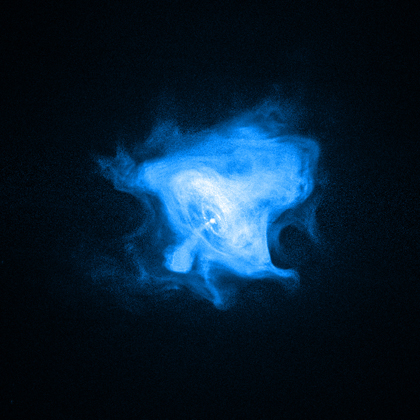
X-Ray (electromagnetic radiation emitted by electrons) image of the Crab Nebula, NASA Chandra X-Ray Telescope
Credit: NASA/CXC/SAO/F.Seward et al

Mel Acheson: The Consensus and the Crab.

Gravity is a weak force, and it can generate only a dribble of energy. Yet throughout the universe we see floods of energy.

The consensus of opinion among astronomers is that the energies of the universe can only come from gravitational mechanisms. Because the force of gravity, and therefore its energy, is directly related to mass, the floods of energy require enormities of mass.

Because the consensus opinion holds that magnitude of mass is equivalent to amount of matter, many of the floods of energy require more matter than can fit into the observed sizes of their sources. Consensus opinion takes recourse in boosting densities: by ignoring all that is known empirically and much that is known theoretically about the compression of matter, the consensus opinion can believe that however much matter is needed can be crammed into the available volume.

The coincidence of such super-densities with the requirements for gravitational production of observed energies is accepted as prima facie proof that the consensus opinion is, in fact, a fact, despite the circular reasoning.

This is the fact that makes the central star in the Crab Nebula’s inner x-ray structure (above image) a pulsar. The press release for this new image states matter-of-factly: “The nebula is powered by a rapidly rotating, highly magnetized neutron star, or pulsar (white dot near the center). The combination of rapid rotating [sic] and strong magnetic field generates an intense electromagnetic field that creates jets of matter and antimatter moving away from the north and south poles of the pulsar, and an intense wind flowing out in the equatorial direction.”

A neutron star has so much matter squeezed into it that the electrons have been squeezed into the nucleus to combine with the protons there and form neutrons. The uncharged neutrons are then packed together, as congested as commuters at rush hour. The pulsations of the pulsar are attributed to a hot spot on its surface that sends a flash of radiation with each rotation of the star. Its operation is analogous to a lighthouse light, back when such lights were mechanically rotating devices, before they were converted to electrically pulsed lamps.

The Crab Nebula’s pulsar pulses 30 times a second. This would mean that the star rotates 30 times a second. This would mean that the centrifugal force is stronger than the star’s gravity … which would mean that the star tore itself apart a long time ago, except that consensus opinion crammed in additional matter to bump up the mass sufficiently to increase the gravitational force enough to hold it together.

Of course, another possibility, one not considered by consensus opinion, is that, as with modern lighthouses, electrical oscillations make the pulsar blink. Super-dense matter and super-fast rotation aren’t needed. The x-ray structure—the jets and rings and sharp boundaries of the diocotron instability around the periphery—are common characteristics of plasma discharges … as is the strong magnetic field, the origin of which consensus opinion neglects to explain. Externally driven electrical circuits provide a unified and coherent explanation that is consistent with electromagnetic theory and laboratory investigations. It’s an explanation that doesn’t require exceptions, circular reasoning, or a consensus of opinion.

Friday, November 21, 2008

Billions of Electron Volts Hitting the Earth


ATIC, the Advanced Thin Ionization Calorimeter, a NASA funded balloon-borne instrument high over Antarctica, has detected Birkeland currents with energies of 300-800 billion electron Volts, thousands of times the energy of X-rays.

Chang, et al.,: An excess of cosmic ray electrons at energies of 300–800 GeV.

Galactic cosmic rays consist of protons, electrons and ions, most of which are believed to be accelerated to relativistic speeds in supernova remnants1, 2, 3. All components of the cosmic rays show an intensity that decreases as a power law with increasing energy (for example as E-2.7). Electrons in particular lose energy rapidly through synchrotron and inverse Compton processes, resulting in a relatively short lifetime (about 105 years) and a rapidly falling intensity, which raises the possibility of seeing the contribution from individual nearby sources (less than one kiloparsec away)4. Here we report an excess of galactic cosmic-ray electrons at energies of 300–800 GeV, which indicates a nearby source of energetic electrons. Such a source could be an unseen astrophysical object (such as a pulsar5 or micro-quasar6) that accelerates electrons to those energies, or the electrons could arise from the annihilation of dark matter particles (such as a Kaluza–Klein particle7 with a mass of about 620 GeV).
Nope, no mass there. They must be talking about two electrons max.

"Freund's (2003) experimental work confirms the infrared radiation emission nature of such geodynamic anomalies and processes. It is therefore logical that Earth's geodynamics are driven by electro-motive force (EMF), or rather, electromagnetic anisotropic concentration processes, and surely not by the conventional physically inadequate heat-engine bulk convection formalism. In other words, volts and amperes control tectonism and all geodynamic phenomena...." -- Stavros T. Tassos (seismologist) and David J. Ford (geologist), 2005

Tassos, S.T., and Ford, D.J., An Integrated Alternative Conceptual Framework to Heat Engine Earth, Plate Tectonics, and Elastic Rebound, Journal of Scientific Exploration, Volume 19, Number 1, Pages 43-90, 2005

Thursday, November 20, 2008

Little Star Lost


Stephen Smith: Little Star Lost

Astronomical theories predict that a planetary nebula in the constellation Centaurus should harbor a white dwarf star at its center. However, such a star cannot be found.

NASA scientists are on the hunt for a missing star. A recent press release from researchers operating the Hubble Space Telescope has described SuWt 2 as a luminous ring of dust and gas with hourglass-shaped longitudinal discharges. Astrophysicists expected the nebular material to be shining because of extreme ultraviolet radiation from a white dwarf star at its center. However, no such star is there and the ultraviolet light has not been detected.

The nebular ring (or spherical shell) does contain a pair of stars in orbit about a common center of gravity, moving at a velocity of one revolution every five days. The stellar pair is more than 100 times brighter than the Sun and nearly three times hotter. Although the stars are so hot and shine so brightly, the radiation is not powerful enough to energize the nebula. As NASA investigators assume, only a flood of ultraviolet light, such as that from the missing white dwarf, could do that.

Since their initial discovery 200 or more years ago, planetary nebulae have demonstrated behaviors and characteristics that are not easy to explain. They exhibit helical loops, rings, bubbles, jets, lobes and many other features that seem to trump standard theories. They are said to be composed of hot gas and owe their morphology to the influence of shockwaves from exploding stars or the pressure from stellar winds blowing through them. In some cases, the nebular forms are described as “like a windsock” inflated by a strong breeze.

Astronomical theories do not yet have a mechanism for the nebular clouds and energetic emissions that have been found. They do not know how stars “shrug off” their outer layers or how they eject lobate structures from their polar axes. The reason for the misunderstanding is that nebulae are composed not of hot gas, but of plasma. Gases obey the laws of kinetic motion: molecules bump into each other due to thermal energy or they are accelerated by the impetus imparted by other fast-moving particles.

Plasma behaves in accordance with the laws of electricity rather than Newtonian physics. Stars are created within Birkeland currents that flow in a great circuit through the galaxy. The Bennett pinch effect squeezes plasma inside these cosmic “transmission lines” in space, igniting stars and forming toroidal currents around the stellar equators. It is actually the electrical current density that causes the plasma in nebular rings and shells to glow.

According to the Electric Universe hypothesis, SuWt 2 is actually an hourglass-shaped toroid viewed in perspective. The binary star in the center of the nebula generates a current sheet along the system’s equatorial plane that astronomers have misidentified as a stellar wind. The Birkeland currents pass through regions of greater density in the disc of gases around the twin stars, causing the disc to light up in a bright ring like a searchlight illuminating clouds in the sky. As the publicized observations have confirmed, the ring is not lit by ultraviolet radiation.
And here's another example of science getting it wrong: Ancient Galactic Magnetic Fields Stronger than Expected.

"It was thought that, looking back in the past, earlier galaxies would not have generated much magnetic field," Kronberg said. "The results of this study show that the magnetic fields within Milky Way-like galaxies have been every bit as strong over the last two-thirds of the Universe's age as they are now-and possibly even stronger then."

Serving as a looking glass into the past, the powerful telescope at the European Southern Observatory, adding to the radio RM data, allowed the scientists to make observations of high magnetic fields between 8 billion and 9 billion years ago for 70 intervening galaxies whose faint optical absorption spectra revealed them as "normal" galaxies. That means that several billion years before the existence of our own sun, and within only a few billion years of the Big Bang, ancient galaxies were exerting the tug of these strong magnetic fields.

This research suggests that the magnetic fields in galaxies did not arise due to a slow, large-scale dynamo effect, which would have taken 5 billion to 10 billion years to reach their current measured levels. "There must be some other explanation for a much quicker and earlier amplification of galactic magnetic fields," Kronberg said. "From the time when the first stars and galaxies formed, their magnetic fields have probably have been amplified by very fast dynamos. One good possibility is that it happened in the explosive outflows that were driven by supernovae, and possibly even black holes in the very earliest generations of galaxies."

This realization brings a new focus on the broader question of how galaxies form. Instead of the commonly held view that magnetic fields have little relevance to the genesis of new galaxies, it now appears that they are indeed important players.

Tuesday, November 18, 2008

Banded Iguanas: A 3 Year Tour


In my TV watching days (before my brain was developed) I used to watch reruns of popular "sitcom" shows like Gilligan's Island.

Just sit right back and you'll hear a tale, a tale of a fateful trip, that started from this tropic port, aboard this tiny ship. The mate was a mighty sailin' man, the skipper brave and sure. Five passengers set sail that day for a three hour tour. A three hour tour.
OK. A 3 hour tour is believable. So what about a 3 year tour with no water? But not by humans. I'm talking about iguanas of course.

Can iguanas raft for 7,000 miles with no water and then mate on the other side?

Via Retardipedia: Fiji Banded Iguana.

These iguanas are believed to have evolved from green iguanas that rafted on debris across 7,000 miles of Pacific Ocean from South America some 13 million years ago.
The farthest I've seen is 200 miles. A 1 month journey with no water: Rafting Iguanas.

Incredibly, in September 1995, 15 green iguanas were swept out to sea after hurricane Luis blasted the island of Guadeloupe. The lizards clung for life to a mat of uprooted trees for some 320 kilometers (200 miles), until one month later they washed up on the island of Anguilla (an-GWI-luh). Local fishermen who spotted the iguanas surfing ashore were stunned.
So in other words, the trip to Fiji-Tonga would be a 35 month journey with no water.

Hmm, maybe Hume was wrong about miracles after all.

Or maybe not.


"Fiji's banded iguana Brachylophus is sister to the Californian iguanid, Dipsosaurus (Sites et al., 1996) and iguanas appear nowhere else in the Central or West Pacific." (McCarthy 2005)

"The most likely reason for the distributional pattern of... banded iguanas is not because of a conspiracy of local environmental circumstances that somehow prevented long term colonization of every other oceanic island in the world.... A more reasonable explanation is that the papers disputing the geological paleomaps and molecular clock assumptions are, in fact, correct." (McCarthy 2005)

Sites, et al., Character Congruence and Phylogenetic Signal in Molecular and Morphological Data Sets: a Case Study in the Living Iguanas (Squamata, Iguanidae), Molecular Biology and Evolution, Volume 13, Pages 1087-1105, 1996

Yoon, C.K., Hapless Iguanas Float Away And Voyage Grips Biologists, New York Times, Oct 1998

Rivera, R., Rafting Iguanas, Science World, Jan 1999

McCarthy, D.D., Biogeography and Scientific Revolutions, The Systematist, Number 25, Pages 3-12, 2005

And speaking of TV watching, Season 1 of The History Channel's The Universe is now available on Blu-Ray from Amazon.Com.


Oh and in case you can't get the stupid Gilligan's Island Theme Song out of your head, listen to The Dune Sea of Tatooine, The Moisture Farm, and Landspeeder Search/Attack of the Sand People by John Williams. It's good desert iguana music.

Monday, November 17, 2008

Birkeland Currents


Via NASA Electric Currents from Space (Hat tip: Anaconda)

When in 1973 the navy satellite Triad (see history) flew through this region in a low-altitude orbit, its magnetometer indeed detected the signatures of two large sheets of electric current, one coming down on the morning side of the auroral zone, one going up on the evening side, as expected. Because Kristian Birkeland had proposed long before currents which linked Earth and space in this fashion, they were named Birkeland currents (by Schield, Dessler and Freeman, in a 1969 article predicting some of the features observed by Triad). Typically, each sheet carries a million amperes or more.
1 million amperes or more? Nope, no mass there...LOL.


Potemra, T.A., Observation of Birkeland Currents with the TRIAD Satellite, Astrophysics and Space Science, Volume 58, Number 1, Pages 207-226, Sep 1978

Sunday, November 16, 2008

Endless Oil


Robert Langreth: Endless Oil?

Radical [sic] Russian researchers say we are looking for oil in all the wrong places.

Everybody [sic] knows [sic] that oil and gas drilled out of the earth comes from the remains of plants and animals trapped underground millions of years ago. This received wisdom [sic] so dominates our thinking that it is enshrined in the very language we use--fossil fuels. They took eons to form, and we are using them up far faster than they can be replenished.

What if the whole theory [sic] is wrong?

That's the premise of a small but passionate band of Russian and Ukrainian contrarians. They argue that oil and gas don't come from fossils; they're synthesized deep within the earth's mantle by heat, pressure and other purely chemical means, before gradually rising to the surface. Under the so-called abiotic theory of oil, finding all the energy we need is just a matter of looking beyond the traditional basins where fossils might have accumulated.

The idea that oil comes from fossils "is a myth. … We need to change this myth," says petroleum engineer Vladimir Kutcherov, at the Royal Institute of Technology in Sweden. "All kinds of rocks could have oil and gas deposits."

Alexander Kitchka of the Ukrainian National Academy of Sciences brashly estimates that 60% of the content of all oil is abiotic in origin, and not from fossil fuels. He says companies should drill deeper to find it.

Kitchka says oil may be found in all sorts of geological structures such as volcanic rock or deep-sea thermal vents where companies aren't looking today.

Kutcherov points to a handful of productive oil fields in Vietnam and elsewhere that lay in hard rock such as granite. Traditional theory says oil shouldn't be present there. Certain wells in the Gulf of Mexico have produced more oil than expected. The abiotic crowd says they are slowly being refilled from a deeper source.

The abiotic oil theory goes back centuries and includes as its prominent champions Dimitri Mendeleev, best known for inventing the periodic table. It didn't gain much visibility in America until the late Cornell University astronomer Thomas Gold championed it in the 1980s. He said that oil contains organic compounds not because it is derived from fossils but because giant colonies of deep-earth bacteria feed on deep hydrocarbon pools way down in the mantle.
The New Oil Paradigm No One Is Talking About.

Offshore production is increasing, and the industry may soon be asked to reconsider its basic assumptions about oil. Over the past few decades, a number of industry experts and geologists have conducted research suggesting that the origin of hydrocarbons may be abiogenic, not organic. Stated simply, the abiogenic oil theory posits that oil is not formed from plants and animals compressed for millions of years in sediment rock. Instead, oil is a primordial substance created before the formation of Earth, and found deep underground.

The abiogenic theory raises questions about both "peak oil" and the conventional wisdom that petroleum is a "fossil fuel." The theory is not widely discussed in the West, though it has proponents dating back more than a century.

Deepwater wells are teeming with abiogenic potential. As early as 1995, a New York Times article quoted Dr. K. K. Bissada, a Texaco geochemist: "I think we pump oil out much faster than oil can come in. ... But from a long-term perspective, I believe that hydrocarbons are coming in from great depths and are filling the newer reservoirs at shallower depths.''

Thursday, November 13, 2008

Fluid Dynamic (Ether) Sink Gravity


So this might be my most bizarre post yet but my ego is not really involved in this since I can just blame it all on people much smarter than me.

"The most reasonable mechanism for planetary expansion, in my opinion, involves fluid-sink views of gravity which involves the collection (not the spontaneous generation) of ultra-mundane matter at the cores of astronomical bodies." -- Dennis D. McCarthy, geoscientist, October 2003

"There is no known physical principle, no known physics law, no known physics theory, and no known physics equation which remotely suggests that planets and stars cannot gain mass via collection of sub-sub-sub atomic particles. None. There is no violating regarding known laws of physics. Indeed, the Earth does gain some mass (a small amount) due to being pelted with solar wind, neutrinos, etc. Does this change all of physics? It does not change or alter basic physics -- or even modern physics. It merely reinterprets the equations of general relativity. It is consistent with mass conservation and energy conservation. I really can't state this any more simply." -- Dennis D. McCarthy, geoscientist, October 2003

This model specifically predicts the spiral shape of galaxies which is a failing of mainstream views of gravity.


Ether is actually quite mainstream: "With regards to the general theory of relativity, space cannot be imagined without ether." -- Albert Einstein, physicist, 1920

And, as Anaconda notes, every 8 minutes we have an electromagnetic "flux" transfer event.

Magnetic Portals Connect Sun and Earth

Oct. 30, 2008: During the time it takes you to read this article, something will happen high overhead that until recently many scientists didn't believe in. A magnetic portal will open, linking Earth to the sun 93 million miles away. Tons of high-energy particles may flow through the opening before it closes again, around the time you reach the end of the page.
Nope no mass there.


Le, et al., The Magnetic and Plasma Structure of Flux Transfer Events, Journal of Geophysical Research, Volume 104, Number A1, Pages 233–245, 1999

Visser, M., Acoustic Black Holes: Horizons, Ergospheres, and Hawking Radiation, Classical and Quantum Gravity, Volume 15, Pages 1767-1791, Jun 1998

Volovik, G.E., Induced Gravity in Superfluid 3He, Journal of Low Temperature Physics, Volume 113, Numbers 5-6, Dec 1998

Barcelo, C., et al., Analogue Gravity from Bose-Einstein Condensates, Classical and Quantum Gravity, Volume 18, Pages 1137-1156, Mar 2001

Visser, M., et al., Analogue Models of and for Gravity, General Relativity and Gravity, Volume 34, Pages 1719-1734, 2002

Jacobson, T.A., and Parentani, R., An ECHO of Black Holes, Scientific American, Pages 69-75, 2005

Thornhill, W., Electric Earthquakes, Dec 2005

"Many strange phenomena precede large earthquakes. Some of them have been reported for centuries, even millennia. The list is long and diverse: bulging of the Earth's surface, changing well water levels, ground-hugging fog, low frequency electromagnetic emission, earthquake lights from ridges and mountain tops, magnetic field anomalies up to 0.5% of the Earth's dipole field, temperature anomalies by several degrees over wide areas as seen in satellite images, changes in the plasma density of the ionosphere, and strange animal behavior. Because it seems nearly impossible to imagine that such diverse phenomena could have a common physical cause, there is great confusion and even greater controversy." (Freund 2003)

"Based on the reported laboratory results of electrical measurements, no mechanism seemed to exist that could account for the generation of those large currents in the Earth's crust, which are needed to explain the strong EM signals and magnetic anomalies that have been documented before some earthquakes. Unfortunately, when a set of observations cannot be explained within the framework of existing knowledge, the tendency is not to believe the observation. Therefore, a general malaise has taken root in the geophysical community when it comes to the many reported non-seismic and non-geodesic pre-earthquake phenomena. There seems to be no bona fide physical process by which electric currents of sufficient magnitude could be generated in crustal rocks." (Freund 2003)
Barcelo, C., et al., Analogue Gravity, Living Reviews In Relativity, Dec 2005

Thornhill, W., Electric Gravity In An Electric Universe, Aug 2008

Einstein in his special theory of relativity postulated there was no medium, called the ‘aether.’ But Maxwell’s theory of electromagnetism requires it. And Sir Oliver Lodge saw the aether as crucial to our understanding. So Einstein, at a stroke, removed any possibility that he, or his followers, would find a link between electromagnetism and gravity. It served the egos of his followers to consecrate Einstein’s ideas and treat dissent as blasphemy. “Sometimes a concept is baffling not because it is profound but because it's wrong.”[9,10]

Decades later, Paul R. Heyl wrote in Scientific Monthly, May 1954:
“The more we study gravitation, the more there grows upon us the feeling that there is something peculiarly fundamental about this phenomenon to a degree that is unequalled among other natural phenomena. Its independence of the factors that affect other phenomena and its dependence only upon mass and distance suggest that its roots avoid things superficial and go down deep into the unseen, to the very essence of matter and space.” —Gravitation: Still A Mystery.

This sentiment has been echoed down to the present but few are listening. The problem has been worsened by the particle physicists who indulge in their own virtual reality — inventing “virtual particles” to transmit forces. If they “could understand the structure of the particle, in terms of the medium of which it is composed” and put flesh on the metaphysical bones of quantum theory we should be much further advanced. Sir Oliver Lodge deserves to be heard once more:
“..it may be that when the structure of an electron is understood, we shall see that an ‘even-powered’ stress in the surrounding aether is necessarily involved. What I do feel instinctively is that this is the direction for discovery, and what is needed is something internal and intrinsic, and that all attempts to explain gravitation as due to the action of some external agency, whether flying particles or impinging waves, are doomed to failure; for all these speculations regard the atom as a foreign substance -- a sort of ‘grit’ in the aether -- driven hither and thither by forces alien to itself. When, some day, we understand the real relation between matter and aether, I venture predict that we shall perceive something more satisfying than that.”[11]
Bryner, J., Strange Portal Connects Earth to Sun, Live Science, Nov 2008

Also see: Sansbury, R., PlasmaCosmology.Net