Wednesday, November 26, 2008

Magnetic Monsters


Stephen Smith: Magnetic Monsters.

Extreme magnetic fields in space are said to be caused by the high-speed rotation of neutron stars. One of many cases where a theory is built on the incorrect assumptions of another theory.

Several Picture of the Day articles have addressed the problem of neutron stars and how they affect the progress of astronomical investigation. According to electric star theory, neutron stars belong in the same category with invisible pink unicorns. Deficits in gravity-only cosmology made the neutron star hypothesis necessary in order to defend gravity's ostensibly endless powers.

Neutron stars were proposed as the answer to pulsar behavior. Pulsars are stars whose brightness fluctuates over a short period of time. Pulsars are important to astrophysical models because they are used as measuring tools. Those with "known" distance, coupled with variations in their luminosity, are thought to be road markers in space, so that the distances of other stars with similar characteristics can be determined.

Pulsars are described as "light houses" with beams of energy concentrated at specific points. Consensus gravitational theory demands that any new information conform to the tenets of the theory rather than the other way around, so a rotational mechanism was proposed for the pulsations. When the spin of a pulsar brings its beam inline with telescopes on Earth, a flash of light is visible.

However, when the rotation rates of some pulsars were measured at once per second or less (even with many times the mass of our Sun), "neutron stars" were fabricated. Only a super dense material like neutronium was thought able to withstand those rotational speeds. Neutronium is a hypothetical material that has had all of its electrons smashed down into the nuclei, where the protons and electrons combine into neutrons.

"Magnetars" are anomalous stars identified as x-ray pulsars (AXP) or soft gamma repeaters (SGR). They are said to be created by neutron stars with magnetic fields measuring over 10^15 Gauss. For comparison, the Earth's magnetic field is about one-half Gauss, so these "magnetic pulsars" are surprisingly powerful sources. It must be stressed, though, that the evidence is indirect and no neutron star has ever been observed.

What is observed are intense magnetic fields sometimes pulsing in a fraction of a second. Some magnetars have also been detected emitting gamma ray bursts ascribed to “star quakes” in the ultra-hard surface of the neutron star. Because the mass per unit volume is so great, any rapid movement in the crust generates intense "magnetic reconnection," thereby producing gamma rays. It is not necessary to reiterate the problems with magnetic reconnection except to say that it is also one of the class of imaginary constructs created by astrophysicists in an attempt to explain energetic events without sufficient gravity

It is a well-established fact that magnetic fields are induced by electric currents. Therefore, there must be an electric current generating the intense fields in the magnetar. It is also indisputable that the feeder current must be part of a circuit, since persistent electric current must flow in a completed circuit.

The Electric Universe hypothesis requires no collapsed stars or rotational speeds so great that ordinary matter could never take the strain. The oscillations in magnetars (or pulsars, in general) are caused by resonant effects in electric circuits. The sudden release of stored electrical energy in a “double layer” is responsible for the occasional outburst of gamma rays. The outburst begins with a sudden peak of energy, and then declines gradually, like a stroke of lightning.

Don Scott, author of The Electric Sky, recently wrote: "The 'neutron star' is simply yet another fantasy conjured up, this time, in order to avoid confronting the idea that pulsar discharges are electrical phenomena. A nucleus or charge free atom made up of only neutrons has never been synthesized in any laboratory nor can it ever be. In fact, a web search on the word 'neutronium' will produce only references to a computer game—not to any real, scientific discussion or description. Lone neutrons decay into proton/electron pairs in less than 14 minutes; atom-like collections of two or more neutrons will fly apart almost instantaneously."

It seems more likely that we are witnessing in magnetars an immense concentration of electricity being focused by some kind of "plasma gun." As the current flows through clouds of dusty plasma it concentrates forces because of the Biot-Savart effect, drawing itself together and forming helical zones of immense compression known as "z-pinches" or "Bennett pinches." Stars form in the compression zones, and depending on how much current is flowing through the circuit the star's magnetic field will be greater where there is more current.

Tuesday, November 25, 2008

Cosmic Ray Hot Spots Identified


Cosmic Ray 'Hot Spots' Bombarding Earth With Cosmic Rays.

ScienceDaily (Nov. 24, 2008) — A Los Alamos National Laboratory cosmic-ray observatory has seen for the first time two distinct hot spots that appear to be bombarding Earth with an excess of cosmic rays. The research calls into question nearly a century of understanding about galactic magnetic fields near our solar system.

Joining an international team of collaborators, Los Alamos researchers Brenda Dingus, Gus Sinnis, Gary Walker, Petra Hüntemeyer and John Pretz published the findings November 25 in Physical Review Letters.

“The source of cosmic rays has been a 100-year-old problem for astrophysicists,” Pretz said. “With the Milagro observatory, we identified two distinct regions with an excess of cosmic rays. These regions are relatively tiny bumps on the background of cosmic rays, which is why they were missed for so long. This discovery calls into question our understanding of cosmic rays and raises the possibility that an unknown source or magnetic effect near our solar system is responsible for these observations.” ...

Researchers used Los Alamos’ Milagro cosmic-ray observatory to peer into the sky above the northern hemisphere for nearly seven years starting in July 2000. The observatory is unique in that it monitors the entire sky above the northern hemisphere. Because of its design and field of view, Milagro was able to record over 200 billion cosmic-ray collisions with the Earth’s atmosphere. ...

But because Milagro was able to record so many cosmic-ray events, researchers for the first time were able to see statistical peaks in the number of cosmic-ray events originating from specific regions of the sky near the constellation Orion. The region with the highest hot spot of cosmic rays is a concentrated bulls eye above and to the right visually of Orion, near the constellation Taurus. The other hot spot is a comma-shaped region visually occurring near the constellation Gemini. ...

Milagro scientists are currently working with researchers in Mexico to build a second-generation observatory known as the High-Altitude Water Cherenkov (HAWC) experiment. If built, the HAWC observatory could help researchers solve the mystery of cosmic-ray origin.

Monday, November 24, 2008

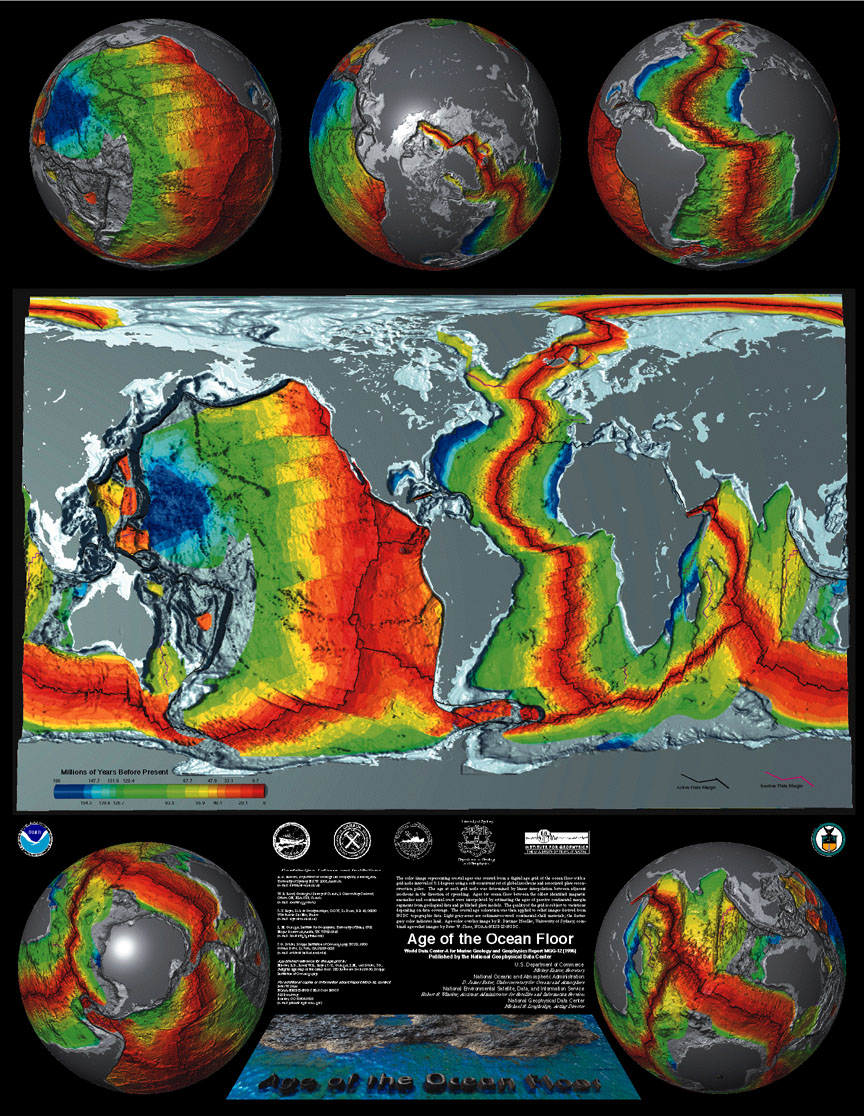
Marsupials Vs. Plate Tectonics


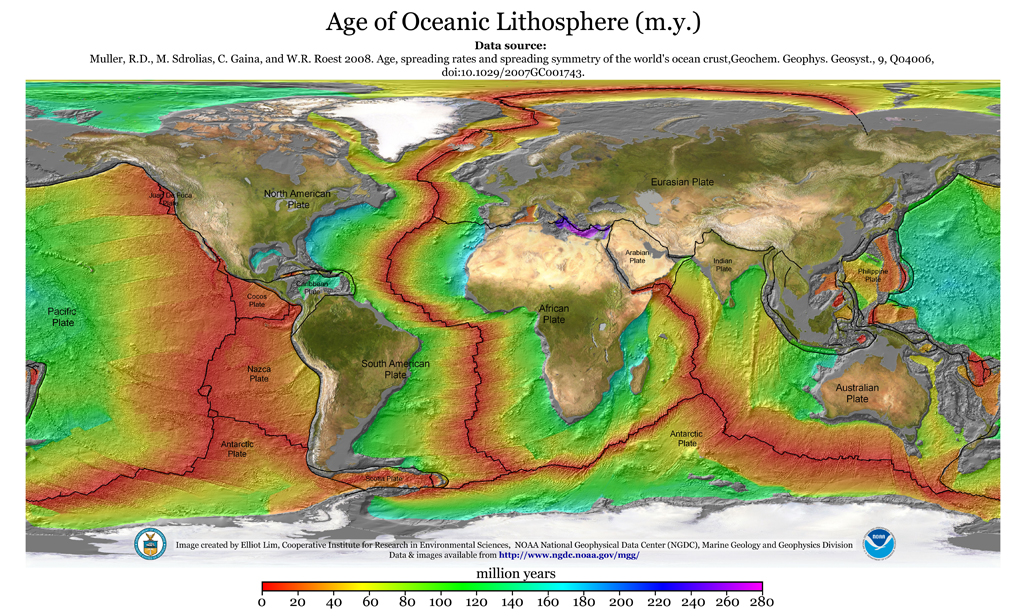
According to plate tectonics, this is what the Earth looked like during the Cretaceous period, 125 million years ago.

Here it is more clearly from the same source (Northern Arizona University) as the crude maps above.


At the risk of beating a dead horse, the paleomaps based upon plate tectonics are utterly absurd and totally contradicted by observation and logic.

Why?

Because marsupials "evolved" in Northern China.


A mouse-sized fossil found in China may be the oldest ancestor of modern marsupials - the mammal family that includes kangaroos and koalas.

The creature, which was unearthed in Liaoning province, extends the ancestry of marsupials by 50 million years.

The stunning specimen preserves an imprint of the animal's coat of hair and analysis of its feet suggests it was adapted to climbing in trees.

Details of the find are reported in the latest edition of the journal Science.

Sinodelphys szalayi, as the new species has been named, lived alongside the dinosaurs in the early Cretaceous Period.

The 125-million-year-old creature has close affinities with the family of mammals known as metatherians, which includes the marsupials.
Question: if marsupials evolved in China 125 million years ago, how did they teleport to Australia and South America? I guess since banded iguanas have no problem rafting 7,000 miles to Fiji-Tonga, kangaroos have no problem hopping across the Pacific Ocean?

Saturday, November 22, 2008

Consensus and the Crab


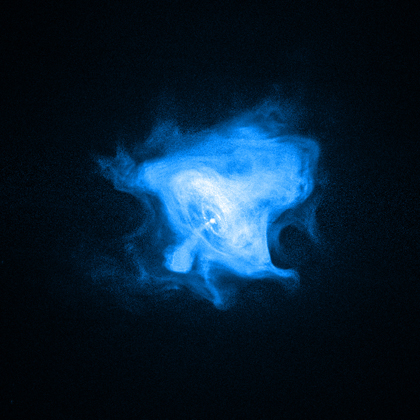
X-Ray (electromagnetic radiation emitted by electrons) image of the Crab Nebula, NASA Chandra X-Ray Telescope
Credit: NASA/CXC/SAO/F.Seward et al

Mel Acheson: The Consensus and the Crab.

Gravity is a weak force, and it can generate only a dribble of energy. Yet throughout the universe we see floods of energy.

The consensus of opinion among astronomers is that the energies of the universe can only come from gravitational mechanisms. Because the force of gravity, and therefore its energy, is directly related to mass, the floods of energy require enormities of mass.

Because the consensus opinion holds that magnitude of mass is equivalent to amount of matter, many of the floods of energy require more matter than can fit into the observed sizes of their sources. Consensus opinion takes recourse in boosting densities: by ignoring all that is known empirically and much that is known theoretically about the compression of matter, the consensus opinion can believe that however much matter is needed can be crammed into the available volume.

The coincidence of such super-densities with the requirements for gravitational production of observed energies is accepted as prima facie proof that the consensus opinion is, in fact, a fact, despite the circular reasoning.

This is the fact that makes the central star in the Crab Nebula’s inner x-ray structure (above image) a pulsar. The press release for this new image states matter-of-factly: “The nebula is powered by a rapidly rotating, highly magnetized neutron star, or pulsar (white dot near the center). The combination of rapid rotating [sic] and strong magnetic field generates an intense electromagnetic field that creates jets of matter and antimatter moving away from the north and south poles of the pulsar, and an intense wind flowing out in the equatorial direction.”

A neutron star has so much matter squeezed into it that the electrons have been squeezed into the nucleus to combine with the protons there and form neutrons. The uncharged neutrons are then packed together, as congested as commuters at rush hour. The pulsations of the pulsar are attributed to a hot spot on its surface that sends a flash of radiation with each rotation of the star. Its operation is analogous to a lighthouse light, back when such lights were mechanically rotating devices, before they were converted to electrically pulsed lamps.

The Crab Nebula’s pulsar pulses 30 times a second. This would mean that the star rotates 30 times a second. This would mean that the centrifugal force is stronger than the star’s gravity … which would mean that the star tore itself apart a long time ago, except that consensus opinion crammed in additional matter to bump up the mass sufficiently to increase the gravitational force enough to hold it together.

Of course, another possibility, one not considered by consensus opinion, is that, as with modern lighthouses, electrical oscillations make the pulsar blink. Super-dense matter and super-fast rotation aren’t needed. The x-ray structure—the jets and rings and sharp boundaries of the diocotron instability around the periphery—are common characteristics of plasma discharges … as is the strong magnetic field, the origin of which consensus opinion neglects to explain. Externally driven electrical circuits provide a unified and coherent explanation that is consistent with electromagnetic theory and laboratory investigations. It’s an explanation that doesn’t require exceptions, circular reasoning, or a consensus of opinion.

Friday, November 21, 2008

Billions of Electron Volts Hitting the Earth


ATIC, the Advanced Thin Ionization Calorimeter, a NASA funded balloon-borne instrument high over Antarctica, has detected Birkeland currents with energies of 300-800 billion electron Volts, thousands of times the energy of X-rays.

Chang, et al.,: An excess of cosmic ray electrons at energies of 300–800 GeV.

Galactic cosmic rays consist of protons, electrons and ions, most of which are believed to be accelerated to relativistic speeds in supernova remnants1, 2, 3. All components of the cosmic rays show an intensity that decreases as a power law with increasing energy (for example as E-2.7). Electrons in particular lose energy rapidly through synchrotron and inverse Compton processes, resulting in a relatively short lifetime (about 105 years) and a rapidly falling intensity, which raises the possibility of seeing the contribution from individual nearby sources (less than one kiloparsec away)4. Here we report an excess of galactic cosmic-ray electrons at energies of 300–800 GeV, which indicates a nearby source of energetic electrons. Such a source could be an unseen astrophysical object (such as a pulsar5 or micro-quasar6) that accelerates electrons to those energies, or the electrons could arise from the annihilation of dark matter particles (such as a Kaluza–Klein particle7 with a mass of about 620 GeV).
Nope, no mass there. They must be talking about two electrons max.

"Freund's (2003) experimental work confirms the infrared radiation emission nature of such geodynamic anomalies and processes. It is therefore logical that Earth's geodynamics are driven by electro-motive force (EMF), or rather, electromagnetic anisotropic concentration processes, and surely not by the conventional physically inadequate heat-engine bulk convection formalism. In other words, volts and amperes control tectonism and all geodynamic phenomena...." -- Stavros T. Tassos (seismologist) and David J. Ford (geologist), 2005

Tassos, S.T., and Ford, D.J., An Integrated Alternative Conceptual Framework to Heat Engine Earth, Plate Tectonics, and Elastic Rebound, Journal of Scientific Exploration, Volume 19, Number 1, Pages 43-90, 2005

Thursday, November 20, 2008

Little Star Lost


Stephen Smith: Little Star Lost

Astronomical theories predict that a planetary nebula in the constellation Centaurus should harbor a white dwarf star at its center. However, such a star cannot be found.

NASA scientists are on the hunt for a missing star. A recent press release from researchers operating the Hubble Space Telescope has described SuWt 2 as a luminous ring of dust and gas with hourglass-shaped longitudinal discharges. Astrophysicists expected the nebular material to be shining because of extreme ultraviolet radiation from a white dwarf star at its center. However, no such star is there and the ultraviolet light has not been detected.

The nebular ring (or spherical shell) does contain a pair of stars in orbit about a common center of gravity, moving at a velocity of one revolution every five days. The stellar pair is more than 100 times brighter than the Sun and nearly three times hotter. Although the stars are so hot and shine so brightly, the radiation is not powerful enough to energize the nebula. As NASA investigators assume, only a flood of ultraviolet light, such as that from the missing white dwarf, could do that.

Since their initial discovery 200 or more years ago, planetary nebulae have demonstrated behaviors and characteristics that are not easy to explain. They exhibit helical loops, rings, bubbles, jets, lobes and many other features that seem to trump standard theories. They are said to be composed of hot gas and owe their morphology to the influence of shockwaves from exploding stars or the pressure from stellar winds blowing through them. In some cases, the nebular forms are described as “like a windsock” inflated by a strong breeze.

Astronomical theories do not yet have a mechanism for the nebular clouds and energetic emissions that have been found. They do not know how stars “shrug off” their outer layers or how they eject lobate structures from their polar axes. The reason for the misunderstanding is that nebulae are composed not of hot gas, but of plasma. Gases obey the laws of kinetic motion: molecules bump into each other due to thermal energy or they are accelerated by the impetus imparted by other fast-moving particles.

Plasma behaves in accordance with the laws of electricity rather than Newtonian physics. Stars are created within Birkeland currents that flow in a great circuit through the galaxy. The Bennett pinch effect squeezes plasma inside these cosmic “transmission lines” in space, igniting stars and forming toroidal currents around the stellar equators. It is actually the electrical current density that causes the plasma in nebular rings and shells to glow.

According to the Electric Universe hypothesis, SuWt 2 is actually an hourglass-shaped toroid viewed in perspective. The binary star in the center of the nebula generates a current sheet along the system’s equatorial plane that astronomers have misidentified as a stellar wind. The Birkeland currents pass through regions of greater density in the disc of gases around the twin stars, causing the disc to light up in a bright ring like a searchlight illuminating clouds in the sky. As the publicized observations have confirmed, the ring is not lit by ultraviolet radiation.
And here's another example of science getting it wrong: Ancient Galactic Magnetic Fields Stronger than Expected.

"It was thought that, looking back in the past, earlier galaxies would not have generated much magnetic field," Kronberg said. "The results of this study show that the magnetic fields within Milky Way-like galaxies have been every bit as strong over the last two-thirds of the Universe's age as they are now-and possibly even stronger then."

Serving as a looking glass into the past, the powerful telescope at the European Southern Observatory, adding to the radio RM data, allowed the scientists to make observations of high magnetic fields between 8 billion and 9 billion years ago for 70 intervening galaxies whose faint optical absorption spectra revealed them as "normal" galaxies. That means that several billion years before the existence of our own sun, and within only a few billion years of the Big Bang, ancient galaxies were exerting the tug of these strong magnetic fields.

This research suggests that the magnetic fields in galaxies did not arise due to a slow, large-scale dynamo effect, which would have taken 5 billion to 10 billion years to reach their current measured levels. "There must be some other explanation for a much quicker and earlier amplification of galactic magnetic fields," Kronberg said. "From the time when the first stars and galaxies formed, their magnetic fields have probably have been amplified by very fast dynamos. One good possibility is that it happened in the explosive outflows that were driven by supernovae, and possibly even black holes in the very earliest generations of galaxies."

This realization brings a new focus on the broader question of how galaxies form. Instead of the commonly held view that magnetic fields have little relevance to the genesis of new galaxies, it now appears that they are indeed important players.

Tuesday, November 18, 2008

Banded Iguanas: A 3 Year Tour


In my TV watching days (before my brain was developed) I used to watch reruns of popular "sitcom" shows like Gilligan's Island.

Just sit right back and you'll hear a tale, a tale of a fateful trip, that started from this tropic port, aboard this tiny ship. The mate was a mighty sailin' man, the skipper brave and sure. Five passengers set sail that day for a three hour tour. A three hour tour.
OK. A 3 hour tour is believable. So what about a 3 year tour with no water? But not by humans. I'm talking about iguanas of course.

Can iguanas raft for 7,000 miles with no water and then mate on the other side?

Via Retardipedia: Fiji Banded Iguana.

These iguanas are believed to have evolved from green iguanas that rafted on debris across 7,000 miles of Pacific Ocean from South America some 13 million years ago.
The farthest I've seen is 200 miles. A 1 month journey with no water: Rafting Iguanas.

Incredibly, in September 1995, 15 green iguanas were swept out to sea after hurricane Luis blasted the island of Guadeloupe. The lizards clung for life to a mat of uprooted trees for some 320 kilometers (200 miles), until one month later they washed up on the island of Anguilla (an-GWI-luh). Local fishermen who spotted the iguanas surfing ashore were stunned.
So in other words, the trip to Fiji-Tonga would be a 35 month journey with no water.

Hmm, maybe Hume was wrong about miracles after all.

Or maybe not.


"Fiji's banded iguana Brachylophus is sister to the Californian iguanid, Dipsosaurus (Sites et al., 1996) and iguanas appear nowhere else in the Central or West Pacific." (McCarthy 2005)

"The most likely reason for the distributional pattern of... banded iguanas is not because of a conspiracy of local environmental circumstances that somehow prevented long term colonization of every other oceanic island in the world.... A more reasonable explanation is that the papers disputing the geological paleomaps and molecular clock assumptions are, in fact, correct." (McCarthy 2005)

Sites, et al., Character Congruence and Phylogenetic Signal in Molecular and Morphological Data Sets: a Case Study in the Living Iguanas (Squamata, Iguanidae), Molecular Biology and Evolution, Volume 13, Pages 1087-1105, 1996

Yoon, C.K., Hapless Iguanas Float Away And Voyage Grips Biologists, New York Times, Oct 1998

Rivera, R., Rafting Iguanas, Science World, Jan 1999

McCarthy, D.D., Biogeography and Scientific Revolutions, The Systematist, Number 25, Pages 3-12, 2005

And speaking of TV watching, Season 1 of The History Channel's The Universe is now available on Blu-Ray from Amazon.Com.


Oh and in case you can't get the stupid Gilligan's Island Theme Song out of your head, listen to The Dune Sea of Tatooine, The Moisture Farm, and Landspeeder Search/Attack of the Sand People by John Williams. It's good desert iguana music.